
On January 10th, 1914, A Salt Lake City grocer (a former policeman) named John G. Morrison and his son were murdered. A Swedish-born itinerant laborer went on trial for the crime, and was convicted and sentenced to death.
The young laborer was born Joel Emmanuel Hagglund in 1879. After emigrating to the United States he took the name Joseph Hillstrom, then let it be shortened to Joe Hill. Working as a machinist and at various laboring jobs, he drifted his way West, where he joined the Industrial Workers of the World (I.W.W.).
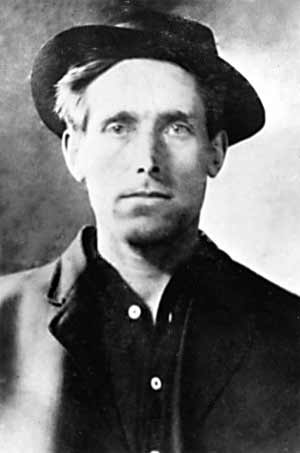 Though he had already begun making a name for himself as the unofficial songster for the I.W.W., he may not have achieved legendary status had not the State of Utah executed him by firing squad on November 19, 1915. While on trial for murder, unable to afford a capable defense counselor, Hill refused to properly defend himself, though the evidence against him was flimsy. Among those pleading for his life was Helen Keller, the blind-deaf activist. The Swedish embassy in Washington, D.C., intervened to have him spared. President Woodrow Wilson requested the governor of Utah to postpone the execution, pending further examination of evidence. The request was spurned.
While working on the West Coast, Hill had taken popular songs of the day and inserted his own lyrics–satirical, irreverent, often humorous–commenting on the plight of the working class in America. The I.W.W. proved to be a perfect fit for Hill. A loose organization of young, rowdy itinerant workers in the woods and in the mines and on farms, factories, and wherever else cheap labor was sought, the “Wobblies” used songs and street corner oration to denounce the economic and political system they saw as being skewed against them. In “free speech” demonstrations, in cities such as Spokane and Portland, they let themselves be hauled off to jail in droves, driving their captors to distraction with their songs and antics.
In 1910, Joe Hill wrote “The Preacher and the Slave,” borrowing the melody from the hymn “In the Sweet By and By.” Also called “You Will Eat By and By,” it was sung on the street corners of Portland, Oregon. Copies were sold for 10 cents each. A verse ended with:
Work all day, live on hay. You’ll get pie in the sky when you die.
Likely Hill didn’t know when he wrote that last line that he was coining a phrase soon to become commonplace in American speech.
The ranks of people whose lifetime overlapped the times when Joe Hill lived, and died, are drastically thinning. The I.W.W. was decimated not long after Hill’s execution, a consequence of President Wilson and his crackdown, through the Espionage Act, on those opposing our entry into World War One. The counterculture of the late 1960s revived, for those who were not too drugged out, an interest in not-to-distant past movements–such as those of the Wobblies, and their spokesmen and heroes such as Joe Hill. At the Woodstock festival of 1969, Joan Baez reverently sang “I Dreamed I Saw Joe Hill Last Night.” The Vietnam War, racial inequality and the nuclear arms race prodded a younger–and arguably more pampered–generation to question the corporate-government establishment; much as economic inequality and the insanity of World War One had energized the young to protest in decades past.
With an emerging revival of class-consciousness–spurred on by the exportation jobs, leading to union busting and stagnant wages, as the corporate sector and its executives and speculators profit mightily–it may be time for a new generation to find inspiration from those who fought similar injustices 100 years ago.


 J.P. Kenna
Reblogged this on Blue Collar Author.