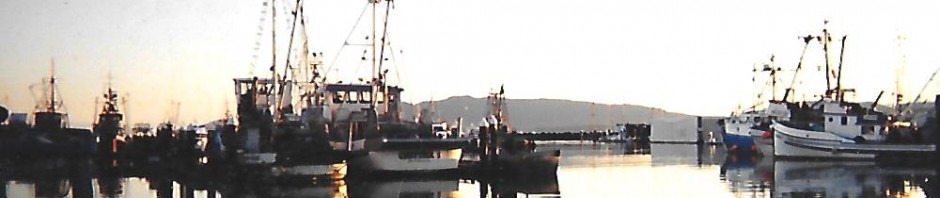
Twice I’ve made the approximately 600-mile trip up the inside passage from Puget Sound to Southeast Alaska in a salmon troller–and one return trip. Averaging 5 to 6 knots, anchoring or tying up each night, seven to ten days from Seattle to Ketchikan was about right. Not much more than wagon-train speed.
My 1914-built troller probably skirted over the water at a little over half the speed of the old Puget Sound side-wheel steamboat, the George E. Starr. Not known as a speeder, even in the closing years of the 19th century, the Starr was soon eclipsed by propeller-driven steamers such as the Flyer and the Tacoma–the latter capable of 20 knots. (A more modern-day Puget Sound ferry such as the Hyak travels at 16 knots). To sum up–none of these are breath-taking speeds. But each in its time and place did (or does) its job.
There is little new to say about our obsession with speed in travel. But as an introduction to an excerpt herein from my novel Beyond The Divide, I’d like to admit that my writing isn’t high-speed either. My goal is to keep it engaging even if it plods along at 10 to 20 knots. If you’re looking for lightning-fast action and constant cliff-hanging suspense, you may want to look elsewhere. Certainly there are moments when the pace quickens. But I like to read and write a story that is on par with the steady rate at which human life and historical drama unfold–or at least did, until the recent hyper-speedup in the media and seemingly everything else we do. All to what end?
A little “back-story” here:
It is early 1889. Jimmy Scanlon, age 23, made his way West following railroad construction. He’s just left Seattle on the Starr, leaving behind his girlfriend Susie Taylor–a school teacher–and best friend and mentor Johnny Driscoll, also a railroad worker. Jimmy is seeking new fortune and opportunity at the boomtown of Fairhaven, some 80 miles north of Seattle. He’s hoping Susie will soon follow him.
Jimmy in the second week boarded the elegant—if not speedy—side-wheeler George E. Starr for Bellingham Bay. Leaning on the rail absorbing the subdued steely-gray water and mountain scenery, he listened to the swishing paddle wheels and steady thump of the walking beam oscillating over the upper cabin. From inside the main cabin came the singing of early-in-the-day merry makers, the childhood tune familiar:
Paddle, paddle, George E. Starr
How I wonder where you are.
You left Seattle at half past ten
You’ll be in Fairhaven, God knows when.
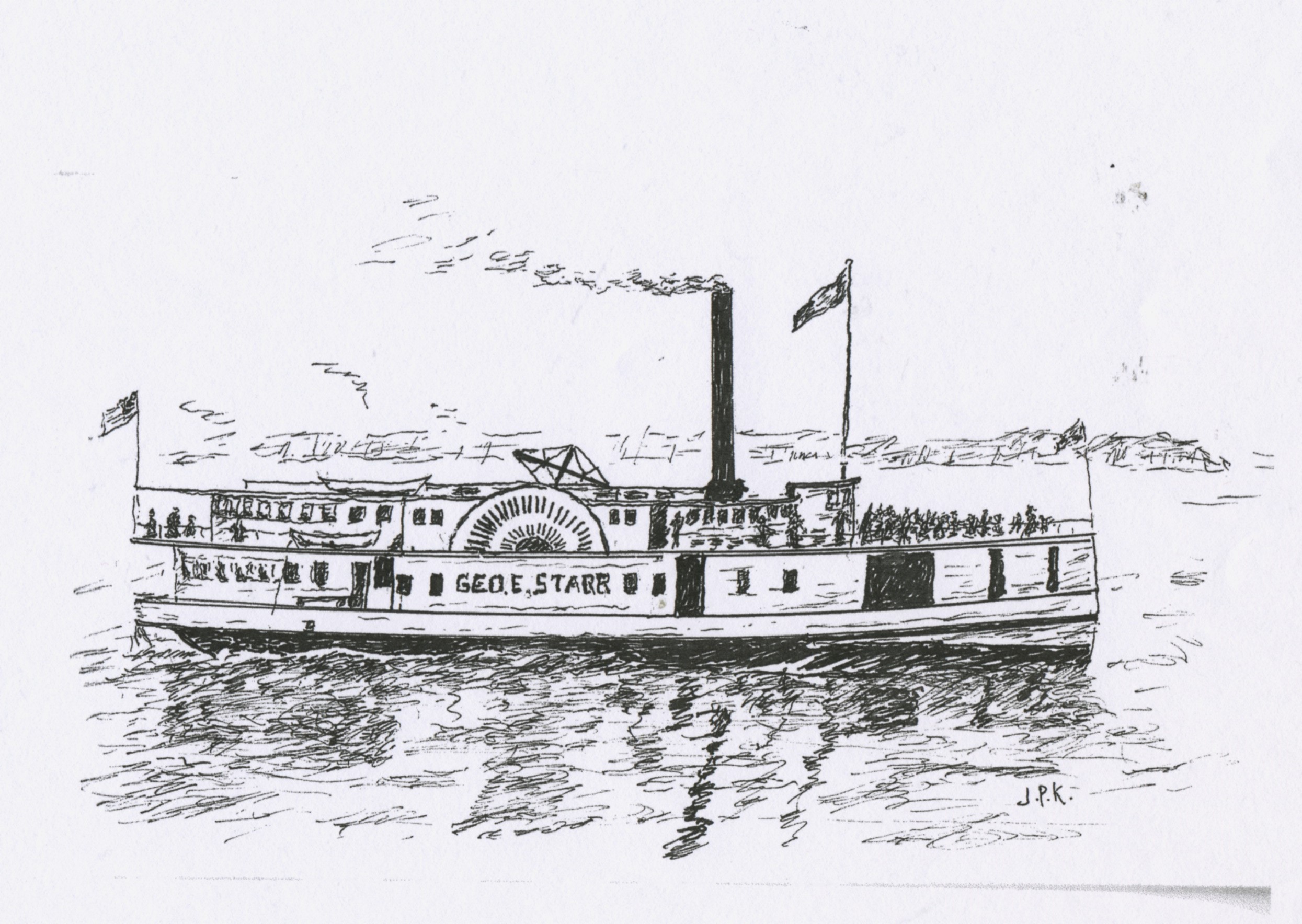
Sidewheeler Geo. E. Starr plods up Puget Sound on a calm, overcast day.
Sketch by J.P. Kenna
With plenty of railroad construction going on, Jimmy finds a niche in Fairhaven as winter gives way to spring, while keeping up with the happenings of the larger city–and the woman–he’s left behind.
More interested in his own activities and the world immediately around him than in distant news, Jimmy welcomed the coming of spring of 1889, though the rainy days frequently continued to intrude. With memories of springtime “back East” as a profusion of warmth and color under blue skies, he adapted to the unfolding of greenery and flowering of bulbs and fruit blossoms subjugated to days that more often than not continued chilly and gray. On the downtown streets, brightly painted storefront signs did their part to dispel the somberness as pedestrian and horse-drawn traffic plodded about its daily business oblivious to the slick wooden walks, soggy sawdust paths and muddied streets. Human activity continued to proclaim its presence in the richness of burning fir and cedar and maple drifting their scented clouds above brick chimneys and sheet-metal stacks pushing haphazardly over moss-coated shakes and shingles. Never far from the ear were the sounds of sawing and nailing of boards and the slap of mortar and chink, chink of the bricklayers hammer, the laughing and banter and sometimes barked orders of men working, mingling with the squawk of seagulls or the lordly croaking cry of a raven overhead, background sounds for a new city rising.
Jimmy and Susie Taylor exchanged letters weekly and, less regularly, a missive from Johnny Driscoll would describe among other things the latest in Seattle politics and the progress of the Seattle, Lake Shore & Eastern, pushing toward the Canadian connection at Sumas—as was Captain Cornwall’s Bellingham Bay & British Columbia. Also sustaining Jimmy that spring was the memory of huddling close to Susie on a late December evening, sheltered from the worst of the weather by the porch of the house where she boarded. Illuminated by the electric-arc streetlight, he could study her face—so close to his between kisses, her mouth partly open, softening the firm contour of her lips as her breathing quickened, the light sending a straight line down her nose under arched eyebrows as her nostrils widened. Beneath the bundling of winter coats he felt the pliant warmth of slender body, as again they would bury their faces in kisses, breathing in the scent of damp wool and the floral essence of her soap.
~
On the 6th of June, during a spell of premature dryness, men and women mingled and huddled around the Fairhaven telegraph office as the news arrived that Seattle was in flames. The following day Jimmy read past the headlines into details of how the “Queen City” of Puget Sound had burned to the ground. A pot of heating glue had caught fire in a shop and kindled nearby wood shavings and sawdust. From Yessler and Coleman wharves up to Third Avenue, from the Skid Road up to Pike Street, all were embers and ashes and lonely standing chimneys. The arch-rival city of Tacoma was sending up special trains loaded with tent canvas, food, medical supplies, along with tools and scores of people ready to help commence the rebuild.


 J.P. Kenna