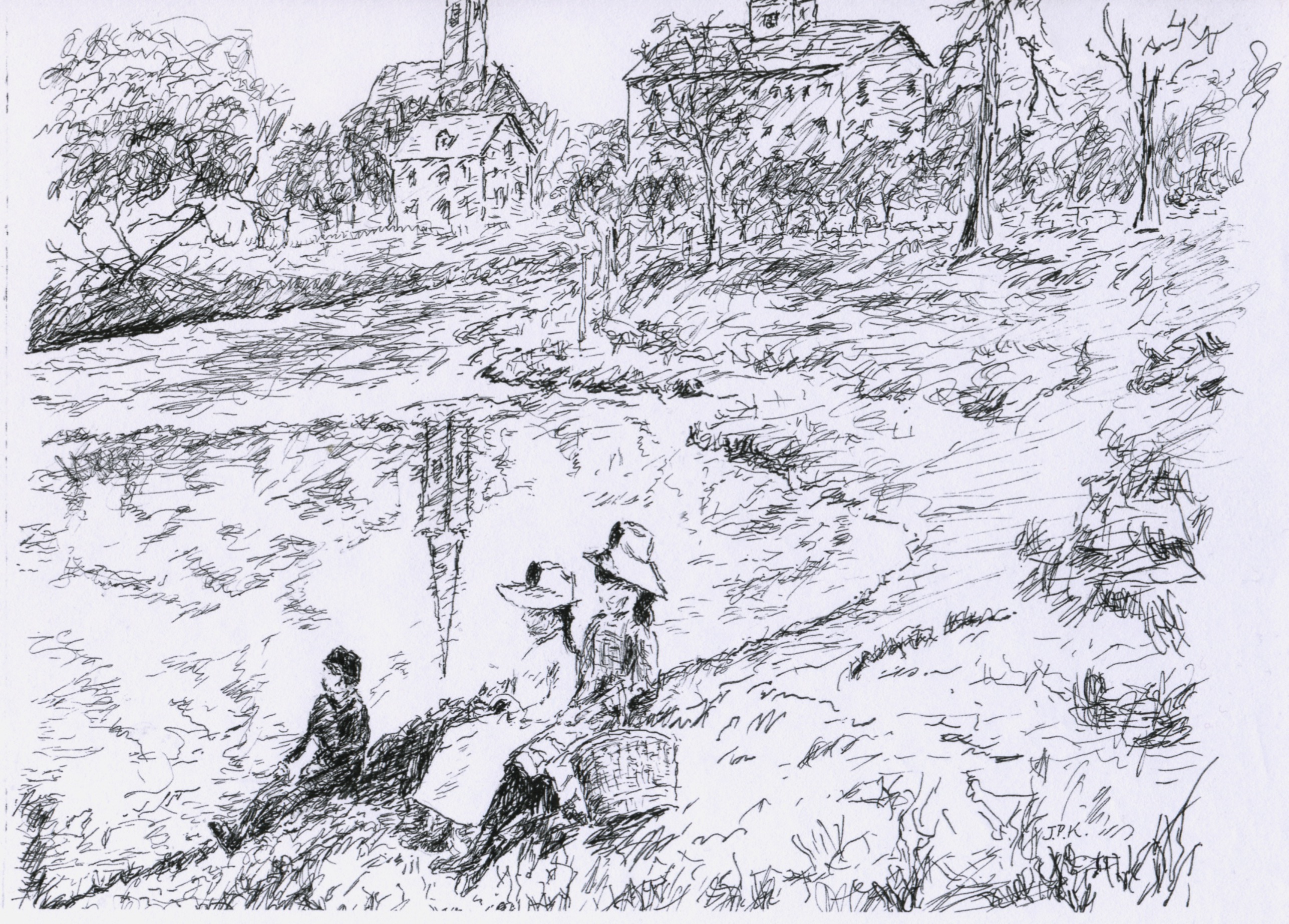
Sunday picnic along the Robinson’s Branch. Steeple of German Catholic Church reflected in stream.
Sketch by J.P. Kenna
From photo appearing in Rediscovery of Rahway, by Alex Shipley
As Seattle begins recovery from a June fire that leveled nearly its entire commercial district, Jimmy Scanlon continues working railroad construction in the booming, more-northerly Puget Sound city of Fairhaven. Learning his girlfriend Susie Taylor came through the Seattle fire unscathed, he continues writing her and longs for a visit. Likewise, struck by unexpected bouts of homesickness, he finds himself pining for his family left behind on the opposite coast–especially his father Francis and little brother Mike.
An excerpt from Beyond The Divide:
That fall of 1889, in New Jersey, Mike Scanlon entered 2nd grade at St. Joseph’s School, a 7-year-old with gaps in his front teeth. His play area widened, a favorite spot now being along the banks of the Robinson’s Branch, its winding course separating Central Avenue from Hamilton Avenue—along with the city’s two Catholic churches, ethnically divided into Irish and German.
The year before Sister Katherine Dominic had taught him to write letters and words in a neat hand, to read, to add and subtract, and to learn through the Baltimore Catechism and vivid storytelling the mysteries of the Catholic faith that he’d taken to heart in his First Holy Communion. Confession was now a monthly ritual, interrupting late Saturday afternoon play with an examination of conscience and, if playing near home, a walk uptown to the church on Central Avenue; or, if he caught the driver Bill O’Hanlon, and the conductor was amenable, a ride from Hazelwood Avenue and up through the center of town on the streetcar. When times were slack and no official looking persons were in sight, Mike used his gap-toothed charm to stand next to the blue-and-brass uniformed driver and jangle the bell, or even take the reins in the less populated areas near his home.
Emerging from the darkened mysteries of the purple-curtained confessional, praying his penance as the stained glass windows on the west wall revealed their episodes of the life of Jesus illuminated by the lowering sun—a boy teaching elders in a temple, a young man pouring clear liquid from one vat turning purple as it entered a second—Mike felt a pleasing mixture of relief and cleansing, heightened by anticipation of supper, as he thought of the three bottles of water on the sister’s desk, props for a classroom demonstration, one clean and pure, as his soul now was again, restored by the sacrament of Penance, in preparation for tomorrow’s Eucharist; the next bottle lightly mottled by drifting ink, a soul in the normal state of venial sin, as his was an hour earlier, the small disobediences and occasional fib; and the third bottle, after the sister poured in a copious amount of ink, stained to deep blackness, mired in mortal sin, a loathsome condition he resolved he’d never reach.
When walking home from school, he often stopped at the Dunlap works to visit his father. Occasionally Francis would get off work early and he and Mike would walk toward home, the boy contentedly taking striding steps to keep up with the man with graying hair and mustache, Francis exchanging a hello with a passersby on the sidewalk, with a shopkeeper in a doorway. Sometimes it would lead to a verbal exchange of pleasantries, to comments on the weather or politics. Having known nothing else, Mike could only take for granted that the man next to him—his father—both protected and admired him, and was well-liked by the people they ran into. The boy also sensed that people liked him too, that just a smile and maybe a few words uttered with a hint of bashfulness would elicit a soft chuckle and a hair ruffling from a big masculine hand; or a returned smile from a woman, and perhaps a comment on his pretty eyes and whether they favored his father or his mother. There were similar reactions when he’d go to the stores with his mother, but sharing the world with his father was yet more special, a world of strong scents, of sweat and tobacco; of political talk and the telling of jokes he didn’t really understand; of background noises of screeching, chugging trains and clattering wagons; of sights of barrels and coal shoots and large tools of wood and iron; of firehouse horse teams stomping on stall floors during idle hours, the animals behind great arched doorways, as ponderous and impressively housed as locomotives in a roundhouse; of livery stables and noisy shops, of the forbidden saloons; all part of a world belonging to men he was already sensing would someday be his, a world that, as in his present state of being well-loved and fed and safe, he had no reason to think would ever change. Things inexplicable, ink-blackened swirls of the feared and unknown did impinge on occasion, such as the disappearance from his life—from all life—of the little black boy he had once played with at the Quinn’s. And the more venial, such as the tolerable torments of his 11-year-old brother Eddie, and his once being buried in a snow bank; and before that, before she became Mrs. Quinn, the cutting of his head on Mrs. O’Hanlon’s porch railing, somehow intertwined with a string of events that led to Jimmy’s leaving. Jimmy, why have you gone from us? Where is this world you write letters from, that they call the West? Is it the final place the trains lead to?


 J.P. Kenna