This coming week marks the 98th anniversary of the Irish Easter Rebellion, also known as the Rising. Following is an excerpt from a letter, dated March 31, 1916, sent by 28-year-old Mary Scanlon–of Riverport, New Jersey–to her older brother Mike, out in Seattle. In her letter, Mary narrates taking the train into New York City, accompanying old family associate Steve O’Hanlon, on his way to visit with Irish revolutionary John Devoy. An uprising against British rule is to be a topic of discussion. O’Hanlon, like many Irish-Americans, has pledged monetary support to the cause.
From Book 4 (not yet named or published) of the I’ll Take You Home Kathleen series. Previous excerpts are from Book 2, Beyond the Divide.
Our train eased out of Newark, rumbling across the Passaic River into Harrison. Before we had time to gain any speed, we were stopped at Manhattan Transfer, the junction where the old line veers eastward to Jersey City and the new track, with its electrified “third rail,” runs northeasterly, to mid-town Manhattan. We were stopped for at least five minutes as our steam engine was switched off. An electric locomotive, a “tunnel motor,” was coupled on to what Steve referred to as our “head end.”
As we eased smokelessly and relatively quietly over the Hackensack Meadows (more marsh and swamp than meadow, as I’m sure you remember Mike—plus now sprouting increasing numbers of grim-looking industrial structures), Steve asked me about Margaret Sanger, whom I’d once met at one of Mabel Dodge’s salons, to which I’d gone accompanying Steve’s mother, Norah Quinn. Steve chuckled at the memory of his mother, of the eclectic element of people she’d met in her post-motherhood years of advocacy of what she termed “social justice”—at times to her son’s distress, (particularly when accompanying Mary Harris Jones on her sojourns organizing coal miners). He then turned serious while looking at me, asking what I knew about this Sanger woman and her notion of “voluntary motherhood.”
“I believe in the suffrage movement,” Steve said. “Women should certainly have full equality when it comes to being citizens. But some of this stuff coming out—feminism, I hear they’re calling it—well, it seems to me it could cause our whole society to fracture along dangerous lines. Anything that threatens the sanctity of the family…”
I composed a reply while taking in the dubious New Jersey scenery. With no barking steam engine up ahead, it was as though our train were propelling itself by some magical force—which is what electricity is to me. Out our right-side window the torpid Hackensack oozed through multiple acres of cattails and sedge grass, backed by the abrupt escarpment of Bergen Hill—the rock-solid underpinning of Jersey City, Hoboken, Weehawken—walling us off from the Hudson and any glimpse of skyward-building Manhattan. On our left side, undefined in distant haze, the cities of Kearney, the Oranges, Bloomfield, the ridge of Montclair, abounded beyond the Passaic—the river, brother to the Hackensack, draining the hills of Northern New Jersey into Newark Bay. “Margaret Sanger,” I said to Steve, “is not at all opposed to family. But as a nurse, she has seen more than enough suffering while working in the tenements of the Lower East Side. Women exhausted physically and mentally from bearing and rearing children—lives made hellish for both wife and husband, overworked trying to provide a living on inadequate wages—ten people crowded into spaces suitable for two or three. She has nursed women severely injured who in desperation tried to end their pregnancies—and in not-a-few cases have died from the attempt.”
Steve O’Hanlon was silent for a moment. Out the left window the sudden rise of Snake Hill—rock-faced island seeming to float on the green sea of marsh—flitted past. “Please don’t think, Mary, that modest success in life has made me insensitive to human suffering. Though perhaps people like Mrs. Sanger—and yourself—who enter the medical profession are…more directly affiliated with such.”
“Poppa Steve,” I said. This is what I’d been calling him—the father of our brother Ed’s wife—since I was a little girl. “I hope you don’t think I’m implying that you’re inured to human misery—especially among the disadvantaged classes. I know that would be your main motivation for taking up the cause of Irish freedom. We must choose our battles, mustn’t we? But of course you know there is suffering on a grand scale among the poor on this side of the Atlantic too.
“I would hardly deny that, Mary. And certainly my mother—bless her—never let me forget it!” Our train was now curving directly toward the twin tunnel entries piercing Bergen Hill.
“Margaret Higgins,” I said, “was not born poor, but she’s seen her own share of suffering. Her mother, a devout Catholic, endured 18 pregnancies, with 11 live births. In 1896—when Margaret was 17—Mrs. Higgins died of T.B. and cervical cancer. Margaret caught the T.B. from her dying mother. In 1902, she married William Sanger, an architect. They lived up at Saranac Lake, for her health, in a house Mr. Sanger designed—which burnt down four years ago. Since then they’ve lived in New York City. Three years ago she separated from her husband. Just last November, their second child, a daughter named Peggy, died at age five. Through it all—besides her work as a nurse—Mrs. Sanger has traveled and lectured, and been threatened with arrest for preaching what they’re starting to call ‘birth control.’ She’s also been threatened for writing a pamphlet called Family Limitation and for her regular columns in the New York Call—the socialist weekly—called ‘What Every Girl Should Know.’
“But,” I continued, “I think religious leaders and others of her critics have the wrong idea about her. She sees contraception not as a license for wanton sexual behavior, but rather as a means to alleviate human suffering, especially among women. In fact, her moral standards are really quite strict.”
In an instant we were in the tunnel, now enveloped in darkness outside, the incandescent-lit interior of our coach accentuating our placement in a public setting. I could see Poppa Steve was now visibly uncomfortable with the topic, especially after my airing of certain terms. In the new intimacy of the tunnel, I chose to let the topic lie…. It may have made an impression on him. I stared out the window, nothing to see but an electric bulb darting by every hundred feet or so, barely illuminating the concrete-lined conduit through which we careered. A continuous concrete platform—level with the coach windowsills—completed the monolithic scene “outside.” When I estimated we were well under the Hudson River, I said, “Poppa Steve—do you ever think of the possibility of our train running headlong into an oncoming wall of water?”
That brought him out of his dour reverie regarding feminism and birth control. He smiled as we looked around at our electrically-illuminated fellow passengers—in various attitudes of boredom, whether gazing idly out at the passing concrete, buried in a newspaper, or dozing. Besides Steve and me, only two passengers, both ladies, were actually regarding one another and engaged in conversation.
“I would imagine, Mary,” Steve replied, “that the thought may have popped into the head of everyone on this train—if only for a fraction of a second.”
“And then instantly banished,” I added. “Doesn’t it seem odd, Steve, that ten years ago men were building this tunnel and that it was the ‘talk of the town?’ How everyone marveled at the audacity of it all? Pushing through the muck under the Hudson, men drowning—or getting the bends. And now look!” I said, with a perfunctory hand wave taking in the sight of our jaded fellow riders, “Just five years after opening to train traffic, it’s become mundane…a boring interlude on the way into the City. And to think, they once feared these tubes—providing us passage through rock and mud and under water—would shift…and fracture.”
“They still might, Mary—hopefully not while we’re in them.”
I confessed to Poppa Steve that I had an urge to stand up in the aisle and start yelling at the somnambulant passengers, telling them to wake up, to realize the sacrifices that went into this travel convenience, the incredible engineering, the business acumen, the political maneuverings—not to mention the precariousness of our position, hurtling along beneath the riverbed. We should all be singing peons…and praying for our safety.
“Sure it’s the Irish in you, Mary,” he said, unable to stifle a laugh. “You’re much like my mother was—though you’re not blood-related.”
Every time I mount the stairs from the subterranean gloom of the train platforms into the welcoming concourse of Pennsylvania Station, I feel like singing peons… toward the vaulted glass roof shimmering with sunlight 100 feet above us, over soaring lattice-steel columns and arches. Tramping the glass-block floor are throngs of humanity—the immensity of space swallowing up any sense of crowdedness—pulsing in all directions, purposeful but not harried, rich and poor alike, the learned and the illiterate, each in his or her own way taking in the grandeur that awes but does not cow. A magic melding of corporate grandiosity and Whitmanesque Democracy, it belongs to us all, so long as we are on-the-move. The giant wall-mounted Benrus clocks face from the four directions of the compass; no crucifixes here, in this temple to our national religion: Transportation.
Through a phalanx of doors, leaving behind the glass and steel of the Industrial Age, we come under the pink-granite arches and lunette windows of the waiting room, evocation of the Baths of Caracalla. Next, a broad stairway shall take us up one more level, to the vaulted arcade leading to the colonnaded Seventh Avenue entrance.
“What are you thinking, Mary?” Steve asks as we make this last ascent toward street level.
“Of sandhogs and powder men, and iron workers and stone-chiselers; of corrupt Irish-American politicians—of contracts won in backroom deals; of Pennsy president Alex Cassatt, who didn’t live to see his dream completed—but whose 10-foot-tall granite effigy is at this moment watching over us.”
“Ah, Mary, your daddy was right. You too are afflicted with ‘the touch of the poet’—along with your brothers Mike, and Jimmy…poor Jimmy.”
Emerging into the real New York world through the Corinthian columns bordering Seventh Avenue, Steve hailed a motor-cab which would bear us in modern, horn-bleating fashion to the office of the Gaelic American.
Well, Mike, whether or not we have the “touch of the poet” is certainly debatable—especially in my case. I’ve always thought of myself as a hard-headed, non-romantic realist. But I will admit to being the worst-afflicted in our family of a tendency to run-on in letters to where they end up requiring an extra penny for postage (which has sparked extra criticism from Mother to the point where I will no longer allow her to do any of my mailings!). So here I am, in a letter meant to describe our meeting with Mr. John Devoy, and after multiple pages we’ve just managed to traverse the 20 miles into New York. Thus the introductory portion of my missive may surpass in length that which was meant to be the main content.
John Devoy, I understand, is around Daddy’s age, perhaps a year younger—but quite unlike him in demeanor. The man, sporting a post-Civil War style beard, looked up at me from his typewriter with what I wasn’t sure was suspicion or lizard-like indifference. The office—indeed his very person—sent to my nostrils a message redolent of paper, old varnished wood and dusty bachelorhood. He’d been expecting our dad, as a possible recruit into the Clan na Gael. “Who is this girl?” was his charming conversation-opener when I
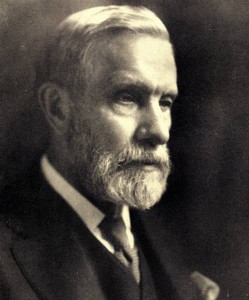
John Devoy
from Wikipedia
was presented instead. Conversationally, Poppa Steve handled him with kid gloves. He’d warned me in the taxi that Devoy is known to laugh about once a year (on a good year) and to smile not much more often. As with Old Tom Clarke (I learned), his 15 years of British imprisonment had hardened his heart not only to that Empire but to humanity in general—though next to Devoy, Tom Clarke was a man exuding levity. Old Devoy, Steve had told me, concentrated his passion, his entire zest for living, on one all-consuming cause—freeing Ireland from seven centuries of British domination. Only when Ireland was free would he return there to gladden his calcified heart, to revel in the green glens and rain-dappled meadows and mist-shrouded hills of his boyhood.
I stifled a giggle when I saw the unused extra hat on the rack by the door. Steve had explained that Devoy kept an extra unworn hat or two on hand, in the event a visit or a telephone call might cause an explosion of temper—which subsided only after he had stomped to shapelessness his current hat.
After the perfunctory introduction, Devoy nodded in the direction of a swivel chair at an unoccupied desk, Poppa Steve mumbling to me a clarification that I could sit there as a listener-observer until I would be asked to wait on a bench out in the dim hallway, with office door and transom shut, when talk turned to more secretively weighty matters.
I did glean that Steve O’Hanlon had the full trust and respect of John Devoy—to the extent that anyone could. Devoy listened in his lizard-like way as Poppa Steve told him I was “one of the family,” a medical student, and “had it within me to be a firebrand.” Devoy actually softened a trifle and even—for my own benefit, I’m assuming—though he looked toward me obliquely at best—reminisced a little about his old times in New York with Tom Clarke, who in 1902 had married Kathleen Daly and settled in Brooklyn for a few years, before returning to Dublin to become “the brains” of the Irish Republican Brotherhood.
Following a pause of acceptable length between Poppa Steve O’Hanlon and John Devoy, I asked Mr. Devoy if he had personally know Jeremiah O’Donovan Rossa, the early-generation Fenian whose passing last year prompted the eloquent eulogy from young Patrick H. Pearse. By now I was familiar with the Rossa legend. Joining the I.R.B. in 1858, he was later captured and imprisoned. When the British governor was inspecting the prison, Rossa tossed through the bars the contents of his slop-pail, landing it straight in the governor’s face. “Oh sir, ’tis clean water!” the mortified head warden managed to utter. O’Donovan Rossa was sent to solitary confinement for 35 days, both his hands tied behind his back the entire time.
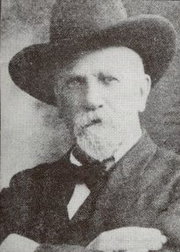
Jeremiah O’Donovan Rossa
from Wikipedia
“After a goodly number of years he was released,” Devoy related. “In ’71, we both moved to the States. What with his drinking and his hatching of monumentally stupid schemes, I soon regretted my getting to know the man. It was a godsend when Tom Clarke came over here and more-or-less took him under his wing. He and Rossa would go out to the cemetery to pray for dead Fenians—very loudly, and in Gaelic of course.”
“I understand,” Steve interjected, “that Rossa maintained that God doesn’t listen to prayers uttered in English.”
Devoy’s face momentarily relaxed with the reminiscence—the closest I’d seen him come to smiling. His features tightened again when he added, “It was Rossa, you know, who’d first egged Clarke on in the London dynamiting schemes—netting Old Tom 15 years of imprisonment.”
“And it was Old Tom Clarke,” Steve said, “who decided O’Donovan Rossa should be sent home to Ireland to die.”
“ ’Tis so, O’Hanlon. I got hold of Joe McGarrity down in Philly and we agreed to send the old buzzard home. Though Connolly says we already have too many horizontal heroes and need more vertical ones, I had to disagree. One dead Fenian is worth 1,000 German rifles.”
I was about to interject that I knew of James Connolly and his family, due to their being former neighbors of Elizabeth Gurley Flynn’s family in the Bronx—but decided against it, after remembering Steve mentioning that Devoy felt that Connolly’s socialistic proclivities interfered with the cause of Irish freedom—and that likely Devoy didn’t have an exalted opinion of the Flynns. Instead, I asked who McGarrity was.
“Joe McGarrity of Philadelphia,” Mr. Devoy enlightened me, “is a prosperous business man and leading financier of our Clan na Gael. When Roger Casement was over here in 1914, hiding out in case word leaked over his part in the gunrunning episode, it was McGarrity who volunteered to take him in—thankfully sparing myself. I can’t stomach the fellow—Casement, that is…. Sir Roger, knighted by the king! McGarrity sees him as Wolf Tone reincarnated. I see him as a potential liability to our plans—too unstable a man, he is. Not that he would intentionally betray us…. But, you know,” Mr. Devoy continued, looking in my direction, “Sir Roger Casement is reputed to have a liking for handsome young men…if you catch my drift.” Devoy must have observed that I neither blushed nor appeared to be going into the throes of a faint. I felt like I’d just passed a test. Devoy went on. “Quite frankly, I couldn’t care a rat’s…bottom, as to what Sir Roger’s proclivities may be—but it does make him more of a risk. If the wrong people find out and threaten to expose him, shaming him before the world, he just might ‘sing like a canary’ to Scotland Yard or British intelligence. Or one of his own ‘play pals’ might betray him.”
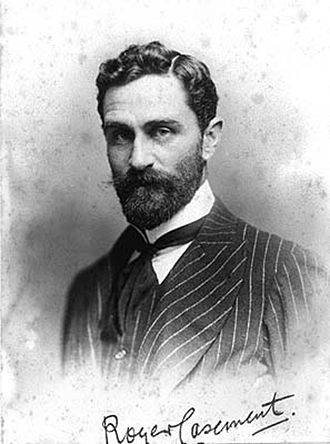
Sir Roger Casement
from Wikipedia
“I’ve already heard,” Steve said, “about that young Norwegian sailor—Adler Christiansen—who accompanied him to Germany.”
“It may well be, O’Hanlon, that I made a mistake in trusting Christiansen to help get Bob Monteith over to Germany…. Ha! Wait till Sir Roger finds out that his boy Adler has a kept woman in some slum in Jersey City! But I know I can rely on Monteith, with or without Adler Christiansen’s help. He won’t let drink or women sidetrack him. And he didn’t flinch when I reminded him that failed Irish plans tend to turn men into corpses.”


 J.P. Kenna