28-year-old Mary Scanlon continues her narrative letter of March 31, 1916, to her brother Mike in Seattle.
With longtime family associate Steve O’Hanlon, she is in the office of John Devoy–New York-based Irish revolutionary. An imminent uprising against British rule of Ireland is being discussed.
I decided not to ask more about who this Robert Monteith is. I only knew that he was a member of Connolly’s Transport Workers’ Union, and that he had recently come ‘stateside’ with his family—that his wife Mollie and three daughters are living safely in the Bronx. And that he is somehow connected with Roger Casement in a second gunrunning expedition–on a much grander scale than that of 1914–and in the raising of an “Irish Brigade” among Irish prisoners-of-war (soldiers fighting on the side of Britain) held in Germany.
At this point it was decided I should sit out in the hall, as more sensitive matters were discussed. Through the imperfectly-closed transom I could here John Devoy’s voice rising, no doubt further discussing Roger Casement’s lack of discretion. I overheard words to the effect that Casement had offered to his German co-plotters the use his prisoner-of-war brigade to liberate not only Ireland, but Egypt. “Egypt, for chrissakes!” I heard Devoy explode from behind the closed door and transom. I also heard more than once the expletive, “the whoreson!” I gathered Casment’s efforts to raise the brigade had been faltering anyhow, and that Devoy was pinning his hopes on Monteith. And that Sir Roger had spent much of the year 1915 in a German sanitarium, suffering from nervous collapse.
A half an hour later I was let back into the office. Poppa Steve and Mr. Devoy were discussing “Skeffy” Skeffington. Though Devoy dismissed him as a crank and a pacifist, besides being a teetotaler, vegetarian and feminist, Steve pointed out that the man’s very notoriety around Dublin could make him useful. His recent hunger strike in Montjoy Jail, where he was serving six months along with Irish Republican Brotherhood organizer Sean McDermott—for opposing British army recruitment—was making him a minor hero on both sides of the Atlantic. “And we need the pacifists over here,” Steve said. “If we go to war against Germany, you know as well as I do that our government would consider the Clan na Gael a treasonous organization.”
“And do you really think, O’Hanlon, that that sanctimonious Presbyterian Woodrow Wilson would have the…guts to round us up and put us in jail? While our boys are ‘over there’…saving democracy?”
“Well, he did allow a Utah firing squad to put an end to Joe Hill last November.”
“But Steve, that was a ‘sin of omission.’ Which takes a lot less courage. He just didn’t intervene forcefully enough with the Utah governor.”
“Well, that may be true, John. But you know what power does to people—especially wartime leaders.”
“I’ll grant, O’Hanlon, that allying with the pacifists here and in Ireland can’t hurt. And there’s truth in Skeffy’s witticism about a crank being an instrument that makes revolutions…. Actually, I kind of like that!”

Francis Sheehy Skeffington
from Wikipedia
“And I like what he says, John, about this ‘war to end wars’—as the Allies are starting to blare. ‘There’s no such thing,’ Skeffy says. ‘Each war is a prelude to the next.’ ”
“But not so our Revolution, O’Hanlon. When Ireland is free, centuries of conflict will be over. But first, men will have to be ready to die. And we’ll need a man who can inspire that readiness in others—a live hero, not another dead one. Though he may well end up a dead one.”
“So, John, are you talking about Patrick Pearse?”
“Who else could it be? Old Tom Clarke watched his way with the crowd at O’Donovan Rossa’s funeral. Why, even Clarke had to bite back tears! And like Plunkett and MacDonagh, Pearse is a poet and a teacher. They say he has the face of an angel; but a heart of iron and a spine of steel—if I may engage in some hackneyed metaphors. The fact is, he will die for Ireland if need be, and others will follow. Tom Clarke sees this—and like me, he’s not one to suffer fools gladly.”
“A pity, John…there will be more ‘horizontal’ heroes. It wouldn’t be so bad if they were geezers like you or me—or Clarke. But I daresay most will be young.”
“The young make the best heroes—and martyrs,” Devoy said. “Thank you for coming in, O’Hanlon.” Steve and I both took this as a dismissal. “And the best to you, Miss Scanlon…. And remember the name—Patrick Pearse.”
It not being quite dark when we returned to Penn Station, Steve and I took the short walk along 34th Street to join the bundled throngs gawking at the moving Christmas display in the chain of windows at Macy’s. By the time we were returning home, I felt grateful to be snug in a warm steam-heated coach. New York City streets can be especially inhospitable in the dead of winter. Unlike the trip in, Poppa Steve and I talked little. He may have been ruminating on men becoming heroes by dying. For Christmas, Daddy had given me an anthology of young Irish poets, which I took with me on our little New York excursion. I opened it and pencil-marked verses from three of the authors. I have since typewritten them and include them here, as a fitting finale to another one of my lengthy letters to you. (Note: I have added the authors’ current ages).
From THE YELLOW BITTERN:
My Darling told me to drink no more
Or my life would o’er in a little short while;
But I told her ’tis drink gives me health and strength
And will lengthen my road by many a mile.
You see how the bird of the long smooth neck
Could get his death from the thirst at last—
Come my soul, and drain your cup,
You’ll get no sup when your life is past.
In a withering island by Constantine’s halls
A bittern calls from a wineless place,
And tells me that hither he cannot come
Till the summer is here and the sunny days.
When he crosses the stream there and wings o’er the sea
Then a fear comes to me he may fail in his flight—
Well, the milk and the ale are drunk every drop,
And a dram won’t stop our thirst this night.
Thomas MacDonagh (age 37)
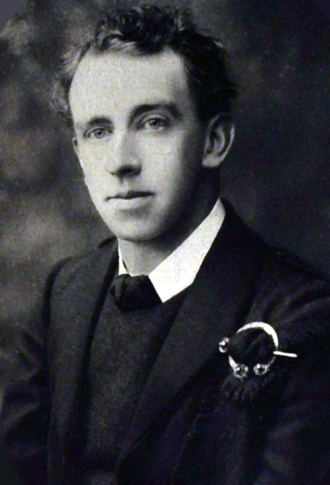
Thomas MacDonagh
from Wikipedia
THE LITTLE BLACK ROSE SHALL BE RED AT LAST:
Because we share our sorrows and our joys
And all your dear intimate thoughts are mine
We shall not fear the trumpets and the noise
Of battle, for we know our dreams divine,
And when my heart is pillowed on your heart
And ebb and flowing of their passionate flood
Shall beat in concord love through every part
Of blood and brain and body—when at last the blood
O’erleaps the final barrier to find
Only one source wherein to spend its strength.
And we two lovers, long but one in mind
And soul, are made only flesh at length;
Praise God if this my blood fulfils the doom
When you, dark rose, shall redden into bloom.
Joseph M. Plunkett (age 29)
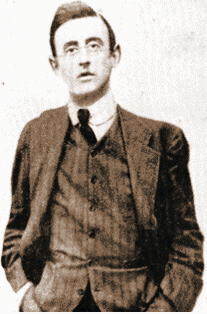
Joseph Mary Plunkett
from Wikipedia
From THE REBEL:
I come of the seed of the people, the people that
sorrow,
That have no treasure but hope,
No riches laid up but a memory
Of an ancient glory.
My mother bore me in bondage, in bondage my mother
was born,
I am the blood of serfs;
The children with whom I have played, the men and
women with whom I have eaten,
Have had masters over them, have been under the lash
of masters,
And, though gentle, have served churls;
The hands that have touched mine, the dear hands
whose touch is familiar to me,
Have worn shameful manacles, have been bitten at the
wrist by manacles,
Have grown hard with the manacles and the task-work
of strangers,
I am the flesh of the flesh of these lowly, I am bone of
their bone,
I that have never submitted;
I that have a soul greater than the souls of my people’s
masters,
I that have vision and prophecy and the gift of fiery
speech
I that have spoken with God on the top of His holy hill.
And now I speak, being full of vision;
I speak to my people, and I speak in my people’s name
to the masters of my people.
I say to my people that they are holy, that they are
august, despite their chains,
That they are greater than those that hold them, and
stronger and purer,
That they have but need of courage, and to call on the name of their God.
Patrick H. Pearse (age 36)
From IDEAL OR RENUNCIATION:
I turned my back
On the dream I had shaped,
And to this road before me
My face I turned.
I set my face
To the road here before me,
To the work that I see,
To the death that I shall meet.
Patrick H. Pearse
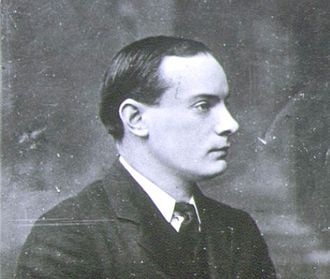
Patrick Henry Pearse, from Wikipedia
They may not be Ireland’s best poets. Certainly William B. Yeats surpasses them. And MacDonagh’s entry is translated form the Gaelic. But—the meeting of crusty old John Devoy still fresh in my mind—I started quietly crying while reading them. Poppa Steve looked over and saw what I was reading, then smiled—giving me a pat on the shoulder and offering me his pocket handkerchief.
What strange times we’re living in, brother Mike! But I shall not be driven to foreboding thoughts—and I shall try to steer our father clear when he threatens to bump up against the wall of mental darkness. It’s really not like him. It is our mother who over the years has been stricken with the bouts of melancholia.
Well, my dear brother, till we meet again—or at least write again, I remain yours,
Mary


 J.P. Kenna