
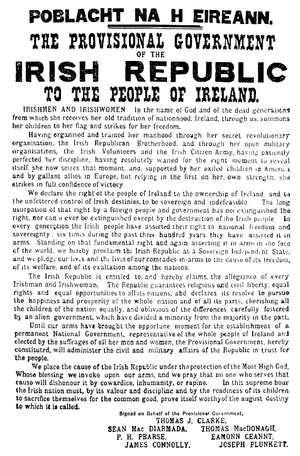
Flag flown over the General Post Office- Dublin
from Wikipedia
Mike Scanlon continues in his journal:
Easter Monday is a holiday in Ireland, marking the second day of the ending of Lent, the end of self-induced prohibitions from such activities as drinking, gambling and smoking. By all reports the weather there today is in keeping with the festive atmosphere, ending a normal spate of gloomy days that the people of Seattle would be habituated to. Eight hours ahead of Seattle time-wise, we’re anticipating newspaper updates and wires directly from Philadelphia and New York to apprise us of the latest events unfolding in Dublin.
By evening here in Seattle, men at the I.W.W. hall down on Washington Street—Irish-American and otherwise—are scanning and commenting on the reports in the evening papers.
“So the rebels have taken over the General Post Office?”
“By golly—it’s like when Haywood declared the “Continental Congress of the working class” in Chicago, back in ’05. ’Cept they’re taking it way beyond talk. These guys are wearing military uniforms and carryin’ guns. People are getting killed.”
“They say Pearse and his young brother showed up to lead the fight, decked out in full gear carrying guns and swords…but not on horseback, like General Lee…but on bicycles.”
“Sure, ’twould ’ave made a sight to see their greatcoats floppin’ over the wheels!”
“A comedy to some, maybe—but not to the brothers’ poor widowed mother. ’Tis said she saw them off in the morning, thinking she’ll never see her boys again.”
“Connolly led the charge into the Post Office—with fellow Irishmen inside—employees and customers—begging them not to shoot.”
“They’re now calling themselves the Irish Republican Army. MacNeill’s Volunteers and Connolly’s Citizen Army combined.”
“No match for the Tommies, they’ll be—who’ll soon be storming the city—followed by his His Majesty’s gunboats steaming up the River Liffey.”
“It’s like as if Vincent St. John and Big Bill Haywood and a bunch of us Wobblies put on surplus uniforms and took on the U.S. Army.”
“Making a wreck of things in central Dublin, they are—so I here…shame, in a way. They say it’s a beautiful city. Grand buildings, parks, monuments.”
“And miles of teeming tenements. They make New York’s slums look like Newport, Rhode Island. There’s a higher percentage of poor than in the U.S.—and worse off.”
“They’re out looting now. Pearse said to shoot…over their heads. That funny little fella Skeffy Skeffington is out there trying to stop the looters.”
“The people aren’t behind the uprising. They only see free food and liquor and clothes—and maybe some real furniture. They’re tired of sittin’ on crates. They’ve had no country to fight for going on 700 years. Lots of ’em are fighting for the English over in France so’s they can send home grub money to their wives and kids and mothers.”
There are dead horses and wrecked wagons and overturned tramcars in the streets. It’s getting impossible to buy food. Both holiday revelers and day-to-day shoppers are angry at the disruption of what promised to be a beautiful Monday.
British soldiers, the “Tommies,” are beginning to roll into Kingsbridge Station from Athlone and Belfast, reinforcing those stationed at the Curragh and the national police force—the Royal Irish Constabulatory. (I’ve heard that real crime is almost non-existent in Ireland, and that the main purpose of the R.I.C. has been to keep the population from turning rebellious). In the yard of Dublin Castle—seat of English power—machine guns and artillery are being readied.
By nightfall, four battalions of the rebel Irish Republican Army—led by Pearse and Connolly—were holding the General Post Office, and were able to prevent Richmond Barracks from sending British troops. The rebels have also taken some of the less-important railway stations. In the darkening Post Office, bereft of electricity, the young Father John O’Flanagan was hearing confessions and administering communion to the wounded and non-wounded alike.
The rebels hold no positions in the provinces. In County Kerry, with Tralee leader Austin Stack in jail, they are said to be especially demoralized, what with the failure of the German arms shipment to arrive.
Somehow, the story is unfolding that the communication to Germany, by way of New York, for the shipment of arms to arrive not before Sunday night or Monday morning had been changed to not later than Sunday night or Monday morning. Arriving off Tralee Bay on Holy Thursday—with no communication saying they were too early (the ship had no wireless set)—the German captain and crew of the gunrunner, disguised as Norwegian tramp steamer Aud, must have experienced their own despair when no one on shore signaled with a green lantern (as was the plan) for the arms to be offloaded. They had volunteered for the mission at known risk of life and assumed they were concluding it successfully.
Reference: Rebels, by Peter De Rosa


 J.P. Kenna