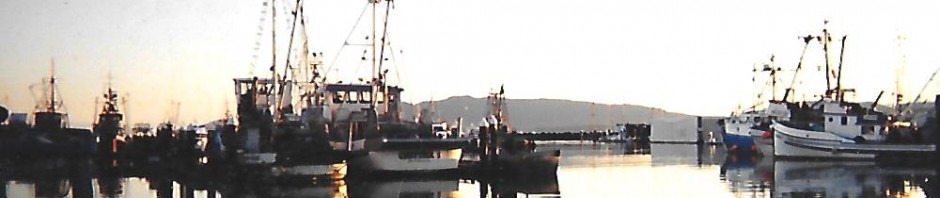
Mike Scanlon–worker, wanderer and dreamer–kept an informal journal during his years spent out West. In spring of 1916 he was working in the engine room of the Hyak, one of the Seattle-based “mosquito fleet” of small steamboats plying the waters of Puget Sound, carrying everything from fish and farm products to well-dressed commuters.
Through letters from his father Francis and his sister Mary, Mike’s been keeping up on events in Ireland; even as the war of aging European empires unfolds on the shell-pocked fields of France, threatening to pull in a reluctant America.
The following excerpts are from Book 4, as yet unnamed and unpublished, of the I’ll take You Home Kathleen series. Mike’s earlier years are followed in Beyond the Divide (available from Amazon and Village Books, Fairhaven- Bellingham, Washington, USA), and Book 3, Lost Utopia (not yet published).

Seattle, Wash. 1916
The exaltation of Easter Sunday Mass, for me, is always tempered by the 3,000 mile separation from the family I was born and raised in. But the joy is still there on seeing the statues no longer draped in the purple of Passion Sunday—and the purple vestments of the celebrating priest now replaced with gold, resplendent as the lilies flanking the altar tabernacle. And with both sexes and all ages of the congregation sporting their finest attire—the children mostly scrubbed and combed to perfection—with greening and blooming outdoors heralding the onset of mild weather, all is magically unchanged since childhood as we immerse ourselves in the celebration of the Resurrection. The mundane mixes with the reverent, as I recall walking up to the communion rail, my feet grandly enveloped in the stiff leather of my yearly pair of new dress shoes—still not fully grown into—to receive the Body of Christ in my heart on this day of the most glorious of the Glorious Mysteries.
Then, from a home surrounded by golden daffodils and forsythia, fresh foliage and early fruit blossoms banishing the stark Lenten grayness of winter sleep, new smoke from the kitchen chimney wafts skyward as a precursor to the aroma of Easter ham soon to be baking. Grandfather James and Grandmother Mary would be plodding up the Leesville Road, their carriage woodwork, brass and leather scrubbed and polished, little marred by a thin coating of road dust. As Grandfather tugged the horse to a gentle stop, I would scurry out through the front half-door, across the porch and down the steps and over the short walk where bordering hyacinths sent there heavenly scent—then tie the horse to the post, as Grandmother, rustling in yards of taffeta, alighted and stooped and gave me a warmly crisp hug, the wool of her shawl tickling my nose. Grandfather, in starched collar and cravat, his generous belly enfolded in knee-length morning coat, reached a beefy hand down for a manly shake before rumpling my combed and oiled hair, his face creased in a smile over gray beard, the early-afternoon sun glistening off his top hat.
This Easter, soon following my 34th birthday, I’m still sporting new—but better-fitting—shoes. And I shall be having a fine dinner at Mrs. O’Grady’s—made all the more satisfying knowing my wages have contributed to it. And she and Marty and his little sisters Ann and Beth will be my family.
Later, my pal Marty O’Grady and I will walk downtown to the Irish-American storefront meeting place not far from Chinatown. Hooked to a network of telegraph and long-distance telephone connections, we’ll hope to learn of verified developments, in contrast to flowing of contradictory rumors we’ve been hearing over Holy Week. And with the time difference, by late Sunday afternoon, Easter Sunday in Ireland will already be over.
Good Friday- April 21, 1916
I attended a service for the Passion of Christ at 3 p.m. at the Church of the Immaculate Conception up on 18th Avenue. Each time the priest chanted flectamus genua, kneeling with the rest of the congregation I closed my eyes, holding my right fist to my heart, and had visions of crates of rifles floating in the waves off of what I assumed was the coast of Kerry. I saw a ship exploding, perhaps detonated by its own crew. I saw ragtag groups of men, in what I visualized as the streets of Dublin, being shot by professional looking soldiers in khaki. I heard wailing from women and children… I saw Christ being taken down from the cross, bloodied and lifeless.
At the conclusion, I prayed for the mortal life and immortal soul of Patrick Pearse.
That evening, at his Pioneer Square newsstand, I asked Red O’Hanrahan if there were any front page articles about an Irish uprising. “Not a thing, man,” he answered.
Holy Saturday- April 22, 1916
Still only rumors are drifting in. Sir Roger Casement swam or was washed ashore on the Kerry coast at Banna Strand near Ballymacquain Castle, at the mouth of Tralee Bay. In one version he lay on the beach dead, with a beatific look on his face, to be at last on the home shore of Ireland, after exile in the United States and Germany. In another version he was apprehended by the Royal Irish Constabulatory near McKenna’s Fort, in the same area—wet and bedraggled but alive. And that he is now in custody at the Tralee police barracks. A 12-year-old boy, Marty Collins, had found a washed-ashore rowboat. A ghostly-looking freighter had been spied on Holy Thursday night, hove to offshore from Tralee Bay. It then disappeared. Some thought they saw a submarine cruising on the surface. Word is, there are absolutely no British submarines cruising the west coast of Ireland.
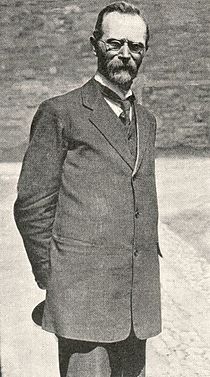
Eoin MacNeill
Chief of Staff on the Irish Volunteers, from Wikipedia
Eoin MacNeill was confronted, so a story is circulating, by Pearse, MacDonagh and McDermott, and told a shipload of German arms was due to arrive imminently—part of a plot engineered by Sir Roger Casement. When informed of this, MacNeill reluctantly—after the fact—gave his assent to an Easter uprising.
The Tralee Volunteers were put on notice that the German arms shipment wouldn’t arrive until late Sunday night or early Monday morning.
Easter Sunday, April 23, 1916
Rumor is being replaced with verified reports:
The day before, Holy Saturday, the ship carrying German arms was blown up and sunk by its own German Crew, as a British cruiser was escorting it to Queensland harbor, around the southwestern tip of Ireland. Sir Roger Casement, captured outside of Tralee, was put on a train to Dublin, then a fast packet to Liverpool, connecting with a train to London, where he is being questioned by Scotland Yard. Condemnation and disgrace now loom for a man renowned for his humanitarian work with exploited natives of South America and central Africa; a man at home in London intellectual circles that included the likes of writer Joseph Conrad.
London has been in a state of vigilance, following earlier nighttime bombs dropped by German Zeppelins floating over a mile above the city—under orders by the Kaiser, it’s being said, to concentrate on docks and warehouses, avoiding his cousin King George’s home of Buckingham Palace, along with other landmarks including Westminster Abbey and St. Paul’s Cathedral.
The loss of the anticipated German arms must have led to MacNeill’s cancellation of any Easter maneuvers; but will the likes of Pearse and Connolly and Plunkett and MacDonagh choose to obey it? When word reaches the outer Irish provinces, will the Volunteers there follow MacNeill—or Pearse? Already, there are reports that Pearse and Old Tom Clarke are simply postponing the maneuvers until Monday.
Another report says Nora Connolly—oldest daughter and frequent confidante of James Connolly—has taken the morning mail train to Dublin to be with her father for an uprising.
Now into the evening, we learn that Sergeant Beverly, the third of the Irishmen who traveled from Germany by submarine (first on the U-20, of Lusitania-sinking ill fame, then the U-19, after the 20 broke down), has turned King’s evidence against his colleagues, with whom he was put ashore at Tralee Bay in a rowboat—Robert Monteith and Sir Roger Casement. Monteith has taken over the ragtag Volunteers from the Dingle, Tralee and Limerick areas. And Sir Roger, following grueling interrogation, may be sent to the Tower of London, where his captors are to keep watch on him for suicide attempts.
In defiance of Eoin MacNeill as chief of staff of the Irish Volunteers(who cancelled an Easter Sunday march after hearing of loss of the German arms shipment), James Connolly and Michael Mallin in the afternoon took their Citizen Army—made up mostly of Transport Workers’ Union men—on a Dublin march, past City Hall and the Castle Yard.
Joseph Plunkett’s Easter wedding with Grace Gifford is postponed. The operation to cure his deadly affliction of glandular tuberculosis was unsuccessful.
Commandant Thomas MacDonagh confirmed that the Irish Volunteers will be mobilized tomorrow, Easter Monday. Fellow Commandant Eamon de Valera is pleased the rising will occur without directly defying their titular leader, Eoin MacNeill.
The seven men of the Military Council, meeting in Dublin at Liberty Hall, have declared the establishment of an Irish Republic; Pearse, elected President and Commandant General; Connolly, Vice-President and Commandant General of the Dublin Division.
A Proclamation of the Irish Republic has been draw up. Some 2000 copies are to be printed overnight on an old hand-crank press in the basement of Liberty Hall. The first name appearing at the bottom is Thomas J. Clarke. Underneath appear: Sean McDermott, P.H. Pearse, James Connolly, Thomas MacDonagh, Eamonn Kent, Joseph Plunkett.
POBLACHT NA H EIREANN
THE PROVISIONAL GOVERNMENT
OF THE
IRISH REPUBLIC
TO THE PEOPLE OF IRELAND
IRISHMEN AND IRISHWOMEN: In the name of God and of the dead generations from which she receives her old tradition of nationhood, Ireland, through us, summons her children to her flag and strikes for her freedom.
Having organized and trained her manhood through her secret revolutionary organization, the Irish Republican Brotherhood, and through her open military organizations, the Irish Volunteers and the Irish Citizen Army, having patiently perfected her discipline, having resolutely waited for the right moment to reveal itself, she now seizes that moment, and, supported by her exiled children in America and by gallant allies in Europe, but relying in the first on her own strength, she strikes in full confidence of victory.
We declare the right of the people of Ireland to the ownership of Ireland, and to the unfettered control of Irish destinies, to be sovereign and indefeasible. The long usurpation of that right by a foreign people and government has not extinguished the right, nor can it ever be extinguished except by the destruction of the Irish people. In every generation the Irish people have asserted their right to national freedom and sovereignty; six times during the past three hundred years they have asserted it in arms. Standing on that fundamental right and again asserting it in arms in the face of the world, we hereby proclaim the Irish Republic as a Sovereign Independent State, and we pledge our lives and the lives of our comrades-in-arms to the cause of its freedom, its welfare, and to its exaltation among the nations.
The Irish Republic is entitled to, and hereby claims, the allegiance of every Irishman and Irishwoman. The Republic guarantees religious and civil liberty, equal rights and equal opportunities to all its citizens, and declares its resolve to pursue the happiness and prosperity of the whole nation and of all its parts, cherishing all the children of the nation equally, and oblivious to the differences carefully fostered by an alien government, which have divided a minority from the majority in the past.
Until our arms have brought the opportune moment for the establishment of a permanent National Government, representative of the whole people of Ireland and elected by the suffrage of all her men and women, the Provisional Government, hereby constituted, will administer the civil and military affairs of the Republic in trust for the people.
We place the cause of the Irish Republic under protection of the Most High God, whose blessing we invoke upon our arms, and we pray that no one who serves that cause will dishonor it by cowardice, inhumanity, or rapine. In this supreme hour the Irish nation must, by its valour and discipline and by the readiness of its children to sacrifice themselves for the common good, prove itself worthy of the august destiny to which it is called.
Signed on Behalf of the Provisional Government,
Thomas J. Clarke
Sean MacDiarmada Thomas MacDonagh
P.H. Pearse Eamonn Ceannt
James Connolly Joseph Plunkett
Reference: Rebels, by Peter De Rosa


 J.P. Kenna