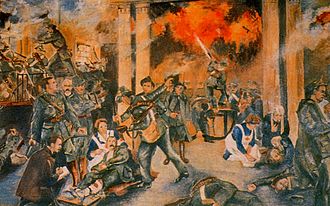
Shelling of the General Post Office, Dublin
from Wikipedea
Mike Scanlon’s journal entries continue, written in faraway Seattle, Washington, as he followed the events of that long-ago but not-forgotten week.
Tuesday, April 25, 1916
Outside the General Post Office (G.P.O.) looms Nelson’s Pillar—obstructing Sackville Street, as it has for decades. Only now the admiral’s granite nose is missing—a casualty of the uprising, now in its second day.
While the rebels hold the G.P.O., military strategists—professional and hobbyists alike—are wondering why no effort has been made to seize the more strategically located sites south of the River Liffey, mainly Trinity College and Dublin Castle. Nor have any bridges or railway lines been destroyed.
Further south of the river, the Countess Markievicz, Michael Mallin and a contingent of Connolly’s Citizen Army have set up the Royal College of Surgeons as a hospital. Nearby, British troops—with a spectacular display of firepower—took the unoccupied City Hall. Back up on Sackville Street, watched over by statues of Charles Stewart Parnell on its north end, and by Daniel O’Connell on its south, and the now nose-less Admiral Horatio Nelson in the middle (three famous adulterers, it’s been said), the looters by mid-morning were again out in full force.
The rebels in the G.P.O., directed by James Connolly, were fortifying their defenses with barbed wire and pilfered newsprint bales.
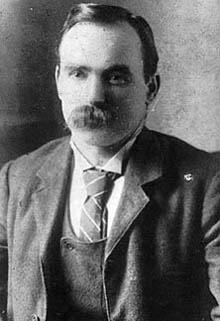
James Connolly, President- Transport Workers’ Union
Vice President- Provisional Republic of Ireland. from Wikipedia
By afternoon it’s obvious that the rebel force in the G.P.O. is fully cut off from the Citizen Army group to the south occupying the Royal College of Surgeons. The British have bisected the city east-to-west as effectively as the River Liffey has for ages.
In London, the House of Commons was deliberating on whether or not to shoot Sir Roger Casement for treason. As an interim measure, he is being held in the Tower of London. Reports are that Scotland Yard interrogators have discovered papers on him proving his homosexuality. “It’d be better for the poor bugger to be shot,” people are saying.
Evening reports tell that Skeffy Skeffington—after spending two days trying to stop the looting, while his suffragette wife Hanna Sheehy was bringing bread to various rebel posts—was arrested as he walked home. Though a civilian with no connection to Sinn Fein or the Irish Volunteers, authorities recognized him as the infamous pacifist who went on a hunger strike while imprisoned for opposing British army recruitment, sharing time with Sean McDermott—a known Sinn Feiner and signer of the recent Proclamation of the Republic—for the same offense.
With night coming on, General Lowe of the Irish Command reports that the rebellion is successfully contained, with his native troops remaining loyal to the Crown. Martial law has been declared in Dublin City and County.
After a long day of giving rousing reports to his men holding the General Post Office, Patrick Pearse allowed in, through the barricades, 60 Republican Volunteers needing safety and sustenance. On the roof, Connolly has had his exhausted men maintaining their positions in the rain, in response to rumors of an immanent English bayonet charge.
Wednesday, April 26, 1916
In Portobello Barracks, a Captain Bowen-Colthurst—whose family owns Blarney Castle and is said to have a fanatical hatred for fellow Irishman who oppose the English—is watching over his prisoner, Skeffy Skeffington. A member of the Royal Irish Rifles, Colthurst fought against the Dutch in the Boer War; and more recently had refused an order to retreat before Von Moltke’s advancing Germans at Mons. Just the other night he lead a march through South Dublin, parading a handcuffed Skeffy before him as hostage, while randomly shooting unarmed, unthreatening civilians, including a teenaged boy.
At Boland’s Bakery, Eamon de Valera—mathematics teacher turned Commandant of Irish Volunteers—kept his men constantly on the move, causing observing British officers to greatly overestimate their numbers.
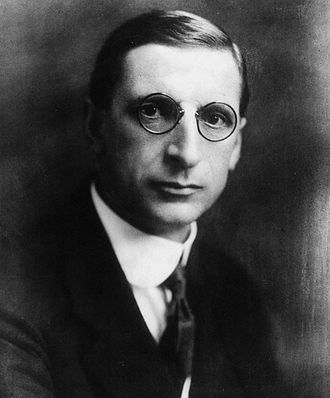
Eamon de Valera
Mathematics teacher turned rebel commandant
Later- President of Irish Free State
from Wikipedia
On the west end of the city, Commandant Ned Daly—brother-in-law to Old Tom Clarke—marshaled his men past the St. John’s convent, stopping to receive the good wishes of the Sisters of St. Vincent de Paul. A Capuchin friar, Father Albert, blessed them. Elsewhere in the city, the rebels are gaining a modicum of grudging admiration from their mostly-disapproving countrymen—the sentiment being that remarkably the rebels are holding out for their third day, that to have been put down by the English within the first hour would have been a bit of a shame. Pearse must be using this as support for his exaggerated claims that at last, after seven centuries, Ireland is in the throes of a successful revolution.
The rain chased by early-morning sun, a shell from the British gunboat Helga signaled the bombardment of the mostly-empty Liberty Hall. General Lowe has set up his headquarters in the rebel-spurned Trinity College. In the southeast section, de Valera’s detachment of 13 men guarded Mount Street Bridge over the Grand Canal, aided by two rooftop snipers, Michael Malone and James Grace—each armed only with a single-shot rifle.
At Portobello Barracks, Skeffington has refused to eat, on grounds that he is vegetarian. After requesting a sympathetic Lieutenant Monk Gibbon to return his handkerchief, confiscated the night before, and to inform his wife Hanna of his whereabouts, he was marched across the prison courtyard, looking, as others had observed, like a miniature version of fellow-vegetarian George Bernard Shaw. From a corner of the courtyard, Captain Bowen-Colthurst gave an order to shoot. “Skeffy”—in the sight of two newspaper editors arrested the night before—crumpled to the ground, fatally shot in the back. Next, the two editors were similarly dispatched. A report says the horrified Lieutenant Gibbon saw Captain Colthurst give a soldier a “vote for women” button—found on Skeffington’s person—as a souvenir.

Francis Sheehy Skeffington
from Wikipedia
There are rumblings that the incident and others, so-far among a handful, are nonetheless beginning to affect public opinion as to how the English are handling the rebellion.
Other areas are erupting with machinegun-fire and shelling, though the English 18-pound guns are unable to directly hit the General Post Office. Instead of looting, crowds along the Liffey are watching the “fireworks” show. A report in from the late afternoon says the house where snipers Grace and Malone were holed up was finally stormed by Colonel Fane’s men. The two snipers are now dead, though it appears so far English casualties far outnumber those of the rebels. They’re saying Connolly—holed up with Pearse and the Volunteers for the third day in the G.P.O.—is ecstatic. And that he has sent his only son, Roddy, on a contrived mission to lead him out of the post office to safety. Meanwhile, Connolly directed the digging of escape tunnels leading to adjacent buildings.
Captain Colthurst, who shot Skeffington that morning, is on another random-killing rampage, in defiance of the orders of his superior at Portobello Barracks, Major Francis Vane.
As daylight waned at Boland’s Bakery, de Valera released the hungry delivery horses, that they might find scant forage along hedges and the canal. Learning that the dogs and cats at the pound were also going unfed, he ordered them released—into the city streets—where likely they are now feasting on increasing numbers of dead horses and human corpses.
On the west end, Ned Daly’s men are fighting a spreading fire they themselves had started, with the intention of burning down Linenhall Barracks—in which they succeeded, only too well.
We wonder what Patrick Pearse is thinking now. Surly he must be wrestling with misgivings. But as a man who takes his inspiration from history and legend, he must be strengthened by the thought that this is the longest-lasting Irish rising since 1789. And that his students, some with him in the General Post Office, could look back many centuries to the boy-warrior Cuchulain. Hadn’t at St. Enda’s their teacher, Pearse, many times inspired his students—in Gaelic—with words from 700 years ago? I care not if my life have only the span of a night and a day, if my deeds be spoken of by the men of Ireland.
Thursday, April 27, 1916
The General Post Office is taking gunfire from all directions, but as of early morning there were no artillery hits. Rebels from rooftops are returning fire.
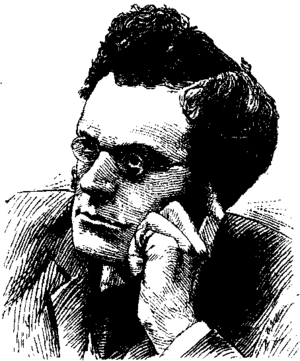
Augustine Birrell
Chief Secretary of Ireland
from Wikipedia
The destroyer H.M.S. Dove arrived at the Customs House. Chief Secretary of Ireland Augustine Birrell is back from London, said to be appalled on hearing that artillery bombardments from his fellow Englishmen will soon be pounding the city he’s learned to love. General Sir John Maxwell is being sent over from London to take charge of putting down the rebellion. A soldier of impeccable credentials with little time or taste for fine distinctions and political interference, photographs of him show a bushy mustache—said to be nicotine-stained yellow—under an enormous nose, which has earned him the nickname “Conky.”
Dead horses are being loaded onto wagons and trucks for the city zoo, where the ravenous lions are threatening a rampage brought on by lack of meat. De Valera has issued an order forbidding the bringing of food into the city, except for milk to the hospital. Tom Clarke had Father John O’Flanagan smuggled back into the G.P.O., where the strangely-cheerful besieged rebels have appointed him chaplain. However, the request to hear yet more confessions can only be taken as a sign that sooner or later artillery will pound them, or fire will smoke them out or consume them.
Late morning, a one-pound cannon—taken from the gunboat Helga by truck—was trained on Boland’s Bakery. To draw fire away, de Valera had a green flag hoisted from the tower of a nearby distillery. The flag, emblazoned with gold harp, continued to wave as the Helga’s transposed gun missed both Boland’s and the distillery but managed to land shells alarmingly close to the gunboat from which it had been recently removed.
Briefly leaving the questionable safety of the post office, in a maneuver to spread out his men by sending a detachment over to the offices of the Irish Independent, Connolly in early afternoon was shot in the foot, shattering his lower shin bone.
In the House of Commons, John Redmond, referring to the Home Rule cause he championed (which, though approved by Parliament, was “tabled” in 1914, upon England’s entry into the war against Germany), asked, “Is the insanity of a few to turn all her marvelous victories of the last few years into irreparable defeat?” Sir Edward Carson—Dublin-born Protestant, leader of the Ulster Unionists—who’d done more than any other single person to squelch Home Rule and ‘those marvelous victories’ to which Redmond alluded, intoned, “…we should be ready to put down these rebels now and for evermore.” This is coming from the man who once said he would resist “Rome Rule” even if it meant taking on the British Army.
Back in Dublin, later in the afternoon, Commandant Eamonn Kent evacuated his James Street Garrison men form the Nurses’ Home at South Dublin Union, expecting to momentarily to be mowed down by half a company of British army men in pursuit. The pursuit, however, was checked for two hours by one man behind a barricade, armed only with an automatic pistol. Charles Burgess, who went by the Gaelic version, Cathal Brugha, taunted the Tommies as they tried to pass through the passage which he now controlled. Singing old Irish battle songs, Cathal Brugha was shot 25 times, and hit by bomb splinters as the British tried to smoke him out with grenades. Eventually, the Tommies took another route, thereby saving Kent and his men, who found Brugha in a pool of blood, still singing “God Save Ireland.” Though seeming a futile gesture, they patched him up to slow the blood flow and moved him to nearby Union Hospital, where he could be given morphine and Last Rights. At last report, Cathal Brugha was refusing to die.
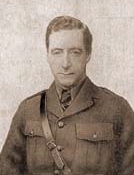
Cathal Brugha
from Wikipedia
De Valera was making his last stand at the granary at Guinness’ brewery, his men with their backs to the canal.
At 5:30 a shell hit the Imperial Hotel across the street from the General Post Office, causing it to burst into flames. Other surrounding buildings soon caught fire. By 10:00 p.m., Hoyt’s Oil Works was raining exploding drums and terror down onto the G.P.O. Sean McDermott and Tom Clarke, present in the post office since Easter Monday but eschewing uniforms and military titles, took charge of the fire fighting in the doomed G.P.O. From his sickbed inside, Joe Plunkett was heard to say this is the first time a capital city has been set ablaze since Moscow in 1814—excepting Paris, in 1871.
That night, Seattle time, I received a telegram from back East, from my sister Mary. In it, she gave a quote attributed to Irish Volunteer co-founder Michael O’Rahilly, regarding the incineration of much of central Dublin. “This is to show us exactly what the English think of poor old Ireland.”
The heat surrounding the G.P.O. caused Pearse to order all explosives to be removed to the cellars. Connolly, wracked with pain from his foot wound, gave up trying to sleep, groaning as the smell of rotting horse flesh wafted in form the streets. As James Connolly took solace in the fact that he was suffering for Ireland, young Michael Collins was chafing that things were being run by military amateurs—and that they were trapped, because no one had thought of an escape plan.
Reference: Rebels, by Peter De Rosa


 J.P. Kenna