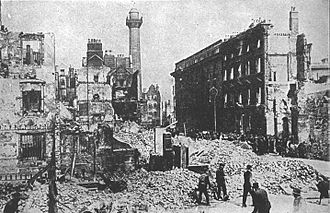
Sackville (O’Connell) Street
after the Rising
from Wikipedia
Mike Scanlon’s journal entries continue:
Friday, April 28, 1916
It’s painfully plain that the rising is not spreading outside of Dublin. There is no Irish Brigade made up of German-held P.O.W.s, there are no German arms, and the majority of the people are not behind it—though admiration is growing, and the atrocities committed under the British flag by the likes of a few such as Captain Bowen-Colthurst—murderer of teenagers and newspaper editors and Francis Sheehy-Skeffington—are having an effect on public opinion.
The ability of the rebels to maintain the occupation—now four days old—of the General Post Office is mostly due to the difficulty the British are having in training artillery directly on to the building. However, communication is now completely cut off from de Valera, Kent and MacDonagh—commandants of the outlying positions—and from Michael Mallin and the Countess Markievicz, Connolly’s Citizen Army cohorts. British snipers have taken positions rivaling those of the rebels. And what artillery has been unable to accomplish in the central city, incendiary bombs are beginning to.
At 4 p.m.—one week past Good Friday—Sackville Street is reported to be in flames. Tom Clarke and Sean McDermott, the rising’s two leading “civilians,” are said to be fighting fires in the G.P.O. with uncertain water pressure and half-rotted, leaky old hoses. Father O’Flanagan, the day before drafted as chaplain for the Irish Republican Army, continues his ministering to the men and women, voluntarily holed up inside the G.P.O., along with a captured English medical student now serving as medic. Connolly’s lower leg wound is threatening to turn gangrenous. Plunkett, his wedding postponed for nearly a week, is growing weaker by the day from T.B.
By 6:30, fire is threatening to swoop down the elevator shafts. Once again, the munitions were moved by hand.
Saturday morning in Seattle, we’re hearing more detailed reports from last night, aided by the time difference. After dark, the General Post Office, replete with interior barricades of newsprint bales and collapsed timbers, began to further crash down around the rebels in intense heat. Sean McDermott issued a plan of escape, out the rear of the building and westward, to meet up with Ned Daly’s Four Courts battalion.
First to leave was a group of 30 led by Michael Joseph O’Rahilly (who, along with not-present Eoin MacNeill, had not approved of the rising). Charging up Henry Street, O’Rahilly and his men parted their own barricade on Moore Street. Approaching the British barricade at Sackville Place, O’Rahilly divided them to the left and right, then zigzagged between them to draw fire away. The ominous stillness ceased as volleys rang out from windows and behind barricades from all directions. Of the 30, 26 were killed instantly. In the deafening fusillade, O’Rahilly took multiple hits. When his riddled corpse was found this morning, where he’d dragged himself around a corner, a note in his pocket pierced by a bullet hole had a message to his son Aodghan. On the back, in dying hand, he’d added a note to his wife Nancie.
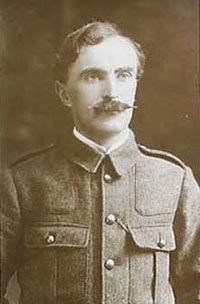
Michael Joseph O’Rahilly
Around 10:30, the wounded were moved out of their refuge at the Coliseum Theatre, as it too caught fire. With Father O’Flanagan and prisoner Dr. George Mahoney carrying the flag of the Red Cross, the British allowed the group safe passage to Jervis Street Hospital, where we’ve heard the nurses and nuns are welcoming them as heroes.
Saturday, April 29, 1916 – The Sixth Day of the Irish Republic
Their nerves frayed by day-and-night rebel sniper fire and the unique difficulties of street fighting, the British reacted by raining overnight terror on North King Street. Women and girls were locked in the rooms of their homes as husbands and sons were taken to other rooms and shot. When doors proved an inconvenient entry, walls were broken down. Homes were ransacked. It didn’t matter whether or not a house had actually been in use by snipers.
Families fell dead from gunfire as they fled burning homes. Pearse saw a man and wife and daughter lying dead on a sidewalk, a castoff white flag beside them. Newly appointed by Connolly, 15-year-old Commandant of the Dublin Division Sean MacLoughlain reported to Pearse that he had raised 20 more volunteers—then, responding to Pearse’s questioning, said they would all die on their planned assault of the British barricade at Moore Street. Minutes earlier, Sean McDermott had quietly informed Pearse that Michael O’Rahilly had been shot dead in the street the night before, with a note in his pocket to his wife and son.
Before noon, Pearse announced to his six fellow leaders of the Provisional Government his decision to surrender. They’re saying, upon hearing this, that Old Tom Clark stood up and faced the wall, silently, his shoulders heaving.
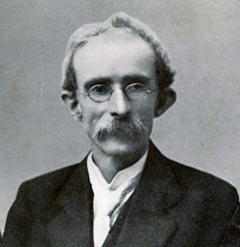
Thomas J. Clarke
from Wikipedia
At risk of life, Elizabeth O’Farrell, Connolly’s secretary-nurse—under white flag carried the message to General Lowe. In Tom Clarke’s tobacco shop, Lowe ordered a ceasefire. For the first time in nearly a week, the streets are quiet.
At 3:30 in the afternoon, next to the Parnell Monument, Patrick Pearse—agreeing to unconditional surrender—presented his sword to General Lowe. He was then put in an auto to be brought to General John “Conky” Maxwell—now the wielder of British military power in Dublin.
Connolly was put under heavy guard in an officers’ quarters room in Dublin Castle.
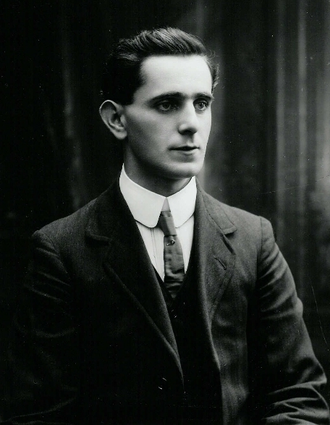
Sean McDermott
from Wikipedia
Sean McDermott faced both anger and tears when he announced to the rebels assembled at Moore Street the decision to surrender. Tom Clarke, whom they say would have preferred to fight to the death, nonetheless backed McDermott in persuading the men to honor the ceasefire.
Looking, they say, as though in a rapturous dream, Pearse—the poet and teacher of Gaelic language and legends—has signed the surrender papers at Parkgate. In his makeshift hospital room at the Castle, Connolly has authorized the surrender of his Citizen Army followers. As of 6 p.m., Ned Daly has surrendered his battalions at Four Courts. Marching past St. John’s Convent for the last time, the men gave their revolvers to the sisters who’d been cheering them on each morning. A Sister Louise hid hers in the folds of her habit, saying, “Even my guardian angel won’t know it’s there.”
Under the late-evening shadows of Nelson’s Pillar and the shell of the G.P.O., Willie Pearse, Sean MacLoughlain and Joe Plunkett walked, holding white flags in a manner suggesting victory banners. Behind them, the rebels—the Irish Republican Army (including a number of women)—marched four abreast. “Vicious Irish bastards!” some of the watching Tommies called out, their machineguns trained.
There were still overturned trams in the streets, and corpses rotting on doorways. Above the ruin of the General Post Office, the green flag—the words Irish Republic still visible—flew at a cocked angle.
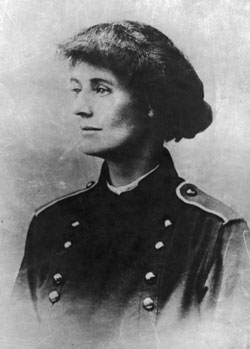
The Countess Constance Georgine Markiewicz
from Wikipedia
Last heard, the Countess Markievicz and Michael Mallin are still holed up in the College of Surgeons, no doubt wondering about the silence now coming from O’Connell Street.
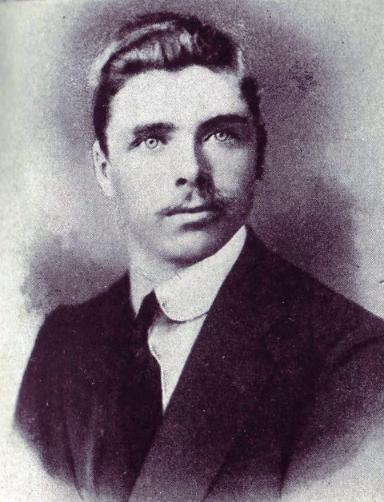
Michael Mallin
British Army to Silk Weaver to
Chief-of-Staff of Irish Citizens’ Army
from IrishCentral
Sunday, April 30, 1916
We’ve received reports of the rebels spending the night on the green at the Rotunda, offered neither food nor drink nor tobacco, forced to lie on the soggy lawn under threat of being shot, men and women alike having to relieve themselves on the spot. It was worse than anything I’ve ever heard regarding the “bull pens” used here in the States to round up strikers. Certainly it surpassed Spokane in 1909. I was there, and that was no “Sunday school picnic.”
A drunken Captain Lee Wilson singled out leaders one-by-one for derision, mocking Old Tom Clarke as a commander-in-chief who runs a tobacco shop. And Sean McDermott—stricken with polio in his boyhood—as a cripple.
Connolly worried over his daughters Nora and Ina, whom he heard were making their return to Dublin from County Tyrone, mostly on foot.
Again, Elizabeth O’Farrell was sent at the behest of General Lowe—again between the flying bullets of still-active snipers—to inform Commandants Thomas MacDonagh and Eamon de Valera, at their respective outposts, of the surrender. Lowe put a chauffeured automobile at the disposal of two Capuchin friars, Fathers Aloysius and Augustine, to further spread the word of the surrender.
The stiff, filth-ridden, thirsty and hungry rebels who spent the night under unspeakable conditions on the Rotunda green were marched through the streets of Dublin to more substantial imprisonment at Richmond Barracks. Now the taunts came not from the Tommies or their drunken officers, but from their own people. From the doorways and windows of the teeming tenements near Christchurch Cathedral came not only vile verbal abuse but rotten cabbages and not-a-few emptied contents of chamber pots. “Bloody Shinners!”—epithet for Sinn Feiners—slatterns both young and old shrieked at them.
Of all the news of the week, this me hit hardest. I sought solitude and silently cried and prayed. Father, forgive them, for they know not what they do.
With the help of the Capuchin friars, the rebel leaders convinced their men that the surrender was real. The hulking, bearded Father Augustine persuaded MacDonagh’s stunned Volunteers to follow the orders of their leaders, that Pearse made his decision to prevent further shedding of civilian blood. The priest promised to return to the men after they’d given themselves up.
Eamonn Kent, Eamon de Valera, Ned Daly and Tom MacDonagh turned themselves in as officers of the Irish Republican Army.
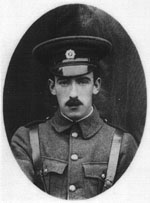
Edward (Ned) Daly
Brother of Kathleen– wife of Tom Clarke
from Wikipedia
The hobbling Sean McDermott—bereft of walking stick—arrived late at Richmond Barracks to find that at last a latrine had been provided, in the form of a large waste-can. To his horror, he saw that when it was emptied, it was then—without even a single rinse—refilled with water, from which the men desperately drank. Rage overcoming all fear of reprisal, he ordered a Tommy guard to remove the “cess bucket,” to provide clean water for the men and women. The British soldiers complied and, according to the report we heard, none called him a cripple.
With the rebellion over, discipline among the English Tommies is breaking down, with increasing drunkenness, looting and killing. We heard a report of a young Nellie Walsh, who hadn’t seen her husband since he was marched to an upstairs room during the Friday night North King Street rampage. Sunday afternoon, she found his corpse in the room, with blanket draped over it serving as a card table for drunken soldiers swilling down stolen canned food. She shrieked to them that Mr. Walsh had honorably served 10 years in the British Army.
At 3 p.m., Secretary of Ireland Augustine Birrell reported all rebels as having surrendered—and they say began penning his letter of resignation to Prime Minister Herbert Asquith. Birrell was heard to comment that “no one can govern Ireland from England except in a state of siege.”
At 3:15, Brigade Commander Tom MacDonagh—poet and Pearse’s fellow teacher at St. Enda’s—handed General Lowe an order of unconditional surrender. With the help of the Capuchin priests, some of the younger boys were able to escape home. Father Augustine helped 14-year-old Vincent Byrne out a window, telling him, “You’ll live to fight for Ireland another day.”
At Portobello Barracks, Skeffy Skeffington’s personal belongings—among them a personal letter from George Bernard Shaw—were being divided as souvenirs. Including a bundle of rejection letters from publishers, the items had been looted Thursday night when soldiers ransacked his home, in front of his wife Hanna Sheehy and their 10-year-old son Owen.
At 5 p.m., the flag of the Republic of Ireland was lowered. Nearby, a more battered version still fluttered lackadaisically at a crazy angle over the shell of the General Post Office. An hour later, Eamonn Kent and his men turned over their arms. Seeing that the British officers intended to strip Kent of his uniform, Fathers Augustine and Aloysius intervened, shaking hands with and offering their blessings to the imposing, handsome Commandant of Irish Volunteers. He and his men were marched off to Richmond Barracks.
A late report says Ina and Nora Connolly (who’d spent part of their girlhood in the Bronx as playmates of Elizabeth Gurley Flynn and her sisters) arrived in Dublin, to hear their own people talking abusively of “those crazy Shinners, rebel bastards.” Footsore, thirsty and hungry, they learned their father was wounded, likely dying.
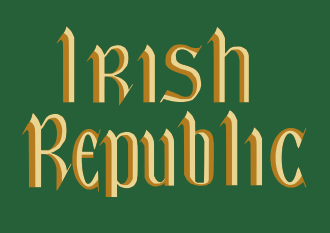
Flag flown over the General Post Office- Dublin
from Wikipedia
Reference: Rebels, by Peter De Rosa


 J.P. Kenna