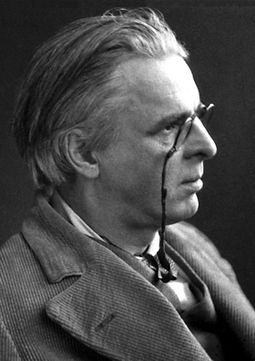
William Butler Yeats
General Sir John Maxwell’s decision to quash even the thought of rebellion in Ireland–by sending 16 men to the firing squad, mostly young men, among them poets and teachers–had the unintended consequence of shifting world opinion of the 1916 rebellion into a favorable tide.
In 1917, all prisoners from the Rising sent to England were released.
In 1919, the Sinn Feiners, combined with the republicans, won 73 out of the 105 seats allotted to Ireland in the House of Commons. Refusing to meet in London, they met in Dublin. Calling themselves the Dail Eireann, they declared all of Ireland a republic. The Irish Republican Army then fought an occupation by British soldiers, mostly hardened World War I veterans—the infamous Black and Tans.
The Government of Ireland Act of 1920, passed by the British Parliament, provided a form of Home Rule, but partitioned the country between Protestant north and Catholic south. A 1921 treaty allowed southern Ireland yet more autonomy as the Irish Free State—remaining, however, a Dominion in the British Empire.
Civil war broke out in 1922 between those seeking to unite the nation as an independent republic—led by Eamon de Valera—and those who accepted the treaty, led by Michael Collins. Fighting ceased in 1923 and the two sides—the Republicans and the Free Staters—became opposing political parties. Not until 1949 did the Dail Eireann establish southern Ireland as an independent republic, disassociated from the British Commonwealth.
Roger Casement was hanged in London on August 3rd, 1916. Circulation of his Black Diaries, revealing homosexual encounters, had caused his former admirers to distance themselves—including President Wilson, who chose not to intervene on his behalf. Forty-eight-and-a-half years later, Casement’s remains were returned to Ireland. On February 23rd, 1965, a funeral was held surpassing in grandeur that held for Jeremiah O’Donovan Rossa half a century earlier. Eamon de Valera—82-year-old President of Ireland—gave the final oration for Sir Roger Casement.
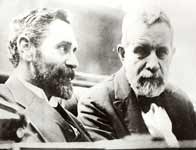
Sir Roger Casement meeting with John Devoy in New York
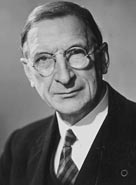
Eamon de Valera
(1882-1975)
President of Republic of Ireland
Michael Collins, Commander in Chief of the Free State Forces during the Irish Civil War, was killed in an ambush in Cork in 1922.
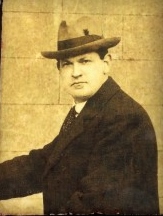
Michael Collins
Cathal Brugha, riddled with bullets and grenade fragments at the start of the Easter Rebellion, miraculously recovered—only to be fatally shot six years later, by one of his own countrymen, during the Irish Civil War.
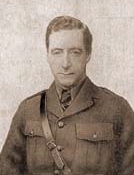
Cathal Brugha
from Wikipedia
Captain Robert Monteith, who traveled with Casement form Germany on the U-20 (noted for its learlier sinking of the Lusitania) and the U-19—a journey ending by rowboat at Tralee Bay—was reunited in New York in December of 1916 with his wife Mollie and two young daughters. He died in 1956.
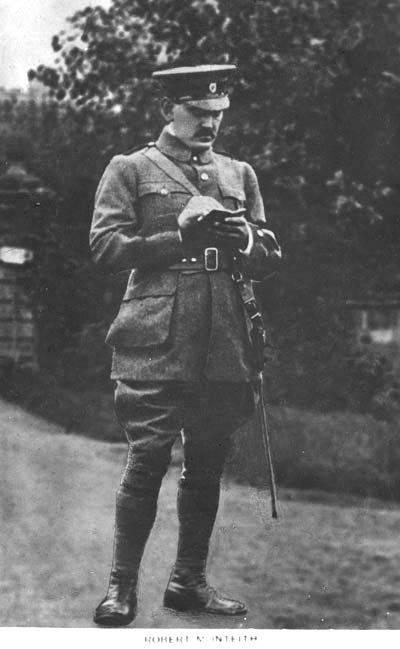
Robert Montieth
Kathleen (Kattie) Clarke, widow of executed Old Tom Clarke, served as Lord Mayor of Dublin from 1939 to 1941, and twice as Senator in the Irish Parliament. She died in 1972 at age 94 and was given an Irish state funeral.
Eoin MacNeill, Chief of Staff of the Irish Volunteers—opposed to Pearse’s plan for an Easter uprising—was court-martialed two weeks following the execution of McDermott and Connolly and sentenced to life imprisonment. He was released a year later, spent 10 years in Irish politics, and lived till 1945.
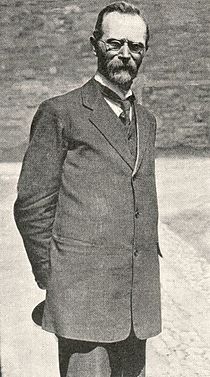
Eoin MacNeill
Chied of Staff of the Irish Volunteers
Countess Constance Markievicz made good on her vow to become a Catholic. The first woman ever to be elected to the British House of Commons, she never took her seat. She died among the poor in Dublin in 1927.
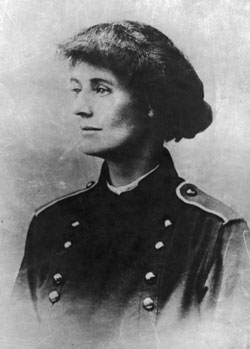
The Countess Constance Georgine Markiewicz
from Wikipedia
Grace Gifford Plunkett, widow of executed poet Joseph M. Plunkett, never remarried. She fought on the Republican side in the Irish Civil War and was imprisoned in Kilmainham jail—the site of her grim late-night wedding.
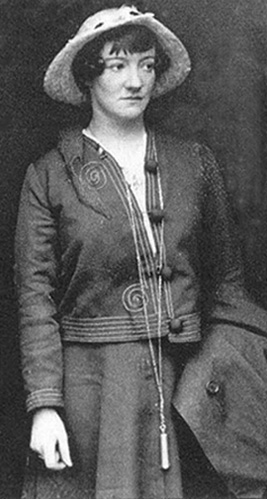
Grace Gifford Plunkett
from Wikipedia
And what if excess of love
Bewildered them till they died?
I write it out in a verse—
MacDonagh and MacBride
And Connolly and Pearse
Now and in time to be,
Wherever green is worn,
Are changed, changed utterly;
A terrible beauty is born.
William Butler Yeats


 J.P. Kenna