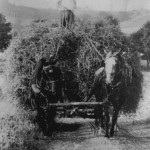
Late Summer, 1894: Jimmy Scanlon falls into the routine of working as hired-man on the Davis farm, a few miles east of Everett, Washington.
Excerpted from Chapter 26, Beyond the Divide–Available from Village Books, Fairhaven (Wash., U.S.A.); and from Amazon.
Curt Davis took special pride in his pigs, from farrowing to final butchering and smoking, his hams and bacons always a source for cash or barter. Jimmy and Melissa were left alone to milk the cows, to strain and separate the milk and fill the cream cans to be picked up before dawn at the depot. Unused to milking more than one cow twice per day, Jimmy’s fingers and wrists would begin to ache toward the end of the late-afternoon milking. Grabbing a clean bucket and re-setting the stool, he and Melissa moved from stanchion to stanchion. But the patient Guernseys, clean from their summer pasture, he found a pleasure to look at in their splotched white and gold…. Often she would sing, keeping a rhythm with the splat! splat! into the bucket, Jimmy pausing to admire the workings of her creamy arms, bared to the shoulders on the hot afternoons. Then she might look up and over at him, smiling with her eyes as she continued her song.
He was beginning to feel himself caught in a bucolic novel as they would exchange furtive glances, or hurriedly set up clandestine meetings, adding comedy to pleasure, heightened by the thrill of danger as they stole moments in haymow or secluded stretch of field along the riverbank, shielded by tall waving stands of wild grass.
Over meals in the commodious kitchen, Melissa enjoyed airing her views as husband Curt’s reddish beard moved up and down in contented chewing. There being no other women or girls in the house, the boys Ely and Nathan, like their father seeing the supper table more as a place for eating than for talking, Melissa was resigned to her role as solo conversationalist, contented with a nod or satisfied grunt or an occasional comment on the food, usually favorable. Curt Davis openly discouraged any table talk having to do with business or operation of the farm, saying there were plenty of other occasions for such, but had no objection to his wife airing matters of politics, including her own outspoken opinions, with which he mostly agreed. Daily she would find time to read the paper, usually in a lull between afternoon tasks and preparation for supper, or before going to bed.
“This Pullman mess,” she said, as Nathan, the younger boy, scooped out a second helping of potatoes, “It’s destroyed any chance for the Democrats in ’96. Most of the country’s up in arms about Grover Cleveland sending the troops into Chicago…. The contest will be between the Republicans and the Populists.”
Among her regular readings now was the Snohomish Sun, edited by John W. Frame, a man of Populist views who kept a keen spectator’s eye on the misfortunes befalling the nearby city of Everett. With her husband usually first to bed, Melissa normally read Frame’s comments alone.
With Henry Hewitt and his Everett Land Company now indebted to Rockefeller, a wave of helplessness settled over the area as reports surfaced of Rockefeller’s anger over what was turning out to be the worthlessness of the assets he’d taken as collateral. The gold mine at Monte Cristo had been “seeded.” The mine and its connecting railroad from Snohomish would likely be foreclosed and liquidated, as would much of Everett proper. As a Populist, Frame pointed out the folly of the people turning down by ballot the opportunity to purchase the city water and electrical systems and street railway at bargain prices, the chance lost to place them into municipal rather than private ownership.
Wherever Rockefeller turned he saw fraud and mismanagement and non-performing assets. Most ominous to Everett business people and residents was the belief, based on fact, that John D. Rockefeller never lost money. When the day of reckoning would come, when his dreaded foreclosures and liquidations occurred, the suffering wouldn’t be his to bear. But Editor J.W. Frame had other targets of scorn and ridicule besides the local “movers and shakers” who had ransomed their city of such promise to New York capitalists.
“Listen to this!” Melissa would say to Jimmy, sitting across from her in the parlor. He’d been made to feel free to spend evenings with the family, who except for her would be in bed well before nine o’clock. Giggling, she read parts of another editorial by John Frame. “He says the Good Citizens’ League should not only drive prostitutes from town, but ‘respectable’ ladies who spend their nights playing ‘cross-legged whist with amorous bank clerks.’ ” Her favorite editorial warned that “…unless the preachers of Everett cease their preaching for John D. Rockefeller’s sake and do a little more for Christ’s sake, the kingdom of Heaven will never be established on this sandpit.”
The Davis’ were Episcopalians and so Melissa, whatever guilt she may have felt regarding her liaison with Jimmy, wasn’t burdened with going to Confession. Being away from home, Jimmy found it easy to avoid church and the sacraments altogether, aided by his leaning toward atheism. The Davis family made no public show of religion, Curt more likely to get riled over such issues as the exploitation of the farmers by the railroads and the bigotry of the American Protective Association, the “Know Nothings,” which sadly, he said, had infiltrated the Grange, along with the Populist movement in Washington State. While he couldn’t fully grasp the Catholic Church with its “Latin mumbo-jumbo rituals,” as he said, and its allegiance to a city-state in Rome, nevertheless he thought discrimination against people because of their religion was a stupidity unworthy of the growing People’s Party. Melissa claimed he’d made himself unwelcome at social gatherings by stating that he respected Jews more than many of his fellow “so-called Christians;” though she added that he hated social gatherings anyway.
In one of Davis’ rare talkative spells, he threw out some numbers, probably gleaned from the columns and editorials of J.W. Frame: The American Protective Association, the “Know Nothings,” dominated the school boards of Seattle, Spokane and Tacoma. Thanks to an A.P.A. mayor, no city jobs in Spokane went to Catholics. Closer to home, they had caused the shutdown of the long-running Catholic school on the Tulalip Indian reservation
“One sixth of the population of Seattle is Italian,” Davis stated. “And the Scandinavians out here from Wisconsin, Illinois and Minnesota can’t abide by so many ‘foreigners’ in their midst. Ha! It’s just one group of foreigners prejudiced against another.”
“And are you bigoted against the ‘Squareheads?’” Melissa asked, throwing a little smile toward Jimmy, as though he were part of a conspiracy to “get his goat.”
But Curt Davis was not easily baited or angered, so he ignored the remark and continued, pointing out that the A.P.A. held a majority in the Washington state legislature, and that a leading “Apa-ist” represented their state in the U.S. Senate.
The only way to anger her husband, Melissa told Jimmy after Davis had left the room, was by mentioning the rates that the Northern Pacific was charging to ship his produce the 30 miles to Seattle.
When the feed corn was ready for harvest, Melissa took the train back to Ohio to help her aging parents for two or three weeks. The boys were plowing up the now harvested, richly manured truck gardens, next spring to be seeded in oats. The weediest pastures would be well manured over the winter, then come spring be plowed up, some for truck gardens and some for feed corn.
The farm being less than ten years old, there was only a small amount of fruit to harvest. “Keeper” potatoes were stored in the cellar and Melissa had shelves filled with Mason jars of preserved vegetables.
Working alone with Davis much of the time, Jimmy found his stolid company and unruffled overseeing easy enough. At times he did think his employer a bit obsessive about hazards. He first noticed it in August in the dusty rich-smelling gloom of the haymow as they were putting away the second cutting. Looking at the four hooks of the clattering hay forks overhead, dangling from the roof peak trolley like some giant metallic spider, Curt had pointed out how a caught suspender or overall strap might get one lifted and dragged the length of the barn and set back down on the waiting wagon being unloaded under the pointed roof peak overhang. Or if his son Ely, working the horse out on the ground controlling the travel of the forks, were careless or inattentive with relayed signals, all manner of things could happen. The hay loader towed behind the wagon had hazards of its own, as did the spring-toothed dump rake, as did being in confined spaces with animals many times your size. Jimmy began to wonder whether it was just to prevent injury that Davis so graphically pointed out how a man might be lacerated or maimed or crushed, or whether the farmer had an unwholesome fascination for injury and possible death.


 J.P. Kenna