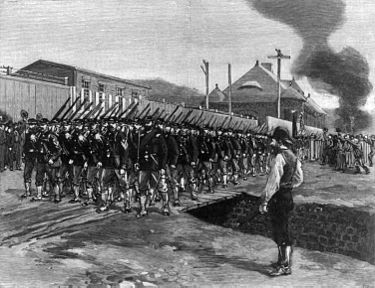
Pennsylvania State Militia arrives to quell hostilities at Homestead, PA.
drawn by Thure de Thulstrip
from Wikipedia
July, 1892: Jimmy Scanlon, in Everett, Washington, has been following the distant events of the Homestead Steel strike.
Excerpted from Chapter 21, Beyond the Divide–Available from Village Books, Fairhaven (Wash., U.S.A.); and from Amazon
It’s rare for the law to be on the side of wage-earners, Jimmy thought, putting the pages aside. He’d long ago learned from his father and Daniel Quinn that the established newspapers usually got the gist of the story correct but often misstated or confused facts, and that a certain amount of lurid prose was needed to make the newspapers sellable and this in turn created competition among reporters to produce the most sensational versions. But he also had seen enough of human nature to know that normally-decent people could be reduced to savage actions, sometimes for understandable reasons.
Regarding the previous day’s events, perhaps the reporters found the plight of the captured, outnumbered Pinkertons more likely to draw sympathy among readers than that of the Homestead workers and their families, enraged though they were by rumors that the agents were brought in not just to guard but to scab. But weren’t most of the Pinkerton agents just average men trying to earn a living like anyone else? And certainly few had any idea of what they were getting into that day. There further lurked the sinister possibility that the day had gone as Henry Clay Frick had hoped, though he may have wished for more casualties among his hired Pinkertons in order to draw in state militia support and to discredit the workers.
Jimmy reasoned that whether or not the rumors of scabbing were true, the fact remained that the mill workers were locked out as part of a plan by plant manager Frick to break the union, and scabs would be brought in regardless. As for the reported happy ending for the Homestead people, Jimmy found it incredulous that a government entity would actually side with mill workers rather than mill owners.
The next day, July 8th, he read later dispatches form the Pittsburgh Press dated July 6th and from the New York Herald dated July 7th. The updated story had a very different ending from the Herald story of July 6th, which had left off with the Homesteaders jubilant over their “victory.”
A train did indeed arrive that night to take away the Pinkerton “prisoners,” who looked–as one reporter wrote–as forlorn and dejected as that of “the lowest immigrant laborers who had just arrived at Ellis Island.” Instead of being met by a fleet of “paddy” wagons to take the 300 Pinkertons to the Allegheny County Jail, around 2 a.m. the train was shunted to the Pennsylvania Railroad yards. From there the railroad obligingly provided another special train, arriving at 10 a.m. July 7th, to take the men to their homes and safety.
That same morning, Francis Lovejoy, Secretary for the Carnegie Steel Company, proclaimed the previous day’s events as the “deathblow” for the Amalgamated Association of Iron & Steel Workers union at Homestead and all other iron and steel works. “The Amalgamated people,” he said, “who committed these recent overt acts will probably find themselves in a very bad hole, for when the proper time arrives, a number of them will be arrested on a charge of murder, and I need scarcely say there will be no lack of evidence.” It was not the Pinkertons who would be indicted for murder. He continued:
“This outbreak settles the matter forever, and that is that the Homestead mill hereafter will be run non-union and the Carnegie company will never again recognize the Amalgamated Association nor any other labor organization. The Homestead trouble will doubtlessly also have the effect of influencing other mills heretofore union to become non-union thus to free their owners from the arbitrary dictates of labor unions.”
After reading the latest releases, Jimmy felt little elation in being correct in his hunch that the previous day’s reporting had ended incorrectly. He also felt thankful that so far he himself hadn’t been put in a position where he had to choose sides.
During the last week of July, Jimmy sacrificed some precious sleep to read of events following the Homestead steelworkers’ lockout. The New York Herald of July 11th had called it “more than a struggle between an employer and an employee. It has become a conflict between the citizens of Homestead and public authority…there can be but one course and one result—the enforcement of law and the restoration of order.” Management publications such as Iron Age and American Manufacturer were raising the specter of a “socialist uprising,” thankfully put in place by co-operation between the Carnegie management and the county and state governments.
Jimmy was pondering that now it was the Homestead workers, not the Pinkertons, who were being indicted for murder, when no one knew who fired the first shots; and it was the Homesteaders who had received the greater number of casualties. Picking up the most recent paper, July 23rd, he read that Henry Clay Frick, the Carnegie Steel manager responsible for the plant lockout, had been shot and stabbed by anarchist Alexander Berkman—described as a “Russian Hebrew Nihilist”—in the company’s Pittsburgh offices. Helping Berkman carry out the attack was a 23-year-old Jewish-Lithuanian immigrant named Emma Goldman. While the Amalgamated Association of Iron & Steel Workers quickly condemned the action, the press was taking it a step further and comparing Berkman to John Wilkes Booth.
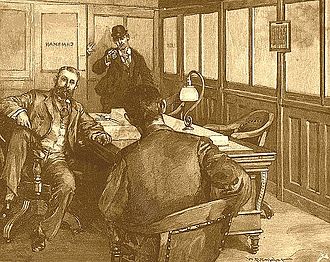
Anarchist Alexander Berkman attempts to assassinate Carnegie official Henry Clay Frick
drawn by W.P. Snyder for Harper’s Weekly
from Wikipedia
Many, however, did not see Henry Frick as Abraham Lincoln. For one thing, Frick survived. John McLuckie, burgess for the town of Homestead, stated, “This man Frick sent a lot of thugs and cut-throats to the peaceful village of Homestead…and they murdered my friends and fellow citizens.”
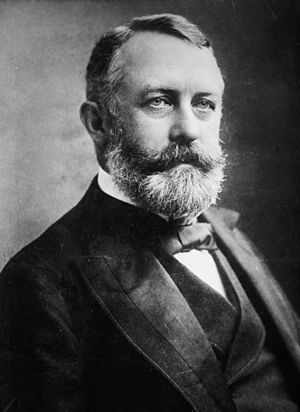
Henry Clay Frick
from Wikipedia
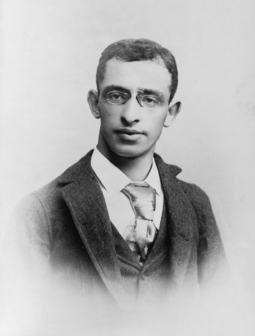
Alexander Berkman
from Wikipedia
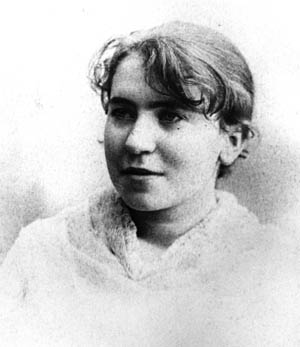
Emma Goldman
from Wikipedia
A young state militiaman, W.C. Sams, on duty to help keep order in Homestead, when hearing of the assassination attempt, gave a rousing cheer for Berkman. Private Sams’ superior officer had him placed in the stockade and hung by his thumbs. Refusing to apologize, he passed out and was cut down after half an hour, then later drummed out of the service.
Not all sympathy for Berkman was local. Eugene Debs pronounced Alexander Berkman as a man of greater moral sensitivity than Henry Clay Frick
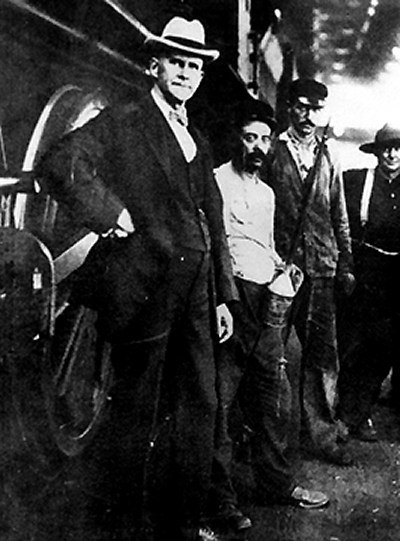
Eugene Debs meeting with railroad workers
courtesy Eugene V. Debs Foundation


 J.P. Kenna
Nice reading about you
Thanks for visiting my blog. Be in touch. Browse through the category sections, I feel you may find something of your interest.
Please visit my new blog if possible, hope you like it 🙂
http://ajaytaobotanicalblog.wordpress.com/
thank you so much 🙂