from Wikipedia
July, 1898. 16-year-old Mike Scanlon has let himself be detained, quite willingly, at a new Utopian socialist colony along the upper reaches of Puget Sound, north of Seattle. He is now “back on track” following the original plan of his journey West–to meet up with his brother Jimmy in Skagway, Alaska, to work on construction of the new Gold Rush railroad, the White Pass & Yukon. With much reluctance, he has left Anna behind in Washington state, at the Equality Colony. (see previous post, “A Day Trip to New Whatcom”)
Excerpted from Chapter 3 of Lost Utopia (not yet published), part of an Irish-American epic. Two prequels, Cinders Over The Junction and Beyond The Divide, from Shamrock & Spike Maul Publishing Co., are available in paperback from Village Books, Fairhaven (Washington, U.S.A.), and in paperback and Kindle from Amazon.
* * *
The trip up the inside passage took less time than he expected. Only once did Mike feel the onset of seasickness, when crossing the open waters of Queen Charlotte Sound, the dreaded symptoms immediately subsiding after passing Cape Calvert to the west, where once again forest-thick island-mountains sheltered them from the swells of the Pacific.
Mike writes (inspired by an entry from his informal journal, enhanced by his memories and the perspective of many subsequent years):
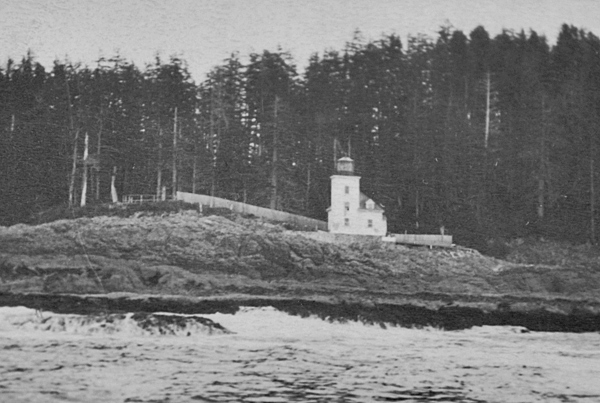
1902 view of Egg Island in Queen Charlotte Sound.
The lighthouse was built August to October of 1898.
Canada Library and Archives
The weather was clear crossing Queen Charlotte, with steady swells riding in on a moderate Northwesterly. We passed Egg Island close to the east (where construction of a lighthouse was about to commence), as I hung onto the rail, in case my increasingly distressed stomach needed to empty the contents that had so recently filled it—which fortunately it didn’t. I had the novel, disquieting vantage as we passed the shore of Egg Island of seeing the hind side of waves breaking onto the the rocks. To see the swelling, rounded humps of breakers rolling away from your vantage, white-rimmed and plunging, the spray sailing shoreward behind them, the effect was so unsettling I had to cast my gaze north or south or I would have certainly cast my recent meal toward the lee shore. I decided then and there, though I’ve come to love boats and inland bays, and always enjoyed rivers, that I had no taste for open-water voyaging. Perhaps some lingering effect, whether consciously gained through my father’s spoken and written memories [of the horrors of the 1840’s voyage across the Atlantic to escape famine] or something more subliminal in the back of my mind from ancestral memories [as the Irish, though surrounded by water, never became noted as a seafaring people, as did, for example, the Scandinavians], further prejudiced me against plying the open oceans.
Again, at Milbank Sound, we were exposed to the western swells, but so briefly as to have no adverse physical effects—though at the time I credited myself with gaining “sea legs.” From there we went into the shelter of Cone Island, the conical effect, as with Lummi Island far to the south, seen only when the landmass is viewed from its narrow end. After Finlayson Channel came the long passage of Grenville Channel, with sheer timbered mountain slopes on either side and so straight that the helmsmen could throw a loop on a spoke and lash down the wheel for many minutes at a time.
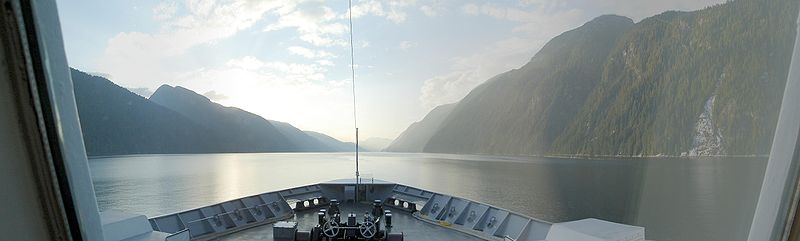
A present- day view of the Inside Passage, south of Prince Rupert, British Columbia.
Such vistas vistas have changed little since the 1890s.
from Wikipedia
It was here that Captain Johnny O’Brien invited me up into the wheelhouse and let me take the helm while the quartermaster sat nearby on a stool, ready to grab a spoke should the need arise. I’d seen Capt. O’Brien in the salon evenings at one of his favorite activities, poker playing (though not for money while on duty). When he was up supervising the watch during evenings I would hear him belt out a voluminous rendition of “Sweet Rosie O’Grady,” which the passengers below loved but I soon learned the crew found to be as little novel and uplifting as the blasting of the whistle or the hourly clanging of the ship’s bell. Capt. O’Brien said he’d given my brother Jimmy his word he’d look after me. When I related a little of my discomfort and general misgivings when crossing Queen Charlotte, he told me his friend Mike Heney, for whom I’d soon be working, had a similar feeling regarding open waters. It was nothing to do with being Irish, he said—he himself had done his share of open water voyaging. He said he’d seen the same trait in Jimmy and remarked that a railroad man would much prefer to follow a river than venture out across “blue water.”
Again, past Prince Rupert, we felt a Pacific swell as we made heading to Duke Island, the sentinel beckoning us back into United States of America territory. Yet Alaska from the ship’s rail looked no different from British Columbia, the endless mountains and spruce, fir and cedar-clad shores and islands becoming almost oppressive, especially when the weather turned gloomy—which I was told was the rule, except in the height of summer. The occasional fishing or Indian village, with dock, a few shingled buildings, sometimes a cannery, provided visual relief, along with the reassurance of human habitation, appreciated all the more due to its sparseness—as did a passing Indian canoe or the sail of a trim boat towing trolling lines, or the exchange of whistles and waves when passing a southbound screw-steamer or paddlewheeler.
Capt. O’Brien explained my observation of the absence sailing ships. What with the restricted channels, the bends, and the fast moving, shifting tidal currents, any bulky sailing vessels without an auxiliary engine would have a hard time of it in the Inside Passage. “The open ocean is their domain,” he said, then added, grinningly, “Though ‘tisn’t such for some of my railroad-building passengers.”
And there was the cavorting of porpoises, often darting back and forth, with their incessant smiles, across the onward-plunging bow, and the gushing dorsal exhale of killer whales, the spray at times felt on deck, and the pointing and “ahs” of newcomer passengers—a group in which I must include myself—at the sight of the twin tail flukes turning upward, to disappear under the rippling surface.
Any oppressiveness I felt by the passing land and waterscapes must not be confused with monotony. I was never bored. Rather it was a touch of homesickness—augmented by the vastness, the endlessness of it all, similar to the impression gleaned from staring hours out a train window, while rolling through much of the continent between the Red River of the North and the Rocky Mountains—except that here, the vistas were often restricted by the nearness of forested slopes.
In the confusion of the Skagway arrival, the passengers, mostly prospectors, disembarking amid a plethora of blanket rolls, backpacks, banded and labeled mining tools, grip bags, suitcases and even steamer trunks, Mike recognized Jimmy, the same broad grin of heartfelt greeting—though now about equal in size, no longer the towering boy-man remembered from 12 years earlier, when as a squealing 4-year-old Mike would run up to greet his big brother up from the Shore, home for a rare weekend off from his trackmen’s job on the New York & Long Branch.
They grinned at each other now from equal heights, with a touch of shyness, pumping each other’s hands, then surrendering to a brief man-to-man embrace. Mike was relieved this now 32-year-old man, who once scooped him up as easily as though he were a cat, was not a stranger to him. The lean muscular body, though now equal in size, felt familiar. There was a recalled smell, part soap and hair tonic, with a hint of tobacco and sweat. And there was the voice and the laugh, just as he remembered. “Well just look at you, if you haven’t grown into quite the young rooster! And a journeyer of many miles!” Trying to say something fitting for a well-traveled young man, Mike could only beam and stammer back.
“You’re here none to soon, little Mike,” Jimmy continued. “The engine came just last week. We’re now an operating railroad. I was thinking we’d have it all built before you got here!”


 J.P. Kenna