
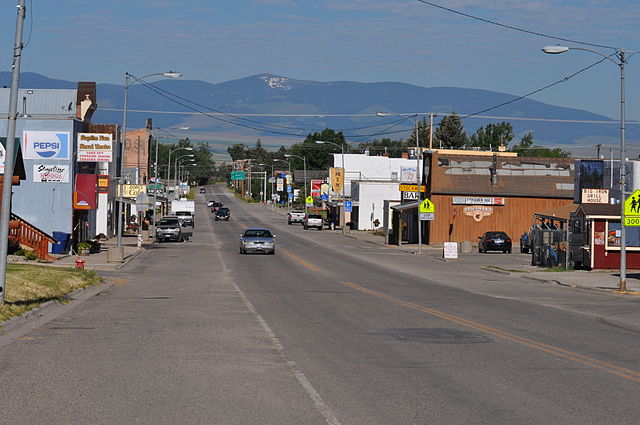
Recent view of White Sulfur Springs, Montana
Main Street, looking west toward Big Belt Mountains
Stockmen Bar to right, on corner
Back about 1980, I was introduced to a town I’d never seen, reading a description by a newly acclaimed 40-year-old writer. And it stayed with me–a mid-1940s scene of a very young boy being happily dragged around by his ranch-hand, sheep-herding father to the bars on a rollicking Saturday night. It sounded as though the main street was a string of bars. The names I recall are the Mint. And the Stockmen–a favorite, it seemed, of Charlie Doig, father of little Ivan.
This town, a county seat, sat snug in the Smith River Valley–a verdant, elongated trough, settled in the mid to late 19th century by highland sheepherders from Scotland. Way to the south are the Crazy Mountains. Walling off the Missouri River to the west are the Big Belt Mountains. To the east loom the aptly named Castle Mountains, with their rocky parapets. More distantly north, the Little Belt Mountains mark the northern end of a frontal range running east of the main Rockies, stretching up from Mexico.
Ivan Doig’s 1979 memoir, This House of Sky, brought it all to life–both the geographic, historical setting and the intriguing details–in flowing, wide-open prose.
In the 1990s I was driving U.S. Highway 12 east, crossing the Missouri River at Townsend, Montana. Leaving the Missouri River Valley, the two-lane “blue highway” began twisting upward, crossing and re-crossing the downward-tumbling Deep Creek. Suddenly the ascent was over. The trees gave way to grassland, a valley dropping off before us, stretching left and right. Ahead, looking toward the Castle ridge, the browning grass gave way to blue-green blanketing of conifer forests at the higher elevations–a timberline in reverse. Far to the left in this CinemaScopic view–some twelve miles to the north–one could make out a whitish cluster, marking a town. That would have been White Sulphur Springs.
Having read This House of Sky over a decade before, the experience of arriving at a place never before seen was a little like a homecoming. True to Doig’s description, the town is shaped like a tee. The mountains surrounding it were in their proper places. On Main Street, there was the Stockmen, and the Mint–both still in business. Though now, incongruously in this sea of grass, it was a logging town, not a sheep-ranching center. There were trees up toward the mountain tops, accessible by new logging roads.
The railroad, The White Sulfur Springs & Yellowstone Park, had been pulled up. A grandiose vision of circus-founder John Ringling, it had never gotten near Yellowstone, getting no further south than its junction with the also now-gone Chicago, St. Paul & Pacific Railroad, at a flag-stop town called Ringling.
Where the combined Highways 12 and 89 turn right onto Main Street, forming the tee, a motel surrounds the hot spring–its healing waters still an attraction, the one that enticed John Ringling’s effort to link it with Yellowstone Park. South of the motel, I observed where the playground of the red-brick elementary school abutted the exercise yard of the county jail. Ivan Doig had attended the school. An incident in his book recalls him seeing a boy at play in the school yard looking across the fence to where the prisoners were out getting fresh air, suddenly looking horror-struck and shouting, “There’s my daddy!”
For one who grew up in industrial northeast New Jersey, This House of Sky portrays a boy growing up in a world unimaginable in anything other than history or fiction. The young Ivan spent summers camped out with his father Charlie and mother Berneta, herding and tending sheep in the higher elevations. The boy was six when his mother died of asthma. He then lived much of the time with his doting grandmother Bessie Ringer in her little house by the tracks in Ringling. Later his father remarried and for a time partnered with Ivan’s stepmother running a cafe’ in White Sulfur Springs, across Main Street from the Stockmen bar.
As a teenager, Ivan has a revelation while driving sheep with Charlie to a more northerly pasture, that this is not the kind life he wants to lead. Charlie is saddened but not surprised. Ivan goes on to study journalism at Northwestern University, where he meets the woman–a fellow journalism student–with whom he’ll be spending the rest of his life. They move to Seattle. In a rental house at University Village, east of the University of Washington campus, Ivan pursues his P.H.D. in history while Charlie, dying from failing lungs, comes to stay with them.
In his youth, Charlie Doig had come to the Gray’s Harbor area and worked in a lumber yard. He was appalled when the foreman expected him to continue working when the rain started. “God-almighty, the rain!” was his impression of western Washington. He spent the rest of his working life in the dry lands of central Montana.
Later settled in, with his wife Carol, near the Puget Sound shore in the Edmonds area, Ivan wrote The Sea Runners, a novel filled with salt spray rather than dry mountain dust. He never returned to Montana to live, but most of his subsequent novels took place in the area of his youth–from the Smith River Valley, then ranging up to the “high line” area along the eastern front of the Rockies. This was the setting for his McCaskill trilogy, tracing generations of a fictitious Scottish family going back to the late 19th century.
Ivan Doig passed away this past week, at age 75, succumbing to the cancer that had stalked him for eight years. Just a year and a half ago, Victoria and I saw him at Village Books, Fairhaven (Bellingham, Washington). Reading from his recent novel, Sweet Thunder, he presented a vigorous-enough appearance. We had no idea he was a dying man. He talked of having spent a long enjoyable night before (over Scotch whiskey, I believe) renewing his longtime friendship with Village Books owner and founder Chuck Robinson. To his audience, with self-deprecating humor, Ivan talked of being a ranch hand at heart, who happened to love Shakespeare and Keats. He recalled his years as a newspaperman, an inspiration for Sweet Thunder, a story that takes place in the copper-mining city of Butte, in the 1920s, in the heyday of newspaper rivalry.
It was gratifying over 20 years ago to see snippets of the real world Ivan Doig had sprung from. And more recently, to see and hear him in person. And to receive a signed book from him. But I couldn’t help noticing there in the basement of Village Books, filled to capacity as it was, that those of us in attendance presented a sea of white and gray hair. The thought crossed my mind that not only has the world Ivan Doig written about–and to a large extent, lived in–passed. Could it be his kind of writing is also passing?
Called The Dean of Western Writers, a title informally inherited from Wallace Stegner, like Stegner, Ivan Doig wove meticulously-researched history with engaging fiction.There were romances in his stories. But they didn’t always come to happy endings. And there were rich people. But mostly he wrote about those who got up everyday and went to work. These included ranch hands, school teachers, newspaper reporters and editors, and copper miners. Lives that in retrospect might be considered romantic–but didn’t seem so at the time, by the people living them.
I’ve never really lived in the world Ivan Doig wrote about, yet somehow I miss it. As I miss much of the world I grew up in. Is this just the normal path of aging? Or is the world really on course toward a celebrity-obsessed digital dystopia? Where only the rich and glamorous are worth reading or writing about. Where best-selling books must have Hollywood-sexy models on the cover and promise a happy ending.
It would be fun to sit down over a bottle of Scotch–or Irish–whiskey, and talk about such things with Ivan Doig.


 J.P. Kenna