By the 1890s, in reaction to the unprecedented power concentration of corporations, a labor movement had formed. The Railroad Brotherhoods and the American Federation of Labor (A.F.L.) dominated the movement, divided into crafts. Eugene Debs in the early 1890s formed the American Railway Union (A.R.U.), an industry-wide organization not given to craft distinction. He saw how craft divisions had been dividing the labor movement, especially during strikes. Debs led the A. R.U. to victory in the Great Northern Railway Strike of 1893–only to face immediate defeat, and prison, in the disastrous Pullman Strike which soon followed.
He came out of his prison term convinced that the only hope for working-class America lay in the formation of One Big Union.
The following line appeared in the “Today in History” column of the Saturday, June 27th, edition of our local newspaper:
In 1905, the Industrial Workers of the World was founded in Chicago.
That was all. But I found it a pleasant surprise that any acknowledgement was made in a corporate-owned small city daily.
The following is excerpted from the historical novel Lost Utopia, by J.P. Kenna –(not yet published)

William Dudley Haywood (1869-1928) Founder of the Industrial Workers of the World —from Wikipedia
Spring, Summer – 1905
At 10 o’clock in the morning, on June 27th, in Chicago’s Brand’s Hall, Big Bill Haywood looked about for a gavel to call together the meeting planned back in January. Finding only the stub of a 2×4 left behind by carpenters working on the stage, the lumbering “Cyclops” rapped it on the table. Facing the 203 delegates at a ¾ angle, his one good eye on them, he boomed over the crowd, creating a near-instant hush:
“Fellow workers, this is the Continental Congress of the working class.”
Nearly half of the delegates represented an assortment of labor unions. Along with Haywood, Charles Moyer and Vincent St. John represented the Western Federation of Miners; Father Thomas Hagerty, a Catholic priest, represented the American Labor Union; William Trautmann, the Brewers; Charles O. Sherman, the United Metal Workers. Among the 60 individual delegates were Eugene Debs, now 50 years old, of the Socialist Party of America; “Mother” Mary Harris Jones, organizer for the United Mine Workers; Algie M. Simons, editor of the International Socialist Review; and Lucy Parsons, widow of Albert Parsons, executed for his role in the Haymarket riot of 1886. And there was Daniel DeLeon, founder of the old Socialist Labor Party, representing the scant 1,600 members of the Socialist Trade and Labor Alliance—like Father Hagerty’s American Labor Union, meant as a rival to Gompers and the A.F.L. Haywood looked at DeLeon with interest, having never before met him in the presence of fellow workingmen. Openly critical of DeLeon’s pedantic, doctrinaire ways, Haywood nonetheless harbored an admiration for intellectuals and men of learning and cultural refinement. Like many rough-hewn miners, Haywood himself was an avid reader of literature and enjoyed poetry. DeLeon, foreign-born, a lawyer by trade, had been educated at the University of Leyden in the Netherlands and taught international law at Columbia. With his aristocratic air and argumentative, sarcastic manner, Daniel DeLeon tended to arouse among those who knew him either revulsion or lifelong discipleship.
To create a unified organization from such a group before him seemed to Bill Haywood a challenge far more daunting than his years of organizing and leading his fellow miners. A constitution was drawn up. Thomas Hagerty wrote the preamble, beginning with:
The working class and the employing class have nothing in common.
Named the Industrial Workers of the World (I.W.W.), the organization would have 13 labor departments, each including a number of national industrial unions. The 13 departments in total were to include every different trade or craft, along with the unskilled. The constituent unions would answer to an executive board in Chicago. There would be restrictions on member unions’ imposition of initiation fees and dues. Likewise, they would be forbidden to make contracts with their employers; officials wouldn’t serve in the same capacity for more than one year; and they would be paid a salary based on the wages of their regular occupations.
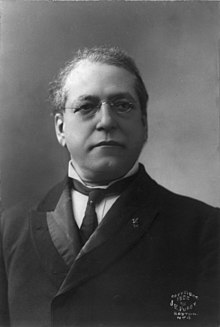
Samuel Gompers (1850-1924). founder of the American Federation of Labor (AFL). — from Wikipedia
Haywood did his best to infuse the themes he’d adopted serving with the Western Federation of Miners. He excoriated Samuel Gompers, who not surprisingly wasn’t in attendance, for the A.F.L. policy of refusing membership to African-Americans and immigrants.
Regarding the low-paid and unskilled, Haywood said:
“We came out of the West to meet the textile workers of the East. We men of the West are getting more wages per day than these men are getting. We must recognize the fact that unless we bring them up to our condition they of necessity will drag us down to theirs.
“We are going to get at the mass of workers and bring them to a decent plane of living…. When we get the unskilled laborer into this organization, the skilled worker will of necessity come here for his own protection.”
Thomas Hagerty drew a wheel representing the 13 “constituent unions,” with the central union, the new I.W.W., as the hub. On seeing the representation, Samuel Gompers dubbed it “Father Hagerty’s Wheel of Fortune.”

Fr. Hagerty’s pamphlet, Economic Discontent and its Remedy. Published by Eugene and Theodore Debs, 1902
Much of the Socialist press likewise reacted with derision, or outright hostility—including Max Hays’ Cleveland Citizen, Morris Hilquit’s New York Forward, and the Milwaukee Social Democratic Herald of Victor Berger and Fred Heath. Eugene Debs, who had given only one speech at the I.W.W. convention, was accused of splitting the trade union movement; that he and his cohorts should “return to the labor movement and the Socialist Party.” Debs responded in a letter to the Social Democratic Herald:
Since when has the S. D. Herald become the official organ and special champion of the A.F. of L.? And since when is it a condition of membership in the Socialist Party that one must belong to the A.F. of L.? … The Chicago dailies are all–like the S. D. Herald–the champions of the A.F. of L. … They understand the rottenness of the old trade union movement … but it is good enough for them, in fact just what they want, for a rotten labor movement is their salvation and that is why they lied about the Industrial (I.W.W.) convention and why they hold up the A.F. of L. as the one organization for workingmen to tie to.
In fact, Debs had talked to reporters of the ”mainstream” Chicago dailies during the convention, hoping to clarify the structure and goals of the new industrial union. With dismay, he read their coverage, which was generally derisive and omitted any of his clarifications. At least one even got the name mangled, calling it the “International Workers of the World,” an obvious redundancy.
Additional Comments:
Eugene Debs never fully embraced the I.W.W., and continued as head of the Socialist Party of America–an outgrowth of his old American Railway Union.
Big Bill Haywood, already known as the two-fisted leader of the Western Federation of Miners, led the I.W.W. into national prominence–and fear. Though out to organize all crafts, it was chiefly among the ranks of the left-behind that most members were recruited–Itinerant loggers, farm workers, miner, immigrant textile workers, and others of the laboring classes who felt that Sam Gompers’ A.F.L. had little room for them.
Out West, the I.W.W. halls became a ‘second home’ for footloose young laboring men, especially between jobs out in the lumbering camps. When not out working, the ‘Wobblies’, as they came to be called, were often seen on the street corners of cities such as Portland, Seattle, Everett–and further east, Spokane, Missoula, Butte. They loved giving speeches denouncing the system they saw as stacked against them. And they sang, often making parodies of the hymns the Salvation Army (“Starvation Army”) would be playing and singing on adjacent or opposite corners.
They led free speech demonstrations, allowing themselves to be arrested for what they saw as the exercise of a constitutional right. With endless reinforcements coming in by boxcar or any means, they could crowd the jails and drive their captors to distraction with their singing and their antics.
Haywood took the fight back East, to the textile strikes of Lawrence, Mass., in 1912 and the Paterson, N.J., silk weavers’ strike of 1913. By then Haywood was overseeing the transition of the once-loose organization–assisted by the likes of Vincent St. John and Elizabeth Gurley Flynn–into a true industrial union. Factory owners took notice. So did the mainstream press, planting fear in the hearts of the complacent and comfortable that wild-eyed, bomb-throwing Wobbly fiends could invade their towns and cities, wreaking mayhem. The U.S. Government also took notice, especially after U.S. entry into World War One. Congress passed the Espionage and the Sedition Acts, tools for the Woodrow Wilson administration–in a turnabout from its progressive policies–to put into full use, jailing scores of I.W.W. members and imprisoning its leaders, essentially breaking the union’s back.
Big Bill Haywood, aging and in deteriorating health, was sentenced to the federal prison at Fort Leavenworth, Kansas. Skipping bail, he escaped to the Soviet Union, where he hoped to find a new society putting the I.W.W. policies into practice. He died there in 1929, homesick and disillusioned.
The I.W.W. never recovered either. Following World War One, it became a victim of the “red-baiting” hysteria of the early 1920s, a movement that gave strength to a new organization, the Federal Bureau of Investigation (F.B.I.), and its very-young leader, J. Edgar Hoover.
It took the Great Depression to revive the dream of one industry-wide union. In 1935, the Congress of Industrial Organization (C.I.O.) was formed.
Following yet another World War, an updated form of “red-baiting” occurred, supported by the recently-formed House of Un-American Activities Committee (H.U.A.C.), culminating in the “witch hunts” of Sen. Joe McCarthy in the early 1950s.
In 1955, the American Federation of Labor merged with the Congress of Industrial Organization, forming the AFL-CIO.


 J.P. Kenna