Sunday, November 5, 1916
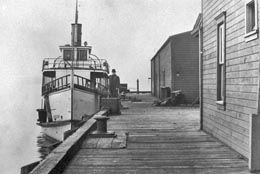
The steamboat Verona at Everett City Dock. Everett Public Library
The Seattle office of the I.W.W. has charted a steamboat to take as many men who could fit aboard up to a citizens’ meeting in Everett. The purpose of the community meeting is to discuss the on going strike of the Shingle Weavers’ Union. The shingle mill workers have been locked out of the mills since May 1st.
Excerpted from the manuscript of The Dark And Strange Flow, by J.P. Kenna (not yet published). Historical Fiction with an Irish-American slant.
After Mass, Marty O’Grady and I opened the office of the Industrial Worker, where he was planning on catching up on typing some copy. It had been a busy week and it would likely get busier. He had no objection when I asked if I could use the telephone to put through a call to Ernest Marsh.
In our conversation of but a few minutes, Marsh reiterated his frustration that the I.W.W. rally planned for this afternoon would overshadow his citizens’ meeting. While outraged at the Beverly Park beatings of Monday night, and wanting to get out the full truth of what was transpiring, he also sought to quell exaggerations—as if what has happened isn’t bad enough. But along with silence of the event in the newspapers—likely carrying out the wishes of the Commercial Club—came monstrous rumors and distortions, fanning the flames of fear that Wobblies today would be coming up by the hundreds, perhaps the thousands, to terrorize the city, seized as they are with vengeful bloodlust. That at the hands of this mob of itinerant fiends, the worst should be feared for the wives and daughters in the decent neighborhoods. Such panic was exactly what the Commercial Club needed. Perhaps Sheriff McRae himself fully believed it was on his shoulders to shield the vulnerable folk from the barbarians massing at the gates.
According to Marsh, the Commercial Club building was now serving as an arsenal—no longer just amassing blackjacks and pick-handles, its storerooms now bristled with handguns, rifles and ammunition—all with the blessing of David Clough and his coterie of mill owners and bankers. Arrangements have been made with the local navy station for access to more arms, and even direct aid. “Have you seen the headline in this morning’s Everett Tribune?” Marsh asked. I hadn’t. “I.W.W. ENTITLED TO NO SYMPATHY. And here’s the final irony, Mike! Though our exalted Men of Distinction at the Commercial Club are fanning rumors of 2,000 I.W.W. terrorists coming to loot, rape and pillage, not a one of them has sent word to Governor Lister to send up the state militia —to insure order.”
In the afternoon, Marty and I were down at the Colman Dock, waiting for the 115-foot steamer Verona to load. With a boxy pilot house, she wasn’t one of the most graceful of the Puget Sound “mosquito fleet,” but she was a decent enough looking boat nonetheless. Built in 1910 of lightweight wood construction, she featured a modern oil-fired pipe boiler to make steam for her 500-horsepower triple-expansion engine.
Walker C. Smith was also at the dock, handing Marty a couple of pages of semi-legible longhand to be typed out, then handed over to the typesetter for the Industrial Worker. Before taking the material back to the office, Marty let me read Walker Smith’s opening lines describing the upcoming voyage.
How shall we enter the kingdom of Everett?
Their mission is an open and peaceable one. Cheerful, optimistic, enthusiastic, the band of social crusaders feel the conquest of free speech is assured. Not for a moment are they thinking that the Everett “Ku Klux Klan” might dare resort to violent and criminal tactics in the broad daylight of this beautiful sunny day and in plain view of a host of conscientious Everett citizens.
I hadn’t realized the Industrial Worker’s co-editor was sensing some of the same misgivings I was having. But for either of us to speak up at this time would do no good.
And so the men, led by Harry Feinberg and Red Doran, are marching in fours, from the Washington Street headquarters, over the steel footbridge crossing Railroad Avenue leading to the Colman Dock. Out at the gangway, Feinberg and Doran assist Captain Chauncey Wiman in taking count. At 250—the capacity of the slim Verona—the remaining men, somewhere around 40, are directed to catch the Calista, waiting a few blocks north at the Galbraith pier. Watching our men filing up the gangway of the Verona, singing and joking in that inimitable way, I notice a few are carrying handguns. A number of these men were at last Monday’s Beverly Park’s calamity, a few still wearing bandages, some with slings, some limping. When the topic of bringing guns along came up at a subsequent meeting, it was agreed that carrying weapons on any return into Everett was not to provoke trouble, but rather—should the need arise—to fend off a repeat of anything like Beverly Park.
Watching George Reese ascend the gangway, I thought of last Monday’s ill-fated voyage to Everett, how he had hung back and slinked off to the waiting room. The loudmouth Reese, always talking up tactics sure to promote violence, passed himself off as a veteran of free speech fights at Aberdeen and Portland. Today he was with several edgy-looking fellows. I’ve heard rumors that the Commercial Club has hired Pinkerton dicks and planted them among us. Now my suspicions about this man are so strong I’m about to mention them to Feinberg, but I’m distracted by an announcement that the Verona is short a fireman. The man filling this position went ashore earlier, leaving the chief engineer to watch the boiler, and is now nowhere in sight. A call goes up for a qualified man to sail as fireman. Some men look in my direction.
“Go on, Mike,” Marty O’Grady says. “You really wanted to go along anyway. Now you can get paid besides!”
Cap Wiman and Chief Engineer Ernest Shellgren, after a perfunctory interview, decide I’ll do. Leaving my Sunday suit coat and hat on the main deck, I descend the ladderway and find a pair of oily overalls and a well-worn cap hanging from a stubbed-off pipe. Now properly attired, I glance at the fire, the pressure gage, and the sight glass, then make a quick tour of the lower level to check out locations of feed pumps, injector, fuel pumps, circulating and condensate pumps. In too short a time, above decks, I hear three short whistle blasts. The gong and jingle sound for reverse, then for a stop, then full forward. I soon glean the best setting for the valves regulating fuel flow and atomizing steam, keeping a smoothly burning fire. The Verona is now underway, the 500-horsepower Seabury engine, with a whisper, pushing us along at a nice 14 knots. In minutes we round Magnolia Bluff.
The festive atmosphere continues on the main and upper decks as we steam northward on an unseasonably beautiful early-November day, the Olympic Mountains a jagged snow-sheathed rampart on our western flank. I hear the favorite songs being sung, especially those of the so-recently martyred Joe Hill; “Casey Jones the Union Scab;” “The Rebel Girl,” a tribute to Gurley Flynn; the rousing “Power in a Union,” sung to the tune of “Blood of the Lamb.” I’m enjoying being back in an engine room, tending the fires, watched over by the rhythmic gyrations of a triple-expansion engine. Before I realize it we are in Port Gardner Bay. From above now come the lyrics and tune I recognize as the old English Transport Workers’ strike song, “Hold the Fort.”
We meet today in freedom’s cause,
And raise our voices high;
We’ll join our hands in union strong,
To battle or to die.
Hold the fort we are coming,
Union men be strong.
Side by side we battle onward,
Victory will come!
Answering the gongs and jingles signaled from the pilot house, Chief Engineer Shellgren spins the throttle valve shut and heaves over the “Yohnson” bar, setting the engine in reverse. I watch the water level bouncing in the sight glass, then turn up the fires to counter a drop in steam pressure as the boat maneuvers into the Everett City Dock—being prepared to douse the fires once we’re tied up, to keep the safety valve from popping. Scrambling up the ladderway, glancing out the windows I see only dripping mussel-encrusted pilings. The tide is low and the dock is level with our upper deck.
As near as I can tell, our bow is snubbed up against the dock, the bowline made fast by what someone says is one of Cap Ramwell’s scab workers. Our stern is angled out into the bay. Looking up to the level of the dock, I see throngs of leather boots.
“Holy shit!” I hear one of our boys yelling. “There’s dicks everywhere. Hundreds and hundreds!”
The engine and machinery below now quietly oozing wisps of exhausted steam, I strain to hear voices.
“Boys, who’s your leader?” I couldn’t mistake the voice of Sheriff Don McRae.
“We are all leaders!” snaps back one of our group. A deckhand is securing a gangplank.
“You can’t land here!” Again, the voice of McRae.
“The hell we can’t!” comes the reply from a burly man on the forepeak. There is no mistaking the crack of a gunshot following. Whether coming from the Verona or the dock I can’t tell. I’m now standing on the main deck, looking out the row of windows, well below the level of the dock. Chief Shellgren is still at his post by the throttle valve and Johnson bar, looking toward the windows with wide eyes. Shoe soles on wood pound and scrape on the deck above us. Barely, I hear a young mans’ voice, singing a repeat round of “Hold the Fort.” Its elevated distance leads me to believe that whoever is singing has likely climbed a masthead or the boat’s flagpole. There are more gunshots. A sickening thud comes from the upper deck. “Hughie Gerlot!” I hear someone shout. “Jesus Christ, they’ve killed him!” There’s no more singing coming from the masthead. Only more cracks sounding from pistols or rifles—and maybe shotguns. With more trampling of feet, the Verona begins an alarming list to starboard. Seeing through the windows on the open-water side, I count two, then three bodies dropping from the upper deck, splashing into the water.
“For cri-sakes, Chief!” I shout to Shellgren. “Back us outa here!”
“I’m waiting for a bell,” the dazed older man says. “Can’t move…no signal from the wheelhouse!”
I already surmised there was no one at the wheel above. The boxy little pilothouse of thin wood siding would provide no protection from bullets. Whoever is in there is either dead or cowering in mortal fear. Any fool can see we need to back out away from the close-range firing, now obviously coming from the dock. Once clear, someone will grab the wheel. Hopefully there is someone alive up above who can steer us to safety, all the way back to Seattle if need be.
To be continued.
Sources: Mill Town, by Norman H. Clark; Revolution in Seattle, by Harvey O’Connor; The Everett Massacre, by Walker C. Smith


 J.P. Kenna