November 5, 1916
Hearing the gunshots above, most apparently coming from the dock, the sound of men falling, Mike–in the engine room of the Verona–realizes they must back away from the dock, or they could all be killed. But he realizes there is now no one up in the wheelhouse to control the boat.
Continued from Part Three of “Mill Town Under Siege: Everett, Washington–1916”
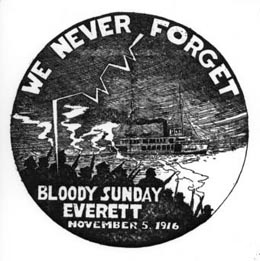
Everett Public Library
The pressure gauge still registers a good head of steam. I shove the confused chief aside and grab the Johnson bar, giving it a mighty heave, throwing the links into reverse position. Chief Shellgren looks as though ready to scold me for my insubordination—bordering on mutiny—but makes no real resistance. Responding to my twisting open the throttle valve, the engine dances to life.
“You pup!” Shellgren says, apparently emerging from his state of shock. “You’ll be hauled to a hearing for this!” So the fool can only think about rules and protocol. I’m thinking of what would happen if McRae’s deputized thugs should start storming aboard the Verona. It would make last week’s Beverly Park episode look like a walk in the park. Looking out a port side window, I see the bowline straining as the reversed engine begins backing us away. Through the starboard windows, nearly close enough to the water to swamp us, I notice water stained red. No one makes a move to untie us. Through what sounds like pandemonium on the dock I hear a voice crying, “Oh, I’m hit! I’m hit!” It could be McRae’s, in an uncharacteristically falsetto mode. The bowline creaks than stretches, then finally parts. Scrambling below, I turn open the fuel and atomizing steam to both burners, letting the hot brickwork re-ignite the fires. It pops into my mind that, in not using the lighting torch, I’m violating yet another procedure. There is a minor flareback, but now the steam pressure is holding steady as the Verona backs away from the Everett City Dock.
“Dear God!” I openly pray, “Someone grab the wheel!” The steering ropes—linking the wheel to the rudder—are visible on either side of the engine room, snaking lackadaisically through the sheaves. The rudder is obviously slapping back and forth, unguided by human hands. Scooting down the ladderway, Shellgren having made no attempt to stop him, a man rushes toward me. Fearing the worst, in the moving shadows cast by the rotating engine I recognize it is not one of McRae’s goons, come to dispatch me for good, but one of our own—a fellow named Billings. Assuming he came down to help and not just to seek shelter, I tell him to grab the starboard steering rope. I grab the portside line and, between the two of us pulling the slack out of the stout manilla, we’re able to keep the boat on a steady reverse course.
After a minute or so, thinking soon our arms would give out in our attempt to control the otherwise lawless rudder, we hear a bell signal. There is a live person in the wheelhouse! This seems to put Chief Engineer Shellgren back into a functioning mode. He responds to a stop bell. With the engine crank now still, a welcome pull comes into our steering ropes. I feel the Verona turning, guided by the living. She has also leveled off, the men above apparently no longer crowding the starboard rail in response to the gunfire coming from portside. Another gong signals full ahead. Ernest Shellgren, after resetting the drip oilers, is seated at his post near the throttle. I’m down at the firebox level, tending to fires, water level and pumps. In a spare moment, I mount the ladderway and steal a glance out a starboard window. Off to the west are the Olympics under a lowering afternoon sun. We are southbound toward Seattle.
A number of events and details of the ill-fated voyage became apparent as we made our premature return trip. Four men aboard are dead: 20-year-old Hugo Gerlot, who was shot down from the mast while singing “Hold the Fort;” Gustave Johnson, John Looney and Abraham Rabinowitz. Felix Baran is mortally wounded. The upper deck is still slick with blood. Thirty one more are wounded and it’s believed six to twelve went overboard. They are either drowned or were picked off by gunshot from the dock as they treaded water. Several deputies were wounded on the dock, including McRae himself—from behind, it appears, likely by fellow Commercial Club citizens’-army men, shooting from the warehouse. Two deputies are dead—Ed Curtis, office manager for a lumber company, and Jefferson Beard, who was seen administering beatings last Monday at Beverly Park. Joe Irving is wounded. The fusillade—augmented by shots from Captain Ramwell’s “scab tug,” the Edison—dwarfed any return fire coming from the Verona. With most of the wounded deputies shot in the back or buttocks, it seems obvious they were accidentally shot at from the warehouse by their own men; and that some caught stray bullets from the Edison. Alcohol appeared to be flowing among McRae’s 500.
As I had guessed, on our boat, Captain Wiman was barricaded, during the shooting, in the “Texas” cabin behind the pilothouse, shielded by the boat’s safe. He then returned to the pilothouse—now perforated with bulled holes—after we’d backed far enough into the water. Resuming control, he headed us for Seattle, after stopping to warn the Calista to turn around also.
The entire sorry episode was witnessed by hundreds of Everett citizens, gathered—in response to Ernest Marsh’s call for a citizens’ meeting—on the low hillside over the water, adjacent to the Great Northern’s Bond Street depot.
Our return to Seattle was greeted by police and hospital ambulances waiting at the Colman Dock. Four of our boys were taken to the city morgue. Those of us on the Verona who weren’t wounded were marched off to the city jail—the Wobblies on board the Calista to the county jail. As a crew member of the Verona, I was spared the incarceration. Chief Engineer Shellgren never mentioned my committing any acts of insubordination.
I later learned that Harry Ault–editor of the Seattle Union Record–was among the hillside crowd up in Everett. In his paper he wrote:
Your correspondent was on the street at the time of the battle and at the dock 10 minutes afterward. He mingled with the street crowds for hours afterward. The temper of the people is dangerous. Nothing but curses and execrations for the Commercial Club was heard. Men and woman who are ordinarily law-abiding … were heard loudly sympathizing with the I.W.W.s…. I heard gray-haired women, mothers and wives, gentle, kindly, I know, in their home circles, openly hoping that the I.W.W.s would come back and “clean up.”
Ernest P.Marsh, in his capacity as president of the Washington State Federation of Labor, later issued a statement:
A dangerous situation existed in Everett after the battle of November 5. Public feeling ran high and anything might have happened. Half a thousand citizens were under arms and enraged at the Industrial Workers of the World and deadly determined to stamp out their organization in Everett. It is no exaggeration to say that literally thousands of the working people of Everett were just as enraged toward members of the Commercial Club who participated in the gun battle.
Of the 240 men jailed, 74 were charged with the murder of two deputies, C.O. Curtis and Jefferson Beard. Most were singled out by two Pinkerton agents, peering through a hole in the wall from a darkened room as the men were marched by in single file. One of the agents, I’ve learned—not to my surprise—was George Reese. Having passed himself off as a Fellow Worker among us, then arousing suspicion among both the I.W.W.s and the striking longshoremen for his continual advocacy of violence, he is now nowhere to be seen in the area—likely, wherever he may be hiding out, fearing for his life.
The 74 I.W.W.s thus indicted have been transferred to jail in Everett. Marty O’Grady tells me the average age of the men is 32 (not surprising, given a 1912 report citing that 90% of the national membership is under 30 years of age). Four were born in Sweden, three each in Ireland and Canada, and six from a variety of other countries. The rest are native-born Americans, representing a variety of labor crafts.
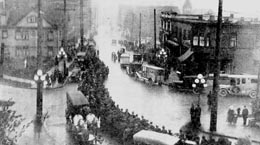
Funeral Procession for slain I.W.W.s, Seattle, November 18, 1916. The Everett Massacre
On November 18th, I attended the funerals of three of the five young men slain aboard the Verona: Felix Baran, Hugo Gerlot, and John Looney. The other two slain men—Gustave Johnson and Abraham Rabinowitz—were claimed by their families. Thousands joined the cortege to Mt. Pleasant Cemetery, on the north end of Capitol Hill. I.W.W. headquarters in Chicago sent the young English poet, Charles Ashleigh—spokesman for the organization—to read the funeral oration. I’ve since memorized two stanzas of the poem he wrote for the occasion:
They came that none should trample labor’s right
To speak and voice her centuries of pain
Bare hands against the master’s armored might!—
A dream to match the tools of sordid gain!
And the decks went red; and the gray sea
Was written crimsonly with ebbing life.
The barricade spewed shots and mockery
And curses, and the drunken lust of strife.
As a chorus sang “Hold the Fort”—the song young Hugo Gerlot was singing as he was shot down from the mast—the caskets were lowered away, then pelted with red roses and carnations.
On November 8, both the Seattle Times and the Post-Intelligencer initiated a recall effort for Seattle Mayor Hiram Gill, for allowing the I.W.W.s to board the Verona on November 5th, and for sympathizing with the “Wobblies.” The Seattle mayor also castigated the dockside shooters in Everett, and the forces backing them. The recall went nowhere.
Donald McRae quickly recovered from his wound. His term as Snohomish County Sheriff expired at the end of the year.
On May 5th, 1917, I.W.W. member Thomas H. Tracy was pronounced Not Guilty for the murders of deputies C.O. Curtis and Jefferson Beard. The remaining 73 indicted—who’d been aboard the Verona—were released, as were those who’d been aboard the Calista.
In the Seattle Union Record, editor Harry Ault wrote:
It is the first victory of its kind ever achieved by labor on the Pacific Coast, previous trials without exception having been decided against the worker.


 J.P. Kenna