Tom Robbins and I

No, Tom Robbins, who died a year ago come February 9th, was not a friend. Or even a casual acquaintance. Though for a few years it seems like our paths crossed obliquely in the picture-perfect town of La Conner, Washington. And, truth to tell, even writing the above title is something of an embarrassment, as I much dislike “name dropping.” Especially as an unknown writer cozying up to an internationally known celebrity writer. Though we both have books for sale in the same waterfront bookstore in La Conner.

Tom lived in an unpretentious house on 2nd Street. For a time in the early 1980s, I lived on a tugboat at Pioneer Moorage, a motley collection of mostly wooden boats inhabited by a random element of fisherman, old-boat enthusiasts, would-be artists, maybe a poet or two–some with steady day jobs and some irregularly employed. And mostly survivors of the counter-culture years, with varying degrees of success. In short, a boiled-down version of La Conner’s historic roots as a produce marketing-and shipping-town transitioned into a colony of the artistic (such as Guy Anderson) and literarily inclined. And more recently and painfully, into a tourist destination.
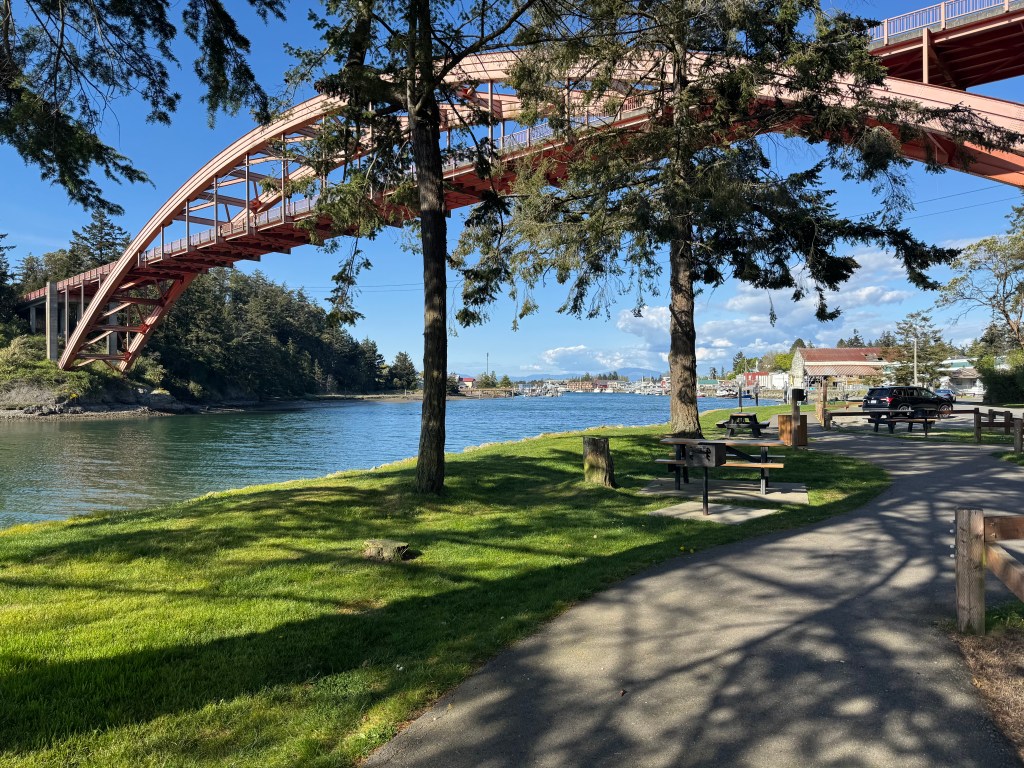
The current image has no alternative text. The file name is: rpp-1.jpg
LOOKING NORTH ALONG THE SWINOMISH SLOUGH – May 2025 Photo by Richmond Prehn

Arching over the Swinomish Slough and Pioneer Moorage was the landmark Rainbow Bridge. The bridge is still there, but Pioneer’s ramp and floats and eclectic boats have long since vanished, some sunken and some surviving and scattered about, like their owners and inhabitants.

A mini-park is sited at where a shaky ramp once led to the floats and the boats. At the foot of the ramp was tied the largest boat there, the 74-foot Katahdin, built in the young Washington state in 1899 by Maine lumber interests. I’d been in the process of bringing back to life the long-neglected vessel on South Lake Union in Seattle, where it had worn out its welcome. And so I had it towed up to La Conner, where the unwelcomed and famed alike could find refuge. After our baby boy Joey died at age 7 months, I quit my job with the State Ferries. My wife Victoria and I sold our house in Anacortes and moved aboard the aged tugboat, with our year-old baby girl, Ellen Rose. A year later, another baby girl, Amy Jean, arrived. The Katahdin was now a floating family home, emitting enticing smells of home cooking and baking from the top-opened Dutch doors of the restored galley.

Bill Slater, with 5-year-old son Japhy, often tied up near us, motoring up on his gray double-ender with the add-on plywood shelter, to reprovision his cabin down on the Skagit Delta, where–likewise among poets and artists seeking refuge–he was neighbors with Robert Sund. Bill was known in the area for his wildlife paintings. He counted Tom Robbins among his closest friends, having known him since their days at the University of Virginia. The two had more-or-less come West together. I don’t know whether it was Bill or Tom who first came to La Conner, but Tom had been living in the house on 2nd Street, where Bill was a frequent visitor, since some time in the 70s.

I would pass by Tom or see him at the Post Office (Easily recognizable, he did, as he claimed, look like “Doris Day with a mustache”). I might end up with him in a checkout line at stores on 1st Street–places of business that didn’t survive the town’s makeover into a tourist destination. Such as Nelson Lumber, perhaps buying a stick of trim or a bag of nails. Or the La Conner Food Center, a very adequate grocery store housed in an un-historical Quonset Hut.

Tom moved comfortably among such settings, treated as any good customer. It was known that he liked a certain level of autonomy in his adopted hometown. It was only once I heard someone in a store blurt out, “Wow, are you Tom Bobbins? Far out!” Tom just nodded, with a slight–probably practiced–smile.

It was Donna who introduced me to him. I was delivering firewood (one of my side-gigs, to support my tugboat restoration habit) to her cozy little house on the north end. I’d first met Donna in 1978, when she lived with her son Jessie on a well-kept boat, an older cabin-cruiser dwarfed by the nearby Katahdin. Jessie was about the age of our son Joey, leading me to think they could grow up together and become best pals–which was not to be. So now, two years later, I was unloading firewood while making small talk with Tom Robbins in Donna’s backyard garden. I didn’t want to spoil this pleasant encounter by telling him my ultimate dream was to be a writer.

Donna and Tom were married that summer. Victoria and I received a wedding invitation, but for reasons that now escape me, we declined. Soon after getting our tugboat running under its own power, I sold the Katahdin to waterfront entrepreneur Peter Strong–who shared with me a fetish for historic old boats. But he normally didn’t let that cloud his astute business sense. Except perhaps for that one purchase. But he had the resources to complete the tugboat’s restoration. Not long afterward the Katahdin won first place in the retired-tugboat races up in Port Townsend. Around that time I bought a 1916-built 70-foot salmon tender, the Bofisco. My boats were getting smaller and newer. This one required a relatively small amount of work and actually paid its way as a workboat. For its first season, Bill Slater hired on as deckhand. I later lost track of Bill, who died in the 1990s. I recall reading his obituary written by Tom Robbins.

Tom Robbins’s first successful work, Another Roadside Attraction, was the first of his I read and has long been a favorite. And the only one that I’m aware of that actually took place in and around La Conner. I can still point out the building along Interstate-5 where the body of Jesus Christ was hidden and stored for a time. Though that plot twist might shock many, I recall no overt ridiculing of religion in Tom’s work. He did claim to be the grandson of two Southern Baptist preachers. If he had a message for readers of his own time, it was to “lighten up.” Admittedly a tough thing to do if one has the habit of reading the paper every morning. Which I do. But a message well worth a try, though yet more challenging if you’re a devotee of history.

The professional literary critics can decide if Tom Robbins’s playful narrative style was at least partly inspired by Kurt Vonnegut Jr. Author of Sirens of Titan and Slaughterhouse Five, Vonnegut’s whimsy was darkened by his having witnessed the immediate aftermath of the fire-bombing of Dresden. Yet I found Vonnegut’s mixture of the light and dark strangely alluring.

I was also captivated by Wendell Berry and his social criticism. And Wallace Stegner and his steely yet panoramic realism. I didn’t quite to know what to make of Tom Robbins and his at-times cartoonish storytelling. And still don’t. But certain lines and phrases continue to do mischief in my mind, in a manner similar to that of the cow-flop mushrooms lurking in the soggy pastures of Tom’s (and my) adopted homeland of Northwest Washington: “A black candle at a wake for a snake;” “The sky was full of dead nuns.” And in a later work, his description of rap music: “Feeding a rhyming dictionary into a popcorn popper.” And after casting his narrational sandbags free from the rainy Northwest corner, a follower could float or soar into pyramid and flying-carpet territory; or witness the long-discredited god of nature, Pan, announcing his random reappearances with a musky smell and the tossing of beets; or indescribable highway travelers called Dirty Sock and Can of Beans; a road vehicle shaped like an Oscar Meyer hotdog; a girl with oversize thumbs who puts them to use as a hitchhiker and ends up at a cowgirls’ commune.

By the time I’d finished Joel Emmanuel in 2020, I had an idea about again meeting Tom Robbins. Like my favorite, Another Roadside Attraction, my novel tales place in and around 1970’s La Conner. I’d heard Tom was not totally opposed to people calling on him unannounced. So would I timidly knock on the front door of his approachable-looking house on 2nd Street and, if he answered, introduce myself, stating that we’d met in town over 40 years ago, that I’m sure he wouldn’t remember me, but there were people we knew in common, that I’ve written a novel taking place in La Conner, and that, well, other than certain locations, our stories really are quite different but, still, would he deign to read my book and, should he like it, write an endorsement? Would I address him as Mr. Robbins? Too pretentious. As Tom? Afterall, we’re both writers of fiction influenced by the counterculture. Both hippies at heart. But over 12 years apart in age, and he basking for 50 years in celebrity-author fame, And I, a supplicant. Having been in difficult introductions and situations before, I’m not one to stammer and shuffle my feet. Could old-fashioned Irish Blarney see me through? I could maybe give a little laugh and say, “You know, Tom, I’m as of this moment starting to see myself acting in a really cheesy novel. Sorry to drag you into it!” Would that break the log jam? If he answered with a smile of his own, I might mention that we both have books for sale down the hill at Seaport Books. “Small world, isn’t it, Tom?”

Well, as we know, Tom Robbines died early this passing year. That imagined encounter was not to come about.

If you’re not already famous, writing a book is all about supplication. “Please buy my book!” Or better, enticement. Visit the picture-perfect historic town of La Conner, decorated for the Christmas season. And while there, visit a cozy picture-perfect little bookstore on the waterfront, Seaport Books. Browse leisurely or chat with the friendly staff. Pick out a few books to give as heartfelt gifts , or for your own reading pleasure. And may I suggest two authors who lived in La Conner and made as a setting this most beautiful and unique corner of these United States? One needs no introduction. Below is another:

Distance a factor? “Hook a book” at Seaportbooks.com.

With grateful thanks to:

Alex

Tricia

Marion

Jana

May your efforts at Seaport Books continue to help make this most beautiful corner of the world so extraordinary. -J.P. Kenna
Posted in farming, history, marriage, rural life, social criticism, Tom Robbins, Kurt Vonnegut Jr., La Conner. Skagit Delta, Swinomish Slough, Rainbow Bridge, bookstores,, Washington State Ferries, writing | Tagged , , , , , , | 1 Comment

An Imaginary (but not unlikely) Fathers’ Day Conversation with my Daughter

SHE: Happy Fathers’ Day! And I see your new book is on a free promotion–for five days. On Kindle.

ME: A chance to save $2.99. People should be beating down Amazon’s door! Here I am, hoping people take the bait, read it, then give it a good review. But, myself, I wouldn’t buy it!

SHE: What do you mean? I liked it! And it got two First in Category awards from Chanticleer Reviews. And a 5-star review from Readers’ Favorite. You know what, Dad? You suck at self-promotion!

ME: Guilty as charged! But…I wouldn’t buy it in Kindle form, because I don’t read e-books. Now if people want to spend $14.99 for the “real book” version, something you can curl up with by a fire on a rainy evening, flip the pages, insert a bookmark…

SHE: I know you don’t read e-books. And you’re a Luddite at heart. You hate Social Media. And smart phones. You refuse to text. Not only that, but…

ME: I know what’s coming. That I don’t even like talking on a regular telephone–an 1870’s invention, at that! But I’m not completely hopeless. I have a flip-phone. And I write on a laptop. Oh, and I use email.

SHE: Dad, e-mail is old hat! But I look forward to yours. They’re more like letters than what people send today.

ME: And that explains why you’re one of the select group of people who actually responds to them. E-mail started out as a good thing. Then came so-called smart phones and free texting. Texting is the ruination of written language! The proliferation of I-phones have destroyed the beauty and benefits of solitude! Shoot, now I’m off on a rant. I know you’ve heard all this before.

SHE: And I’ll hear it again–and more! That smart phones have altered the brains of us Gen Y’s and Millennials. Just as TV did for yours. You told me that!

ME: And I stand by it. Digitalization is sending the written word down the tube, just as TV has ruined spoken conversation–and human interaction in general! That’s why we raised you and your sister without television. And always had lots of books around.

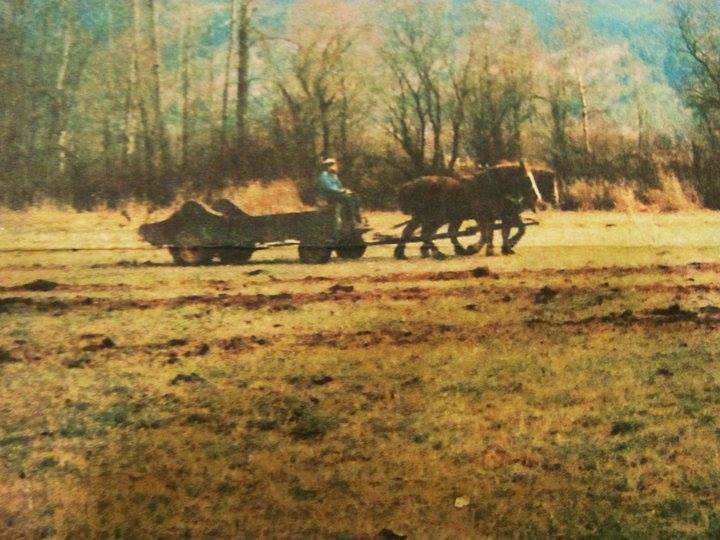
SHE: And raised us on a small farm. And we always had plenty of healthy food. And you had a working team of horses. You once told me that Mom was being Adele Davis and you were aping Wendell Berry.

Spreading manure in South Fork Valley, 1986

ME: Ah yes, the 70s and 80s! Hippies reconstructing themselves as “back to the landers.” But I always wanted to live on a farm, since I was a kid. Why does everything these days have to turn into a cliche? And I’ve always liked old technology.

SHE: Yeah, I know! Like steam engines.

ME: There were still working steam engines in my boyhood. They were awesome! Especially to a little kid. We’ve lost something along the way in our pursuit of efficiency and convenience. Kids today…they wouldn’t know a diesel horn from a steam locomotive whistle–not that it’s their fault.

SHE: Yes Dad. And the old engines burned coal. How would that stand up to climate change?

ME: It wouldn’t. It just goes to show how irrelevant one can be as a white man in his 70s. And a not fully-reconstructed hippie at that. And a socialist at heart. With a spotty work history. Spurned by the rednecks and the cultural elite alike.

SHE: “Fitting in nowhere.” I’ve heard that too. But at least you’re not boring!

ME: Boring can be a good trait.. both in presidents and fathers.

SHE: I’ve suggested before, you should write your autobiograpfy. You’ve told me you thought This House of Sky was Ivan Doig’s best work. And it was a memoir…not fiction.

ME: Ivan Doig came of age sheep ranching with his father in central Montana. I grew up as a hung-up Catholic boy in Rahway, New Jersey. In a mostly-stable home. True, my father lost his position of 30 years in 1955, and went into a deep depression. And I had an outsized fear of atom bombs. And went into my own depression in my early teens. I broke out in acne and feared I was botching my confessions. Which could lead one to Hell. And I was lousy at sports–chosen last for playground baseball teams, and all that.

SHE: Doesn’t sound all that boring!

ME: I always mentally lived in a different reality. Which is why I like writing fiction. Joel Emmanuel is about a boy growing up in the late 1970s, with an absent father and a hippie mother. And no actual religion. In a rural area north of Seattle. He was homeschooled, and was familiar with neighboring farmers, and Indians from the nearby reservation; and commercial fishermen. This was a world I experienced as a transplanted adult in my late 20’s. And I often wondered how it would’ve felt to’ve grown up in that world.

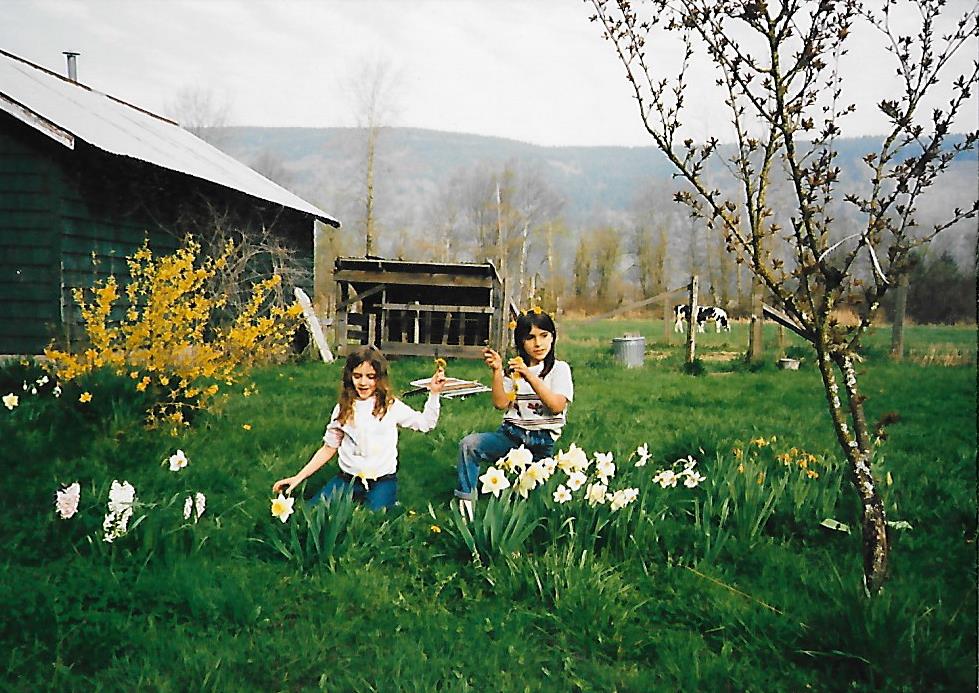
SHE: And by the late 70s, you and Mom had given up fishing, and were trying to settle down in Skagit County. And you had a regular job on the State Ferries. Then you lost Baby Joey. And quit the ferries. And Ellen and I came along and there we were on a little farm in the South Fork Valley. I sometimes wonder about…I mean, if Joey had lived? How different things would’ve been. Would Ellen and I even have been born? I think about things like that.

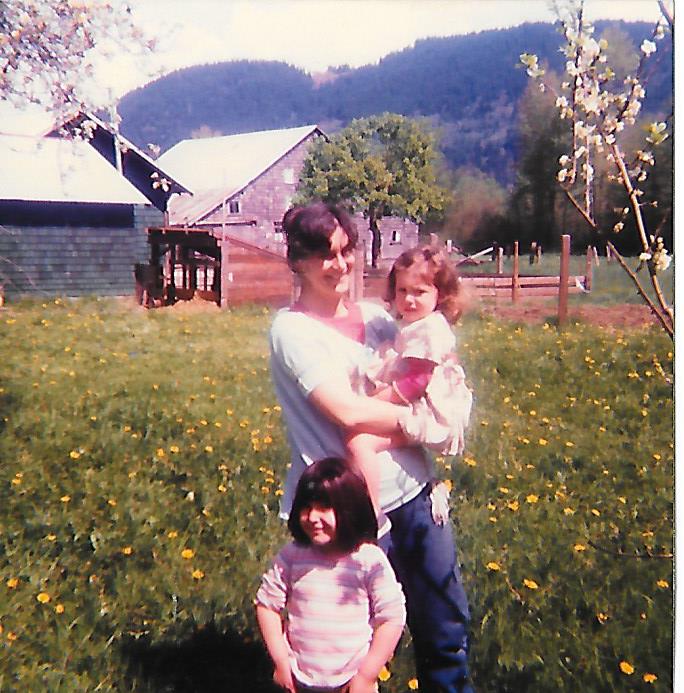
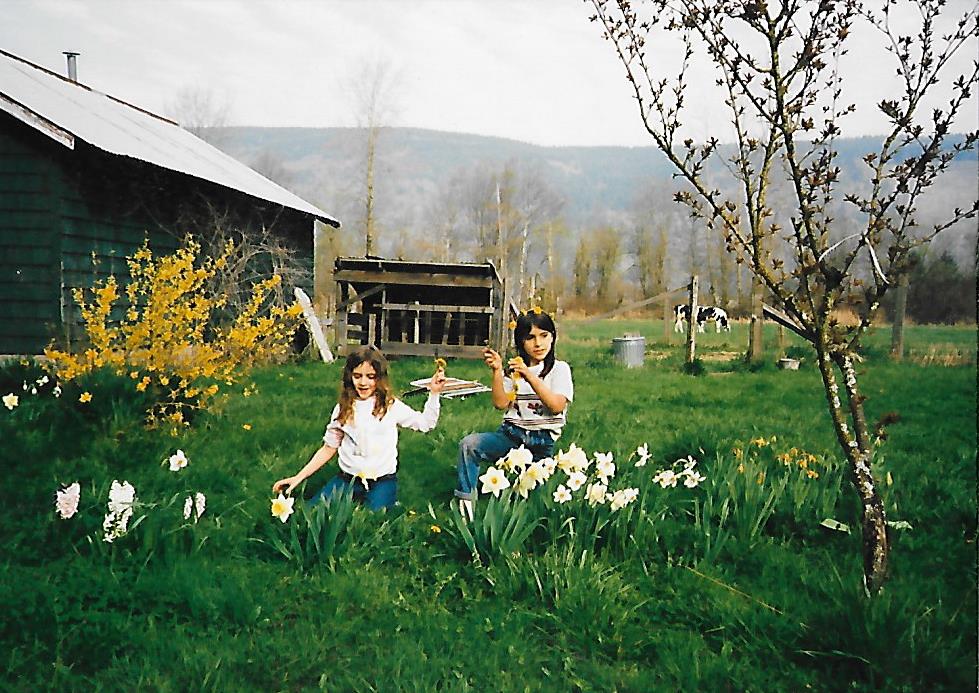
Amy and Ellen, springtime on the farm, 1987

ME: So do I. And it can take one down a mental rabbit hole.

SHE: Real life…like it can be, a chaotic mix…of the boring and the tragic. Both of which can sap the joy out of life…You know, I can see why you might write fiction. And, by the way, Dad. Happy Summer Solstice! And Juneteenth! Along with Father’s Day. And, by the way, I know you think a certain word these days is much over-used. That back in the 50s, it really meant something. But, I’ll say it anyway. I love you.

ME: Perhaps we should’ve used it more when I was growing up. And hugged more. But people mostly did the best they knew how. And, I think, still do. And…I love you too.

Posted in love, marriage, nostalgia, rural life, writing | Tagged , , , | 4 Comments

A Baby Boy and a Ferryboat

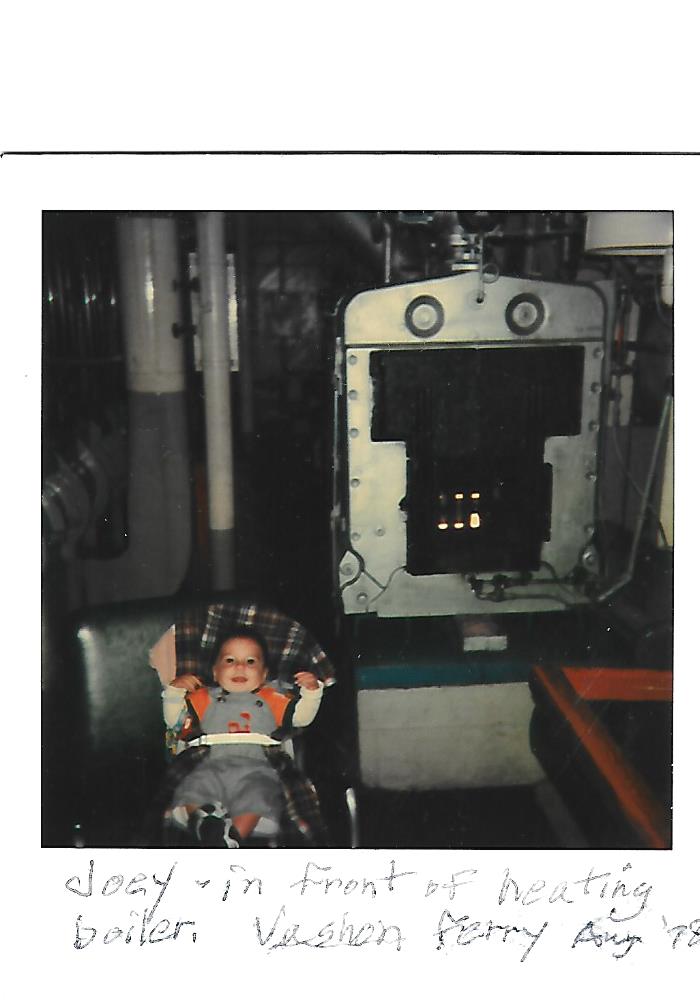
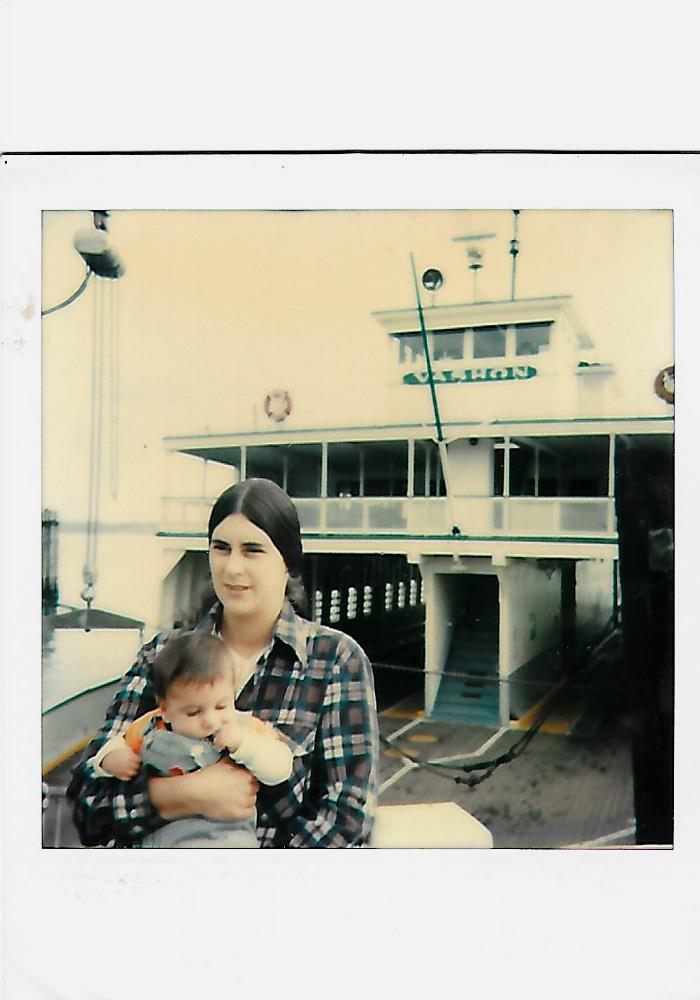
Joseph Patrick Kenna, age 4 1/2 months, strapped in car seat, looking very much at home in the engine room of the Washington State Ferry Vashon.

Our son, Joseph Patrick Kenna, would’ve been 43 years old tomorrow, April 3rd.

In summer of 1978, my wife, Victoria, and I bought a house in the Puget Sound waterfront town of Anacortes. We were 33 years old. I’d been working for a little over a year as an engine-room oiler for the Washington State Ferries, and was now happily assigned to a boat I loved, the 1930-built Motor Ferry Vashon. Though not the oldest boat in the ferry fleet, she was the last remaining wooden vessel, with the added distinction of being the least-modified .

Victoria contentedly divided her time as new mother and homemaker in our 1890’s-built “city farmhouse” (with a 1950’s front door), and teaching Spanish evenings at the Fishermen’s World Market. It had been three years since the loss of our first child; a full-term baby boy delivered stillborn, who looked like a sleeping angel.

We were now a complete family, with a live and lively baby boy, inhabiting a home of our own. The house sat in a residential block near the old Anacortes city center. The small front porch sat amidst summer-blooming rose bushes. The backyard was roomy enough for a generous garden and featured a grape arbor of dense vines drooping from an old swing set. Between it and the garden site were three green-gage plum trees.

The front looked out over the boat harbor and Samish Bay, and in the distance, the Shell and Texaco oil refineries–incongruous in the idyllic setting of treed islands and distant mountains–though for me, a native of northeastern New Jersey, the sometimes smoky industry had an air of familiarity. Victoria, a native of Seattle 80 miles to the south, was eager to pursue her dream of starting a food co-op in our newly-adopted smaller city.

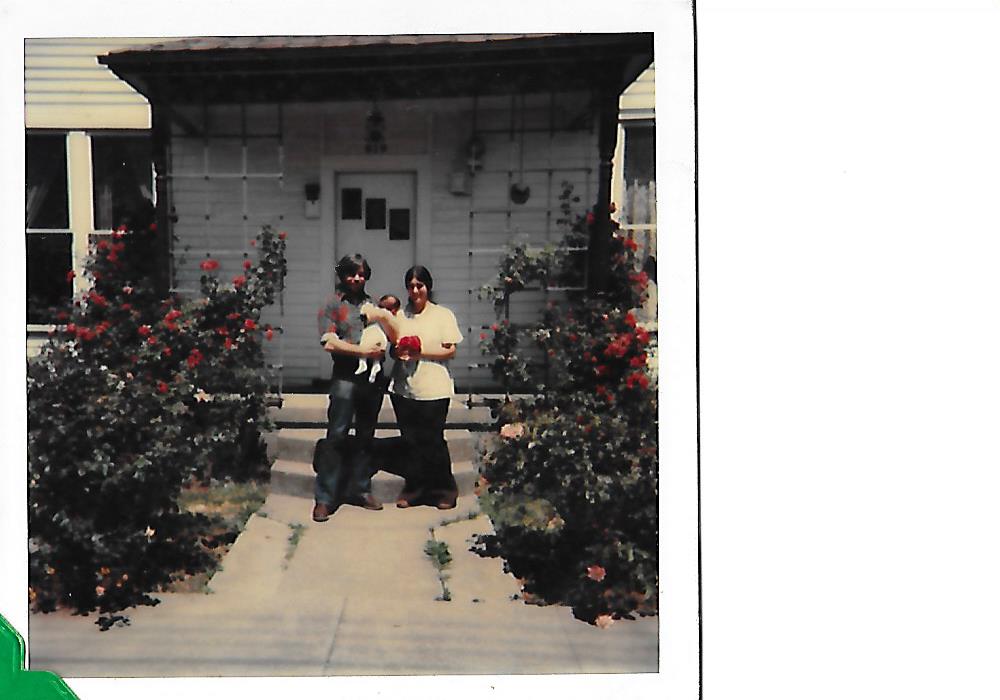
Roses and a 1950’s door. Paul, Joey in arms, and Victoria. Summer, 1978.

Contentment can carry mixed messages; such as fear that it might be an illusion. The tragedy of the stillbirth, three short years in the past, had thrown our lives, our marriage, into disarray. We pulled through, and now were reaping what seemed like manna from heaven. We want more from shared lives than to star in its tragedies. To be the father of a living boy was a new experience. Alert, handsome and in fine health, one could only look into his future with optimism. He might follow his father into marine engineering. Or his grandfather Leonard into a railroad career. Or grandfather Joseph into accounting and later banking. Or into teaching or law or politics. Or into occupations at the time unforeseen and unknown. In any direction, I could see only success.

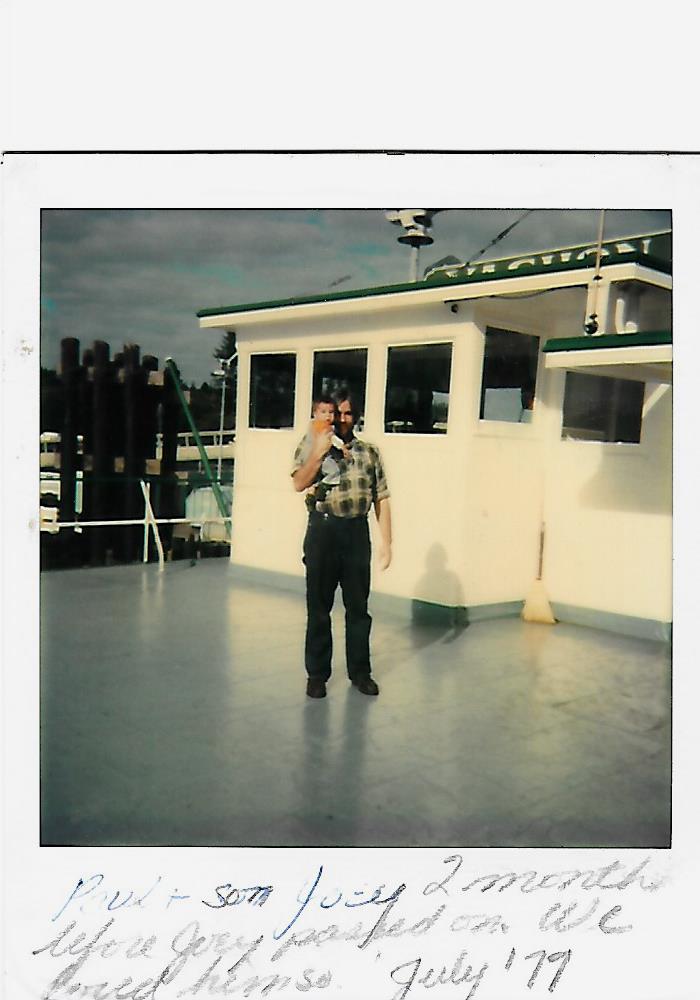
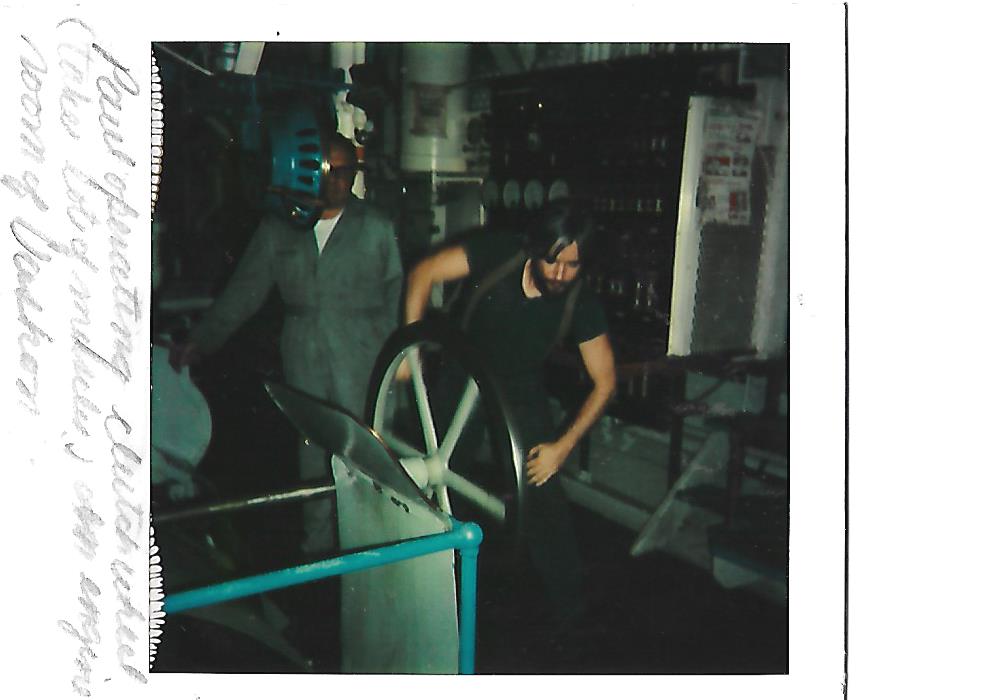
Paul and Joey, next to one of the two Vashon wheelhouses. Being engine-room oiler on the old boat with its 1930’s technology could be an oily, greasy and sweaty job. Also physically demanding, with its large hand-operated clutches. October, 1978 (Date on handwritten caption is incorrect).

Entering middle age had been a double-edged sword. Now I felt not only justified, but in a sense larger. I was ready to strut a bit. I had a union job that, though far from perfect, paid what’s now called a “living wage.” My family would be protected by a good healthcare plan. In less than two years I could take the exam for First Assistant Engineer. In three years I might qualify as a Chief Engineer. But such a position could necessitate leaving the boat I’d loved at first sight. The Vashon was a working boat that also could qualify as a “museum piece.” Long before it became a fashionable term, she’d been “locally sourced.” Built on Lake Washington in 1930, her hull and superstructure were of stout Douglas fir. Her main and auxiliary engines and all electrical equipment were original, from Seattle’s Washington Iron Works. The riverboat-sized steering wheels (one on each end), with manila rope and steel cable mechanism, were–like everything on the boat–“low tech”, long-lasting and dependable. With the possible exception of the radar sets, one in each wheel house–along with radios and depth sounders–the vessel was devoid of “modern” appurtenances. And none graced the engine room.

The Vashon ran out of the San Juan Island ferry terminal west of Anacortes, serving as a summer-only boat connecting the islands Lopez, Shaw, Orcas and San Juan. On her “deadheading” runs between the Anacortes terminal and first stop at Lopez Island, she carried no passengers or cars. Fares came from local islanders, riding from one island to another in the San Juan chain. During County Fair season in August, the bleating of sheep or goats or mooing of cows could be heard above on the main deck, coming from trailers or small livestock trucks, bound for the fair at Friday Harbor, on the “main” island.

Connecting the islands to the mainland were the jobs of more modern (and at times less dependable) boats of the extensive ferry system.

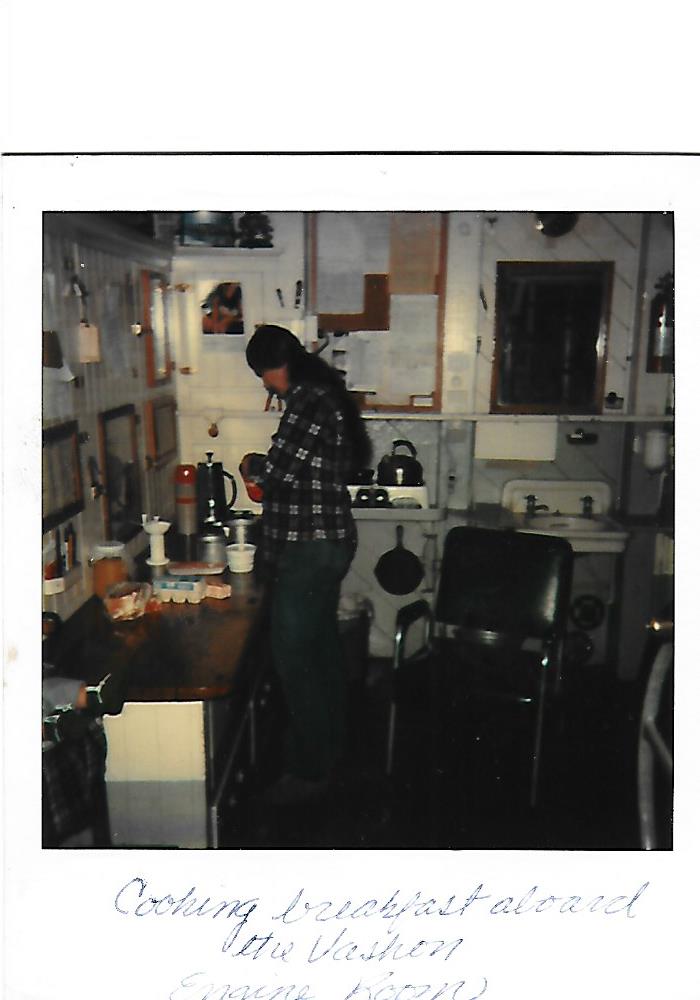
Victoria fixing a breakfast for Paul and baby Joey (white food grinder on counter) during tie-up watch in the engine-room “galley.”

Four of us covered the watches during our 72-hour workweeks, crammed into six days–two oilers and two chief engineers, alternating watches. Another crew of four took over during our alternating week off. The intensity of the week-on duty was eased during tie-up watches at Anacortes by our living only a few miles away. During these watches, Victoria and Joey were regular visitors to the boat, arriving often with a home-cooked dinner or breakfast, reheated in the corner engine-room galley, equipped with a hotplate and iron frying pan and other basic cookware.

Mother and baby. Vashon tied up.

Though largely confined to the boat during the 72-hour week on, the oiler on duty was not without exercise. The “heavy duty” 900 horsepower Washington diesel, which sounded over the water a chortling rhythm easily distinguished from the surly growl of its more modern cousins, required frequent hand-oiling of its exposed moving parts. Direction, signaled from the wheelhouse through the engine-order telegraph, required the engagement or disengagement of a clutch at each end of the engine, connected with its respective propeller. Operation of the clutches came from a large handwheel, spun by the oiler. There was no need for gym attendance during the week off. Until one grew used to the to the physical demands of the old Vashon, the week-off duty might be partly spent resting sore muscles, before digging in the backyard garden.

Paul spinning the wheel that controlled forward-reverse-stop. Chief Engineer Doc Clark is behind Paul, working the throttle and responding to the engine-order telegraph.

In October, 1978, the seasonal “inter-island” run ended and the Vashon was sent down to Clinton, on the south end of Whidbey Island, where she would serve as an extra boat on the run between Mukilteo and Clinton. This meant a 5-day a week hour-long commute for any crew living in Anacortes, a disruption in the 1978 summer idyll I was prepared for. The hardest part was spending nights away from our new home and baby boy. We were getting to know Joey–beginning to crawl, his happy gurgling and chirping became joyful domestic background sounds. Then there was his dazzling smile, engaging his whole growing body. We had reached the point where it seemed inconceivable that he hadn’t always been with us.

Come November in Puget Sound country, the chilly, wet and gloomy season is upon us. Still in a state of happy wonder, we could easily chase the gloom, with plenty of firewood for the kitchen cookstove and the living-room heater, looking forward to the first major holidays in our newly acquired home. I’d enclosed the backyard in a cedar and wire fence and planted front yard trees. When newly-planted flower bulbs emerged in April and May, when the trees and lilacs bloomed, Joey might be walking, and stringing sounds together, heralding the onset of acquired language–a mystery I still contemplate.

On late Saturday afternoon of November 18th, we sat in the kitchen by the warmth of the cookstove for a pork-roast dinner, Joey between us in his highchair. A northeast wind was picking up, blowing in through the less than perfect seal of the back kitchen door. Before reluctantly leaving for work, I banked the living-room fire, then drove south to Mukilteo, where I’d deadhead on the ferry Elwha for a ride over to Clinton. The tie-up watch on the Vashon was uneventful. Morning dawned chilly.

On returning to our Anacortes home, looking forward to waking my family for Sunday breakfast, I rebuilt the fire in the living-room stove, then went upstairs to Joey’s room. Looking down into his crib, I peeled off the blankets. He appeared motionless, his face strangely white. I picked him up, observing he wasn’t breathing.

With a desperate hope that this was only a horrible dream, I began resuscitation on him as I’d learned in first-aid classes. Meanwhile, Victoria had awakened and was calling 911.

As we rushed out the front door to the waiting ambulance, the crew already working on our baby with a resuscitating device, I robotically closed the vents on the heating stove, now warm with the heated iron ticking. The ride in the ambulance was a blur. After an hour of numbed waiting, the doctor on duty at Island Hospital told us; “he didn’t make it.” A young redheaded nurse, her eyes reddened with tears, did her best to lend comfort.

An autopsy confirmed the doctor’s immediate conclusion that Joseph Patrick had died of Sudden Infant Death Syndrome. We’d heard of SIDS, but had chosen not to give it a lot of thought. We later learned it usually occurred at a few months of age, but can happen up until a year old. That it happens more to boys than girls. That a cold may be present, though the victim may be free of any signs of illness–in fact, was often in the best of health.

We had him buried in a tiny white coffin. Though both of us were very-much lapsed Catholics, we had a priest attend. As the months wore on, we learned that doctors now recommended babies sleep on their backs. We always put Joey down on his stomach, which we thought was the preferred way. Though the expert views were that the mysterious syndrome can in no way be consciously prevented, I couldn’t help but mull over “what ifs.” If we had laid him down to sleep on his back, instead of his stomach. If I hadn’t had to go to work that night, or had gotten home earlier. If we’d had central heating and the house better insulated (over the summer of 1979, with another baby due the coming October, I’d added insulation to the attic, backup electric heaters and new storm windows). But we read that the dreaded syndrome could just as likely happen in a well-equipped modern house.

South Fork Valley. Springtime,1984

It’s a blessing we, more often than not, don’t know what the future has in store for us. If we did, life might be unbearable. Yet human resilience must never be underestimated. Within three years, we were the parents of two beautiful, healthy girls. I’d left the job on the ferries. We’d sold the house in Anacortes. We would carve out a new life on a small farmstead in the South Fork Valley, near the inland town of Acme, some 30 miles away. Life goes on. Helped along by the fact that we don’t fully know what the future will bring.

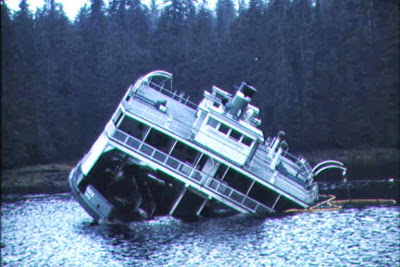
Wreck of the Vashon. Prince of Wales Island, Southeast Alaska. 1984

Posted in labor, maritime history, nostalgia, Sudden Infant Death Syndrome, Washington State Ferries | Tagged , , , , | 2 Comments

The Humble Spike Maul

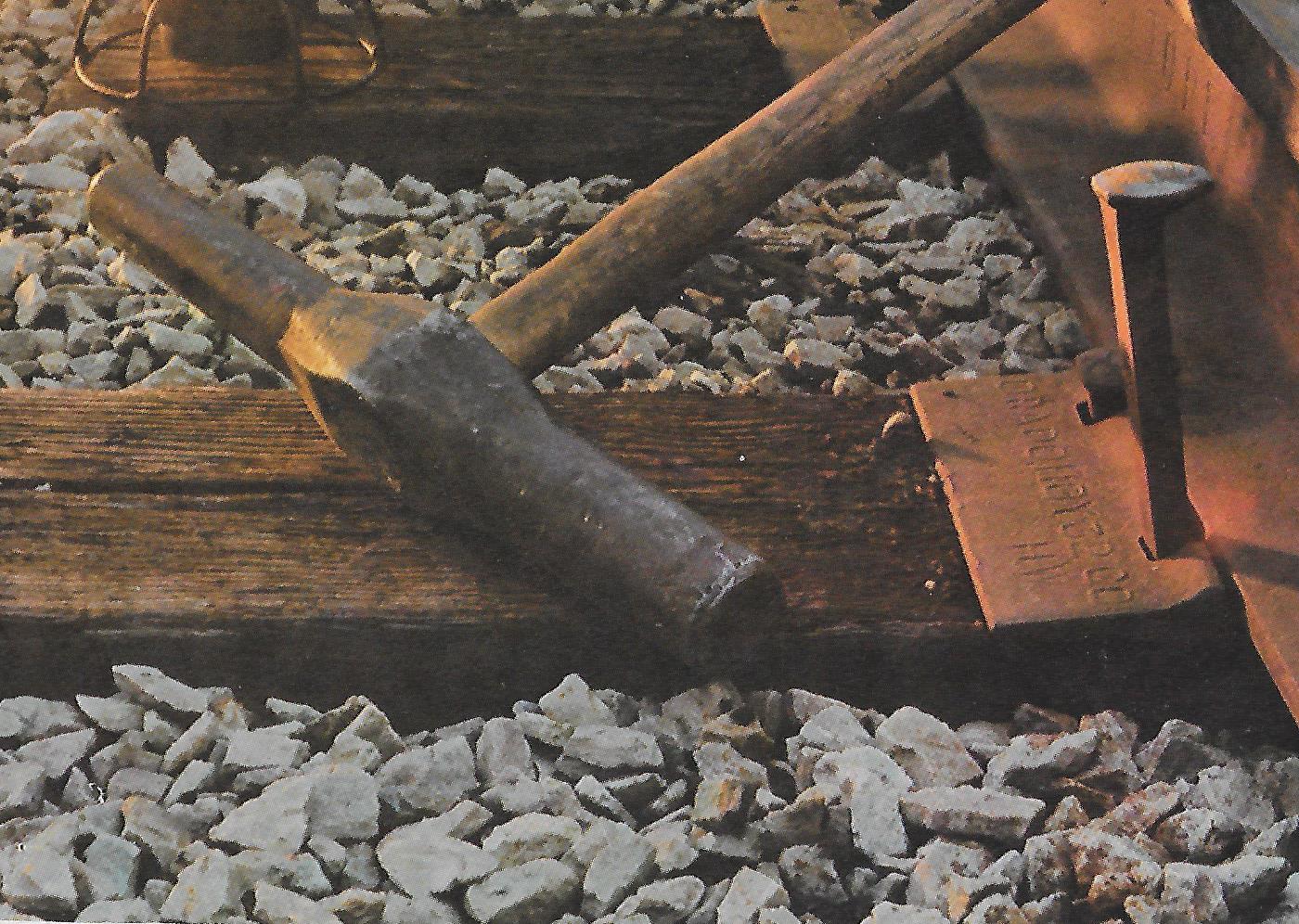
The "T" rail, the offset head cut spike, and the wood tie go back a long way. As does the spike maul.

The “T” rail, the offset-head cut spike, and the wood tie go back a long way. As does the spike maul.

As a day to celebrate, Saint Patrick’s Day is filled with images that are simultaneously hackneyed and cherished. The leprechaun, the green top hat, the harp–and then there’s the shamrock.  Here on the west side of the Atlantic, most of us are more familiar with this little leaf through images than we are seeing or touching the real plant.

It wasn’t until the recent turn of the century (that to me seems very recent) that we had a potted shamrock in our house. For years it never flowered. Now the little white flowers last nearly year round.  It has suffered through sporadic watering and being set out in the cold and being starved for sun. Always, with a little attention, it has come back, usually more green and luxuriant than ever. As a symbol of the resurgence of the Irish people from centuries of foreign domination, it holds meaning beyond its humble beauty.

I felt compelled to use it when starting a self-publishing entity a number of years back, as a focus for writing and hopefully selling a historical novel series centering around a fictitious Irish-American family. Two of the books have since been completed, under the umbrella of Shamrock and Spike Maul Publishing Company, and are now ready for revision. And SSMPC was given a hiatus and recently revived as Shamrock and Spike Maul Books. But that’s another story.

The shamrock, of course, was a natural as a symbol for this fledgling effort at spare-room publishing. And considering how railroad building and the Irish-American experience were so intertwined in the second half of the 19th Century, the spike maul also popped into my brain as a ‘no-brainer’–to use an over-used term. A potato would likewise have had fitting symbolism. But an image of the lowly plant might not have made a powerful logo. And–Potato Publishing Company? Maybe for a subsequent effort.

So Shamrock & Spike Maul it became. Less familiar in the common imagination than the shamrock is the spike maul. You won’t find it in your local hardware store, either the disappearing Main Street variety, with its dusty hardwood floors and a cat lounging on the counter next to the cash register. Nor the soulless big-box version lurking out in the land of sprawling parking lots that not too long ago were farm fields. Sledge hammers are still available in the shrinking hand-tool sections of either variety of store, but they are not to be confused with the spike maul. Railroad trackmen–long known as ‘gandy-dancers’–use sledge hammers. But never to drive spikes. The spike maul is a one-purpose tool and found only in railroad section houses, available only from specialized suppliers.

In my years as a gandy-dancer I’ve hand-driven a fair number of spikes. I’ve also changed out many handles, the most vulnerable part of the tool. In the 21st century, we were still driving spikes by hand. Not all the time, of course. There are both handheld machines for this purpose, using compressed air or hydraulics. And for real production, there are self-propelled track-mounted machines. But track maintenance still involves (though increasingly less so) a lot of spot work, where the machines aren’t always available. So, most of the tools that a 19th century ‘gandy’ would have recognized are still to be found in railroad section houses and the beds of maintenance-of-way trucks. (By the 1970s, the ‘hi-rail’ truck, capable of operating on road or rail, was replacing the ‘speeder’ car–which in turn had replaced the arm-powered hand-car of days of yore.)

There is a natural rhythm in using a spike maul–as with any classical hand tool. Sure it’s hard work, but the user learns to pace himself. And to put the least effort into the swing to get the most out of it. As in athletics, grace is born of such motions. The mechanized tools can do far more work in a given time, but also can be more punishing to the human frame. The machine sets the pace and can induce straining jerks and twists, not to mention vibration and noise. And leaky hoses and exhaust smells. And they discourage conversation among their users.

The beginner at spiking will–besides missing the spike head–break handles, ding the rail, and cause a set spike to go flying. By contrast, two experienced workers doing tandem spiking–taking turns at driving a single spiking–are a joy to watch. Also exhilarating to do, it requires mutual trust.

 The effort in driving spikes can vary greatly. New oak ties, freshly treated with slippery rank-smelling creosote, are the most grueling to spike up. Older fir ties by comparison are a breeze.

Shamrocks should likely be around long after any remaining spike mauls have been relegated to the museum. But I’m guessing there will still be people who are now young who, years from now, will be working in relative obscurity to keep the trains on the track–where they belong. They may or may not at times be using spike mauls. But during or after work, they may be reminiscing about the big trends and fads of their youth. Such as I-pads and texting and people traipsing around with their noses pointed toward silly little screens. And the obsession with all things ‘digital’. And during the time period when the term ‘technology’ became distorted to mean only the latest in consumer electronic gadgets.

To anyone who reads this–Happy Saint Paddy’s Day, 2021 (And please, never spell it Saint Patty)!

Posted in history, Ireland, labor, nostalgia, railroad construction, railroading, social criticism, writing | Tagged , , | 6 Comments

Make a Living at Writing?

There’s money to be made in writing fiction. But not necessarily by those doing the actual writing. As the number of books being churned out in this age of self-publishing has increased astronomically, the odds of making a living wage as a writer have contracted, along with the likelihood of being published in the traditional manner–unless you’re a celebrity; or already a best-selling author.

I’m neither. I’m also retired and on fixed income, allowing for a modicum of spare time but little disposable income. In years leading up to retirement I began seriously writing–at times, compulsively. As a lover of American history and fiction, it was a natural to combine the two. Though no fan of digital technology, I couldn’t deny that the advent of the word processor and cheap laptop computer have been a boon to writing. But then there are the unintended consequence. Not the least of which is, too many people are writing and not enough are reading.

Blissfully unaware that I was merely adding a to a growing surplus of what was now becoming a commodity called “content,” I held onto the hope of some discerning eye in the publishing industry running across my work, seeing something of promise in it, and offering to publish it as a finished book. Isn’t this the dream of everyone who picks up pad and pen, then typewriter or laptop, thinking they have a story–or stories–to tell?

Until the rise of the 21st Century, standard procedure was you submit your work to an agent, who then markets it to a publishing house, which then–it they like it–will agree to edit the work and print it and market it. The beauty of this system is the agent and the publisher, rather than charge the writer upfront for these services, will take a vested interest in the success of the work. The book sells, the publisher profits. While not perfect, this system mostly worked for the benefit of those involved, including the general public as readers. As for the writers, they didn’t need to spend hundreds, or likely thousands, of dollars they didn’t have on support services, in order to see their book in print.

Those of us who put off serious writing until the new millennium failed to take into account that the publishing industry had been evolving into a conglomerate of fewer and fewer companies, now down to four. While publishing had always existed to make a profit, the increasing “corporatization” prioritizes profits for stockholders over all other values, including the enlightened practice of taking a chance on unknown writers, who just might turn out a best-seller or two in the future. In keeping with the corporate ethos rising since the 1980s, publishing books that might just be moderately profitable as opposed to “mega-sellers” has been another casualty of this shift in priorities.

So is the transformation of “big publishing” really a loss? There are many who see the rise of self-publishing, aided by such developments as print-on-demand, along with marketing opportunities on social media, as a path of true progress, away from the “legacy” publishing establishment that’s grown hidebound, resistant to new technology; while retaining the lion’s share of royalties. All of which are largely true. Advocates point to the rise of services that have emerged with the growth in self-publishing. And there are self-published authors getting noticed. And even making money.

What doesn’t seem to get as much mention is the number of self-published writers who don’t get noticed, who don’t sell enough books to even begin to cover the costs of getting them into print. Often overlooked is that the vast majority of successful self-published writers can trace their initial recognition to having been traditionally published.

As the carrot of reward enticingly dangles on the end of the stick ahead of the self-published writer, for many, likely most, the stick can grow longer. Since the transformation of publishing, the average monetary return to authors has been shrinking. Those making money are more likely the providers of services, such as content editing, proof reading, layout, cover design and last–but not least–marketing. These services don’t come cheap. Nor should they. Certainly the providers of quality services, from layout and editing to marketing, deserve fair compensation. But when added up, they can put the carrot out of reach for those who struggle to afford it. And these are the very services once provided by publishing companies, giving the publisher a financial stake in the success of the book. This essential partnership is lost when–as has become the norm–the writer at his or her own cost must hire out the services, whereupon the provider gets paid whether or not the book succeeds or flops.

As I write this, I’m launching a novel, Joel Emmanuel, which has won two awards from Chanticleer Reviews (CIBA). I looked into a very reputable hybrid publisher but rejected their offer, because for me the upfront cost was unaffordable–shades of the vanity presses! Also, I was put off when told that, unless I paid extra for editing and/or proof-reading services, no one of the staff would even read the book. The fact that the author keeps 100 percent of any royalties generated is meant to be a selling point. But to me it meant that the publisher has little vested interest in the success of the work.

My book is now available on Amazon, as a paperback; and soon as an e-book. I was drawn to publishing through its KDP program because there is no upfront fee. KDP also can guide the writer through layout and cover design, along with printing (for a very reasonable cost per book) and distribution. KDP keeps a percentage (less than half) of any royalties. Ironically, in this way Amazon acts more like a traditional publisher, with a stake in the success of the book.

The odds for an unknown writer these days to get traditionally published are comparable to that of winning a mega-lottery. The initial gatekeeper, the literary agent, may well be an underpaid, overstressed intern, whose job is to shield from the more senior agent the overwhelming number of manuscripts submitted each day. The intern or junior agent knows the agency is not looking for new talent, or possibilities, but rather panning for that rare gold nugget, the next best-seller! In the process, how many works brimming with possibilities–submitted by yet-to-be-discovered authors–end up in the shredder?

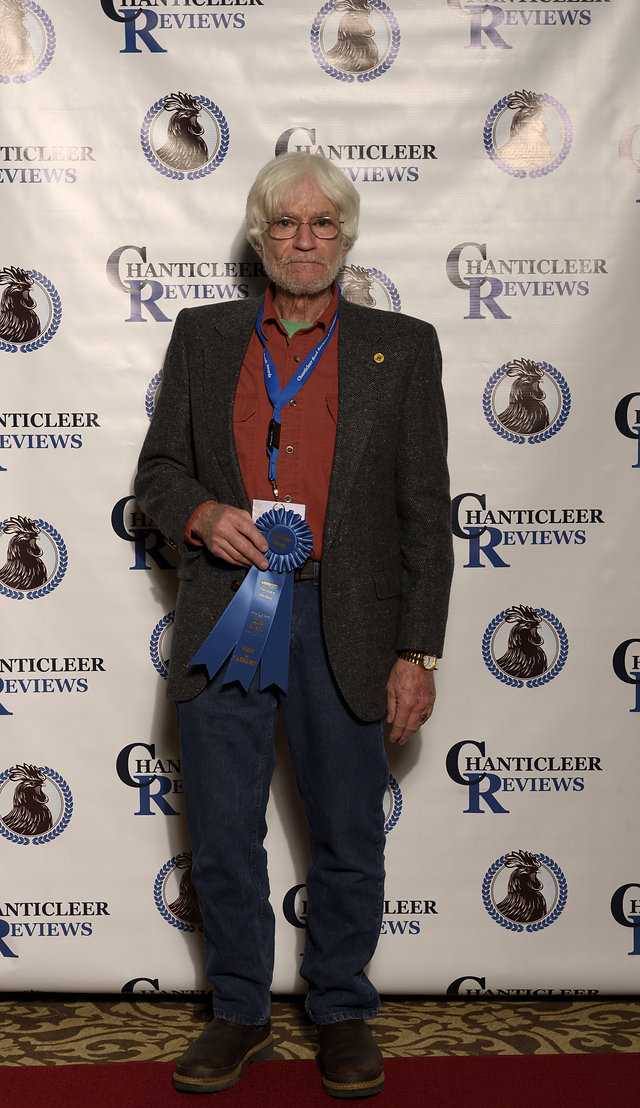
J.P. Kenna receives blue ribbon for Joel Emmanuel.
Not all rewards are monetary.

If a senior literary agent gets to read more than an opening paragraph and sees that shining nugget, and chooses to submit the work to publishers, there’s still the possibility no publishing house will accept it. If in fact the writer himself has struck gold and a reputable house accepts the work for publication, in this day of corporate cost-cutting, it’s increasingly likely that most marketing efforts will be dumped into the lap of the author. And while there are exceptions, writers are notorious for being introverts, lacking the drive for self-promotion (an activity which also takes time and energy away from actual writing). And as for providing editing services, the publisher will expect the work to be mostly edited already. And the days of the likes of Maxwell Perkins are long gone. Likely the editor will be a freelancer working on contract, and may well change during the process. The legendary though stormy partnership formed between Scribner’s editor Max Perkins and the eccentric novelist Thomas Wolfe is a relic of history.

I never thought I’d be a shill for Amazon, but unless you’ve already been on Oprah or in some way have achieved celebrity status, KDP seems to be the only game in town. I’d be happy to be proven wrong.

Posted in Amazon KDP, Christmas, farming, nostalgia, self-publishing, social criticism, Tom Robbins, Kurt Vonnegut Jr., La Conner. Skagit Delta, Swinomish Slough, Rainbow Bridge, bookstores,, Washington State Ferries, writing | Tagged , , , , , , , | 6 Comments

A Valley’s Loss of Innocence

When my wife and two young daughters and I moved into valley of the South Fork of the Nooksack River in the early 80s, we thought we’d bought into a little slice of heaven. This was rural Western Washington state at its best. Threaded, along with the river, by a two-lane highway and a not-too-busy rail line, the rich bottomland was perfect for dairy pastures and forage crops. The mountain ridges (hills by Western standards) lining each side sprouted enough Douglas fir forests for sustained logging, but mostly remained green, though in fall were speckled with the yellow-gold of bigleaf maple. The snow-covered peaks of the Twin Sisters peered over from the east, while to the north, glimpses of Mount Baker loomed beyond Sumas Mountain, the latter protecting the valley in winter from the chilled winds and snows blowing down from Canada’s Fraser River Valley. Summers were often a week’s long idyll of sun and temperatures lingering in the 70s.
Across the highway from our 18-acre farmstead was a 100-cow dairy, where I found seasonal work bucking hay bales and raking fermented chopped corn or grass in one of the farm’s five silos. Polish and German immigrants began farming the area in the early 20th century, forming a strong Catholic community. Loggers and saw-millers came in the 1890s, following construction of the rail line from Seattle to Canada. The post-1960s era saw an unthreatening influx of diverse types–commercial fisherman wintering in, “back to the land” idealists, along with workers and professionals and university students who commuted to nearby Bellingham. Whether out in the open bottomland or tucked back a ways into the woods, there was room for all without crowding. There were few trailers and no McMansions. Early-to mid-20th century homes predominated. On the highway, between the towns of Deming and Acme, were three general stores, the wood floors pocked by decades of logger boots. Out front stood the obligatory gas pumps. As a neighbor who worked mostly in logging put it, “this place is like Alaska. Filled with people who don’t fit in anywhere else. In our own way, we mostly get along.”
I don’t recall once ever locking the doors on our 1920-built home. We could get fresh milk from the bulk tank of the dairy across the road. One of the boys would, without being asked,  run a tractor over following a rare snowfall and plow our driveway. They sold us bull-calves on the cheap for raising beef. When I began putting up my own hay, they would help me bale it. As if, with the two youngest sons and their 70-year-old uncle managing a 100-acre farm, they didn’t already have enough to do. A 90-year-old neighbor, who was born in the area, had a contract with the Burlington Northern Railroad to take down threatening trees along its right-of-way. His equipment consisted of a chainsaw, a choker cable and a 2-cylinder John Deere Model-M tractor. He had a few gruff words to say about some of his “hippie” neighbors, though my family and I could’ve easily passed for such. He would smoke for us some of the sockeye salmon I brought home from my summer fish-tendering. Without taking any kind of payment, he took down a few towering cottonwoods along the stretch of our property that bordered the railroad.

Just recently, this slice of heaven became the subject of two nationally-syndicated crime shows. The TV screen didn’t do the place justice, but the point came across quite clearly–that something changed in this valley on the day following Thanksgiving, 30 years ago.

The Stavik family and the Bass family both lived about a mile away from us, on the Strand Road, at the foot of the mountain that walled the valley on the east. I delivered mail to both, when I had a rural delivery contract. The Staviks had a daughter, Mandy. The Bass’s, a son, Tim. Both attended Mt. Baker Highschool. Mandy’s mother drove the school bus that our daughters rode to Acme Elementary.

In 1989, Mandy was in her freshman year at Central Washington University, home for Thanksgiving. At Mt. Baker High, she was known for her beauty, her friendliness, and athletic and academic prowess. The day after Thanksgiving, she went jogging along the Strand Road with her pet German Sheppard. The dog returned later without Mandy. Frantic searches, including a Whatcom County Sheriff’s posse, went on until the following Sunday, until her body was found submerged in the South Fork of the Nooksack River. We heard references to kidnapping, rape and murder. One neighbor, a commercial fisherman, said he refused to live in fear and suspicion. I tried to do the same. We continued to not lock our doors. But as was pointed out in the TV documentaries , this wasn’t always easy. A pall hung over the woods and fields and sparkling-clean river, that there was “a monster in our midst.” This was before the days of mass shootings, of I-phone sensual bombardment, of internet hysteria. People still believed it possible to live in a safe place of unlocked doors, of trusted, helpful neighbors, who mostly minded their own business. But for those living in this little-known rural refuge nestled between the twin metropolises of Seattle and Vancouver, B.C., 30 years ago such innocence began to unravel.

The cold case hung over the area, including all of Whatcom County and the city of Bellingham, for 29 years. About ten years ago, men who’d lived in the area at the time–myself included–voluntarily submitted DNA samples to sheriff’s department detectives.  One former resident refused–Mandy’s close neighbor, Tim Bass. This year, he stood trial in Bellingham and was convicted of murder, and sentenced to 27 years.

Rural Whatcom County has changed. There are fewer well-kept farms, more shabby trailers and pretentious McMansions. Urban and suburban escapees to the “boondocks” don’t interact with the older established residents, the way the “hippies” and the farmers once often did. Remaining farms have gotten bigger and look more like industrial operations. Loggers have gone into other work, or given up. Liberals–now called Progressives–are more tribal than ever. So are the Rednecks. Many farmers used to have Democratic campaign signs in their yards. Now they’re as rare out in “the County” as are pro-Trump signs in Bellingham.

It goes without saying these changes are national in scope, having nothing to do with the murder of a smart, likeable teenage girl 30 years ago. But there was an innocence back then, that one could find a place where undesirable changes weren’t inevitable. And for a time, many of us thought we’d found it.


Posted in farming, history, nostalgia, rural life, social criticism | Tagged , , , , , , , , | 1 Comment

Nothing Sacred?


It’s summer, down the shore, in 1948, which would make me three years old. If there’s an east wind, aka sea breeze, you can hear the ocean murmuring half a block away, through the back screen door. It’s morning, so the Jersey Shore sun streams through the kitchen window. Great Aunt Ellie–who died a year later–sets before me a bowl of Wheatena, sweetened with Domino dark brown sugar and lightened with top milk, from bottles delivered earlier to the front porch by the Borden’s milk truck. The scent of roasted granulated wheat, released by boiling, wafts from the bowl. As the yellow box with the blue diagonal stripe proclaims (though I was still too young to read it), Wheatena- “Tastes Good”.
For a time period, a place, a setting, a food, to be elevated to the pantheon of sacred memories, details are needed. The cooked breakfast cereal Wheatena is in that revered status. Largely because it tastes the same after these many decades.
At the time, Wheatena was made not far away, in my home town of Rahway. The white masonry factory, known as Wheatenaville, sat across the Pennsylvania Railroad tracks from the sprawling Merck’s complex. Wheatenaville was the centerpiece of a green oasis–a parklike setting of mature trees, happily incongruous in the dominant industrial barrens of the area. Depending on wind direction, one could smell the secret process of roasting wheat when walking home from school, or just traipsing or bicycling about town.

Next to the 1907-built multi-story factory, which resembled a mansion, the elevated water tower stood, capped with a square tank–a giant reproduction of the Wheatena box, visible over the trees and telephone poles lining Grand Street–a beacon, revealing the source of that most pleasant industrial aroma.

For 60 years, the breakfast cereal–which originated on Mulberry Street in New York, in 1879–was a favorite, and best smelling, of the many products made in Rahway, New Jersey. These included Quinn and Boden books , Merck drugs and pills , Purolator oil filters, Regina floor polishers (once the maker of music boxes), Dr. Lyons Tooth Powder, Monte Christo hats, and Tingley rubber wear.
In 1967, up in Maine, I noticed the yellow box no longer honored, on its back, the name of my hometown. Instead it granted the honor to Kansas City, headquarters for some unknown (to me) outfit called Sterling Mills. Back home, Wheatenaville had become a warehouse for Quinn and Boden Books, the yellow-box water tower painted over in white, with the Q and B logo.
I since learned that Wheatena was being made in Highspire, Pennsylvania. Corporate ownership has gone through a dizzying array of changes, exacerbated by acquisitions and mergers. Most recent owner of the brand appears to be Homestat, of Dublin, Ohio–neither my home state nor home town. The box has mutated from yellow to orange,  the blue stripe into an arch, still–like its contents–tasteful. Yes, through it all, it tasted the same, whether during leisurely summers at the Shore, or on chilled winter mornings in Rahway before walking the mile to Lincoln School.
And even out here in Washington state, it could be always found on a supermarket shelf, in the area of Quaker Oats and Cream of Wheat. But then, around the year 2010, it vanished. But thankfully, the Wheatena desert was lifted when I learned you could order the product on Amazon, on your very own laptop. And have it delivered to your doorstep, as was once done with milk. And Dugan’s Bread. And fresh eggs. And produce from the Rahway Public Market on Cherry Street.–all vanished services, that didn’t require a laptop of a smart phone. I’d just as soon have those services back, and be able to buy one box of Wheatena at a time from the neighborhood super market.
Yes, but times change. But not the taste of Wheatena! That is, until last week when I opened my 4-box one-year-supply. As always, I brought one half-cup of the cereal stirred into a saucepan filled with one cup of salted water, bringing it to a slow boil for five or six minutes. But something wasn’t right. It came out too stiff. And there was something about the taste. Like they’d added some unknown grain. It wasn’t unpleasant, just different. And not really an improvement. I didn’t get sick, so rat poison might be ruled out, added by some careless worker or machine in the mixing area, or surreptitiously by some twisted individual.
Or maybe it had just sat too long in some automated Amazon warehouse.
This morning I boiled up another batch. It was better, but something still wasn’t right. Perhaps next week it’ll be better yet, and become the new normal. As Amazon has become. And smart phones. And soon, robot driven cars and trucks…and maybe airplanes? Now there could be a new challenge for Boeing, but it seems they’ve got enough self-inflicted troubles on their hands.
Personally, I think the world could be a more congenial place if we retained more of the “old normal.” But to question the present-day holy trinity of digitalization, convenience, and innovation could brand one at best a hopeless old fogey. Or at worse, a heretic. Are there any other such heretics out there?

Posted in history, nostalgia, social criticism, writing | Tagged , , , , , , , , , , | Leave a comment

Wallace Stegner and Joe Hill–Was He Guilty?

On November 19th, 104 years ago, Joe Hill was executed by the State of Utah.

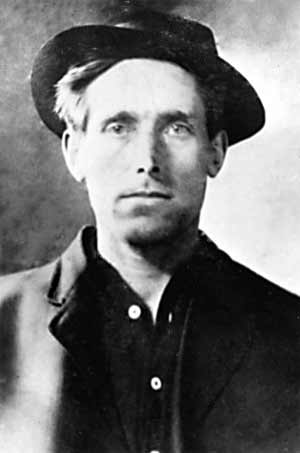
The young itinerant laborer was born Joel Emmanuel Hagglund in 1879. After emigrating from Sweden to the United States he took the name Joseph Hillstrom, then let it be shortened to Joe Hill. Working as a machinist and at various laboring jobs, he drifted his way West, where he joined the Industrial Workers of the World (I.W.W.).

While working on the West Coast, Joe Hill took popular songs of the day and inserted his own lyrics–satirical, irreverent, often humorous–commenting on the plight of the working class in America. The I.W.W. proved to be a perfect fit for Hill. A loose organization of young, rowdy itinerant workers in the woods and in the mines and on farms, factories, and wherever else cheap labor was sought, the “Wobblies” used songs and street corner oration to denounce the economic and political system they saw as being skewed against them. In “free speech” demonstrations, in cities such as Spokane and Portland, they let themselves be hauled off to jail in droves, driving their captors to distraction with their songs and antics.

In 1910, Joe Hill wrote “The Preacher and the Slave,” borrowing the melody from the hymn “In the Sweet By and By.” Also called “You Will Eat By and By,” it was sung on the corners of Burnside Street in Portland, Oregon. Copies were sold for 10 cents each. A verse ended with:

“Work all day, live on hay.

You’ll get pie in the sky when you die.”

Likely Hill didn’t know when he wrote that last line that he was coining a phrase soon to become commonplace in American speech.

On January 10th, 1914, A Salt Lake City grocer (a former policeman) named John G. Morrison and his son were murdered. Joe Hill went on trial for the crime, and was convicted–a chief piece of evidence being a bloodied red bandanna.

Though he had already begun making a name for himself as the unofficial songster for the I.W.W., he may not have achieved legendary status had not the State of Utah executed him by firing squad on November 19, 1915. While on trial for murder, unable to afford a capable defense counselor, Hill refused to properly defend himself, though the evidence against him was flimsy. He claimed there was a woman who could’ve proven his innocence, as he’d been with her at the time of the murder. But he refused to give her name. He claimed to be amorously involved with her and didn’t want to shame her, or embarrass her husband.

Among those who pleaded for Hill’s life was Helen Keller, the blind-deaf activist. The Swedish embassy in Washington, D.C., intervened to have him spared. President Woodrow Wilson requested the governor of Utah to postpone the execution, pending further examination of evidence. The request was denied.

The novelist Wallace Stegner grew up in Salt Lake City. He would’ve been six years old the year Joe Hill was executed. The story of the man himself and the legend his execution launched would’ve been part of the world in which Stegner grew up. In 1950 he published The Preacher and the Slave, a blending of fiction and historical fact that was unique at the time. Published by Doubleday, the title was changed to simply Joe Hill. The story captures the grit and struggle of the labor movement of the time, when the I.W.W. was reaching its peak. But as Stegner pointed out in a 1993 interview, when he was 82 years old, filling in details of Joe Hill’s life those five years leading up to his execution was a near-impossible challenge, considering the secretive existence the man led. So what isn’t verifiable as fact in the story comes out as fiction based on the probable.

A woman who falls in love with Joe at the time of his trial is central in the novel. Named Ingrid Olson, is she “the woman” who’s alibi could’ve saved him? Was she completely fictional? We don’t know, and never will. Another character in the story who is likely fictional, but probable, is Gus Lund, a preacher who runs the Scandanavian Seaman’s Mission in San Pedro. He become’s Hill’s confidante, and spends the last hours with Joe as they await the dawn in the grim confines of Utah’s Sugar House Prison–the dawn that will rise with the sound of simultaneously cracking rifles, as the firing squad in an instant carries out its assignment.

The event that launched the legend that hasn’t yet died. It survives not only as story, but in song–as sung by the likes of Paul Robeson and Joan Baez in “I Dreamed I Saw Joe Hill Last Night.”

In a 1993 interview, Wallace Stegner concedes that Joe Hill was probably guilty, but should never have been convicted, due to the flimsy evidence. When Stegner published a similar stance in the New Republic, back in 1948, there were many still-surviving Wobblies who cried foul. Legends don’t die easy. Whether or not Hill committed the murder will likely never be known. But even if Joe Hill was guilty, the sham trial itself would indicate that he was railroaded into being shot by the State of Utah, as an undesirable labor radical. And by all description it appears he faced death as a martyr. That in itself is the stuff of legend.


Posted in history, labor, love, social criticism, social protest, song writing, writing | Tagged , , , , , , , , , , , | Leave a comment

Mill Town Under Siege: Everett, Washington–1916 (Conclusion)

November 5, 1916

Hearing the gunshots above, most apparently coming from the dock, the sound of men falling, Mike–in the engine room of the Verona–realizes they must back away from the dock, or they could all be killed. But he realizes there is now no one up in the wheelhouse to control the boat.

Continued from Part Three of “Mill Town Under Siege: Everett, Washington–1916”

graphic_everett-massacre_wobblies_ca1916

Everett Public Library

The pressure gauge still registers a good head of steam. I shove the confused chief aside and grab the Johnson bar, giving it a mighty heave, throwing the links into reverse position. Chief Shellgren looks as though ready to scold me for my insubordination—bordering on mutiny—but makes no real resistance. Responding to my twisting open the throttle valve, the engine dances to life.

“You pup!” Shellgren says, apparently emerging from his state of shock. “You’ll be hauled to a hearing for this!” So the fool can only think about rules and protocol. I’m thinking of what would happen if McRae’s deputized thugs should start storming aboard the Verona. It would make last week’s Beverly Park episode look like a walk in the park. Looking out a port side window, I see the bowline straining as the reversed engine begins backing us away. Through the starboard windows, nearly close enough to the water to swamp us, I notice water stained red. No one makes a move to untie us. Through what sounds like pandemonium on the dock I hear a voice crying, “Oh, I’m hit! I’m hit!” It could be McRae’s, in an uncharacteristically falsetto mode. The bowline creaks than stretches, then finally parts. Scrambling below, I turn open the fuel and atomizing steam to both burners, letting the hot brickwork re-ignite the fires. It pops into my mind that, in not using the lighting torch, I’m violating yet another procedure. There is a minor flareback, but now the steam pressure is holding steady as the Verona backs away from the Everett City Dock.

“Dear God!” I openly pray, “Someone grab the wheel!” The steering ropes—linking the wheel to the rudder—are visible on either side of the engine room, snaking lackadaisically through the sheaves. The rudder is obviously slapping back and forth, unguided by human hands. Scooting down the ladderway, Shellgren having made no attempt to stop him, a man rushes toward me. Fearing the worst, in the moving shadows cast by the rotating engine I recognize it is not one of McRae’s goons, come to dispatch me for good, but one of our own—a fellow named Billings. Assuming he came down to help and not just to seek shelter, I tell him to grab the starboard steering rope. I grab the portside line and, between the two of us pulling the slack out of the stout manilla, we’re able to keep the boat on a steady reverse course.

After a minute or so, thinking soon our arms would give out in our attempt to control the otherwise lawless rudder, we hear a bell signal. There is a live person in the wheelhouse! This seems to put Chief Engineer Shellgren back into a functioning mode. He responds to a stop bell. With the engine crank now still, a welcome pull comes into our steering ropes. I feel the Verona turning, guided by the living. She has also leveled off, the men above apparently no longer crowding the starboard rail in response to the gunfire coming from portside. Another gong signals full ahead. Ernest Shellgren, after resetting the drip oilers, is seated at his post near the throttle. I’m down at the firebox level, tending to fires, water level and pumps. In a spare moment, I mount the ladderway and steal a glance out a starboard window. Off to the west are the Olympics under a lowering afternoon sun. We are southbound toward Seattle.

A number of events and details of the ill-fated voyage became apparent as we made our premature return trip. Four men aboard are dead: 20-year-old Hugo Gerlot, who was shot down from the mast while singing “Hold the Fort;” Gustave Johnson, John Looney and Abraham Rabinowitz. Felix Baran is mortally wounded. The upper deck is still slick with blood. Thirty one more are wounded and it’s believed six to twelve went overboard. They are either drowned or were picked off by gunshot from the dock as they treaded water. Several deputies were wounded on the dock, including McRae himself—from behind, it appears, likely by fellow Commercial Club citizens’-army men, shooting from the warehouse. Two deputies are dead—Ed Curtis, office manager for a lumber company, and Jefferson Beard, who was seen administering beatings last Monday at Beverly Park. Joe Irving is wounded. The fusillade—augmented by shots from Captain Ramwell’s “scab  tug,” the Edison—dwarfed any return fire coming from the Verona.  With most of the wounded deputies shot in the back or buttocks, it seems obvious they were accidentally shot at from the warehouse by their own men; and that some caught stray bullets from the Edison. Alcohol appeared to be flowing among McRae’s 500.

As I had guessed, on our boat, Captain Wiman was barricaded, during the shooting, in the “Texas” cabin behind the pilothouse, shielded by the boat’s safe. He then returned to the pilothouse—now perforated with bulled holes—after we’d backed far enough into the water. Resuming control, he headed us for Seattle, after stopping to warn the Calista to turn around also.

The entire sorry episode was witnessed by hundreds of Everett citizens, gathered—in response to Ernest Marsh’s call for a citizens’ meeting—on the low hillside over the water, adjacent to the Great Northern’s Bond Street depot.

Our return to Seattle was greeted by police and hospital ambulances waiting at the Colman Dock. Four of our boys were taken to the city morgue. Those of us on the Verona who weren’t wounded were marched off to the city jail—the Wobblies on board the Calista to the county jail. As a crew member of the Verona, I was spared the incarceration. Chief Engineer Shellgren never mentioned my committing any acts of insubordination.

I later learned that Harry Ault–editor of the Seattle Union Record–was among the hillside crowd up in Everett. In his paper he wrote:

Your correspondent was on the street at the time of the battle and at the dock 10 minutes afterward. He mingled with the street crowds for hours afterward. The temper of the people is dangerous. Nothing but curses and execrations for the Commercial Club was heard. Men and woman who are ordinarily law-abiding … were heard loudly sympathizing with the I.W.W.s…. I heard gray-haired women, mothers and wives, gentle, kindly, I know, in their home circles, openly hoping that the I.W.W.s would come back and “clean up.”

Ernest P.Marsh, in his capacity as president of the Washington State Federation of Labor, later issued a statement:

A dangerous situation existed in Everett after the battle of November 5. Public feeling ran high and anything might have happened. Half a thousand citizens were under arms and enraged at the Industrial Workers of the World and deadly determined to stamp out their organization in Everett. It is no exaggeration to say that literally thousands of the working people of Everett were just as enraged toward members of the Commercial Club who participated in the gun battle.


Of the 240 men jailed, 74 were charged with the murder of two deputies, C.O. Curtis and Jefferson Beard. Most were singled out by two Pinkerton agents, peering through a hole in the wall from a darkened room as the men were marched by in single file. One of the agents, I’ve learned—not to my surprise—was George Reese. Having passed himself off as a Fellow Worker among us, then arousing suspicion among both the I.W.W.s and the striking longshoremen for his continual advocacy of violence, he is now nowhere to be seen in the area—likely, wherever he may be hiding out, fearing for his life.

The 74 I.W.W.s thus indicted have been transferred to jail in Everett. Marty O’Grady tells me the average age of the men is 32 (not surprising, given a 1912 report citing that 90% of the national membership is under 30 years of age). Four were born in Sweden, three each in Ireland and Canada, and six from a variety of other countries. The rest are native-born Americans, representing a variety of labor crafts.

seattle_funeral_gerlot_looney_baran_nov25-1916

Funeral Procession for slain I.W.W.s, Seattle, November 18, 1916. The Everett Massacre

On November 18th, I attended the funerals of three of the five young men slain aboard the Verona: Felix Baran, Hugo Gerlot, and John Looney. The other two slain men—Gustave Johnson and Abraham Rabinowitz—were claimed by their families. Thousands joined the cortege to Mt. Pleasant Cemetery, on the north end of Capitol Hill.  I.W.W. headquarters in Chicago sent the young English poet, Charles Ashleigh—spokesman for the organization—to read the funeral oration. I’ve since memorized two stanzas of the poem he wrote for the occasion:

They came that none should trample labor’s right

To speak and voice her centuries of pain

Bare hands against the master’s armored might!—

A dream to match the tools of sordid gain!


And the decks went red; and the gray sea

Was written crimsonly with ebbing life.

The barricade spewed shots and mockery

And curses, and the drunken lust of strife.


As a chorus sang “Hold the Fort”—the song young Hugo Gerlot was singing as he was shot down from the mast—the caskets were lowered away, then pelted with red roses and carnations.


On November 8, both the Seattle Times and the Post-Intelligencer initiated a recall effort for Seattle Mayor Hiram Gill, for allowing the I.W.W.s to board the Verona on November 5th, and for sympathizing with the “Wobblies.”  The Seattle mayor also castigated the dockside shooters in Everett, and the forces backing them. The recall went nowhere.

Donald McRae quickly recovered from his wound. His term as Snohomish County Sheriff expired at the end of the year.

On May 5th, 1917, I.W.W. member Thomas H. Tracy was pronounced Not Guilty for the murders of deputies C.O. Curtis and Jefferson Beard. The remaining 73 indicted—who’d been aboard the Verona—were released, as were those who’d been aboard the Calista.

In the Seattle Union Record, editor Harry Ault wrote:

It is the first victory of its kind ever achieved by labor on the Pacific Coast, previous trials without exception having been decided against the worker.


Posted in Everett WA, history, labor, social protest | Tagged , , , , , , , , , , , , | Leave a comment

Mill Town Under Siege: Everett, Washington–1916 (Part Three)

Sunday, November 5, 1916

everett_ss_verona_1916-1917

The steamboat Verona at Everett City Dock.  Everett Public Library

The Seattle office of the I.W.W. has charted a steamboat to take as many men who could fit aboard up to a citizens’ meeting in Everett. The purpose of the community meeting is to discuss the on going strike of the Shingle Weavers’ Union. The shingle mill workers have been locked out of the mills since May 1st.


Excerpted from the manuscript of The Dark And Strange Flow, by J.P. Kenna (not yet published). Historical Fiction with an Irish-American slant.


After Mass, Marty O’Grady and I opened the office of the Industrial Worker, where he was planning on catching up on typing some copy. It had been a busy week and it would likely get busier. He had no objection when I asked if I could use the telephone to put through a call to Ernest Marsh.

In our conversation of but a few minutes, Marsh reiterated his frustration that the I.W.W. rally planned for this afternoon would overshadow his citizens’ meeting. While outraged at the Beverly Park beatings of Monday night, and wanting to get out the full truth of what was transpiring, he also sought to quell exaggerations—as if what has happened isn’t bad enough. But along with silence of the event in the newspapers—likely carrying out the wishes of the Commercial Club—came monstrous rumors and distortions, fanning the flames of fear that Wobblies today would be coming up by the hundreds, perhaps the thousands, to terrorize the city, seized as they are with vengeful bloodlust. That at the hands of this mob of itinerant fiends, the worst should be feared for the wives and daughters in the decent neighborhoods. Such panic was exactly what the Commercial Club needed. Perhaps Sheriff McRae himself fully believed it was on his shoulders to shield the vulnerable folk from the barbarians massing at the gates.

According to Marsh, the Commercial Club building was now serving as an arsenal—no longer just amassing blackjacks and pick-handles, its storerooms now bristled with handguns, rifles and ammunition—all with the blessing of David Clough and his coterie of mill owners and bankers. Arrangements have been made with the local navy station for access to more arms, and even direct aid. “Have you seen the headline in this morning’s Everett Tribune?” Marsh asked. I hadn’t. “I.W.W. ENTITLED TO NO SYMPATHY. And here’s the final irony, Mike! Though our exalted Men of Distinction at the Commercial Club are fanning rumors of 2,000 I.W.W. terrorists coming to loot, rape and pillage, not a one of them has sent word to Governor Lister to send up the state militia —to insure order.”


In the afternoon, Marty and I were down at the Colman Dock, waiting for the 115-foot steamer Verona to load. With a boxy pilot house, she wasn’t one of the most graceful of the Puget Sound “mosquito fleet,” but she was a decent enough looking boat nonetheless. Built in 1910 of lightweight wood construction, she featured a modern oil-fired pipe boiler to make steam for her 500-horsepower triple-expansion engine.

Walker C. Smith was also at the dock, handing Marty a couple of pages of semi-legible longhand to be typed out, then handed over to the typesetter for the Industrial Worker. Before taking the material back to the office, Marty let me read Walker Smith’s opening lines describing the upcoming voyage.


How shall we enter the kingdom of Everett?

Their mission is an open and peaceable one. Cheerful, optimistic, enthusiastic, the band of social crusaders feel the conquest of free speech is assured. Not for a moment are they thinking that the Everett “Ku Klux Klan” might dare resort to violent and criminal tactics in the broad daylight of this beautiful sunny day and in plain view of a host of conscientious Everett citizens.


I hadn’t realized the Industrial Worker’s co-editor was sensing some of the same misgivings I was having. But for either of us to speak up at this time would do no good.

And so the men, led by Harry Feinberg and Red Doran, are marching in fours, from the Washington Street headquarters, over the steel footbridge crossing Railroad Avenue leading to the Colman Dock. Out at the gangway, Feinberg and Doran assist Captain Chauncey Wiman in taking count. At 250—the capacity of the slim Verona—the remaining men, somewhere around 40, are directed to catch the Calista, waiting a few blocks north at the Galbraith pier. Watching our men filing up the gangway of the Verona, singing and joking in that inimitable way, I notice a few are carrying handguns. A number of these men were at last Monday’s Beverly Park’s calamity, a few still wearing bandages, some with slings, some limping. When the topic of bringing guns along came up at a subsequent meeting, it was agreed that carrying weapons on any return into Everett was not to provoke trouble, but rather—should the need arise—to fend off a repeat of anything like Beverly Park.

Watching George Reese ascend the gangway, I thought of last Monday’s ill-fated voyage to Everett, how he had hung back and slinked off to the waiting room. The loudmouth Reese, always talking up tactics sure to promote violence, passed himself off as a veteran of free speech fights at Aberdeen and Portland. Today he was with several edgy-looking fellows. I’ve heard rumors that the Commercial Club has hired Pinkerton dicks and planted them among us. Now my suspicions about this man are so strong I’m about to mention them to Feinberg, but I’m distracted by an announcement that the Verona is short a fireman. The man filling this position went ashore earlier, leaving the chief engineer to watch the boiler, and is now nowhere in sight. A call goes up for a qualified man to sail as fireman. Some men look in my direction.

“Go on, Mike,” Marty O’Grady says. “You really wanted to go along anyway. Now you can get paid besides!”

Cap Wiman and Chief Engineer Ernest Shellgren, after a perfunctory interview, decide I’ll do. Leaving my Sunday suit coat and hat on the main deck, I descend the ladderway and find a pair of oily overalls and a well-worn cap hanging from a stubbed-off pipe. Now properly attired, I glance at the fire, the pressure gage, and the sight glass, then make a quick tour of the lower level to check out locations of feed pumps, injector, fuel pumps, circulating and condensate pumps. In too short a time, above decks, I hear three short whistle blasts. The gong and jingle sound for reverse, then for a stop, then full forward. I soon glean the best setting for the valves regulating fuel flow and atomizing steam, keeping a smoothly burning fire. The Verona is now underway, the 500-horsepower Seabury engine, with a whisper, pushing us along at a nice 14 knots. In minutes we round Magnolia Bluff.

The festive atmosphere continues on the main and upper decks as we steam northward on an unseasonably beautiful early-November day, the Olympic Mountains a jagged snow-sheathed rampart on our western flank. I hear the favorite songs being sung, especially those of the so-recently martyred Joe Hill; “Casey Jones the Union Scab;” “The Rebel Girl,” a tribute to Gurley Flynn; the rousing “Power in a Union,” sung to the tune of “Blood of the Lamb.” I’m enjoying being back in an engine room, tending the fires, watched over by the rhythmic gyrations of a triple-expansion engine. Before I realize it we are in Port Gardner Bay. From above now come the lyrics and tune I recognize as the old English Transport Workers’ strike song, “Hold the Fort.”


We meet today in freedom’s cause,

And raise our voices high;

We’ll join our hands in union strong,

To battle or to die.


Hold the fort we are coming,

Union men be strong.

Side by side we battle onward,

Victory will come!


Answering the gongs and jingles signaled from the pilot house, Chief Engineer Shellgren spins the throttle valve shut and heaves over the “Yohnson” bar, setting the engine in reverse. I watch the water level bouncing in the sight glass, then turn up the fires to counter a drop in steam pressure as the boat maneuvers into the Everett City Dock—being prepared to douse the fires once we’re tied up, to keep the safety valve from popping. Scrambling up the ladderway, glancing out the windows I see only dripping mussel-encrusted pilings. The tide is low and the dock is level with our upper deck.

As near as I can tell, our bow is snubbed up against the dock, the bowline made fast by what someone says is one of Cap Ramwell’s scab workers. Our stern is angled out into the bay. Looking up to the level of the dock, I see throngs of leather boots.

“Holy shit!” I hear one of our boys yelling. “There’s dicks everywhere. Hundreds and hundreds!”

The engine and machinery below now quietly oozing wisps of exhausted steam, I strain to hear voices.

“Boys, who’s your leader?” I couldn’t mistake the voice of Sheriff Don McRae.

“We are all leaders!” snaps back one of our group. A deckhand is securing a gangplank.

“You can’t land here!” Again, the voice of McRae.

“The hell we can’t!” comes the reply from a burly man on the forepeak. There is no mistaking the crack of a gunshot following. Whether coming from the Verona or the dock I can’t tell. I’m now standing on the main deck, looking out the row of windows, well below the level of the dock. Chief Shellgren is still at his post by the throttle valve and Johnson bar, looking toward the windows with wide eyes. Shoe soles on wood pound and scrape on the deck above us. Barely, I hear a young mans’ voice, singing a repeat round of “Hold the Fort.” Its elevated distance leads me to believe that whoever is singing has likely climbed a masthead or the boat’s flagpole. There are more gunshots. A sickening thud comes from the upper deck. “Hughie Gerlot!” I hear someone shout. “Jesus Christ, they’ve killed him!” There’s no more singing coming from the masthead. Only more cracks sounding from pistols or rifles—and maybe shotguns. With more trampling of feet, the Verona begins an alarming list to starboard. Seeing through the windows on the open-water side, I count two, then three bodies dropping from the upper deck, splashing into the water.

“For cri-sakes, Chief!” I shout to Shellgren. “Back us outa here!”

“I’m waiting for a bell,” the dazed older man says. “Can’t move…no signal from the wheelhouse!”

I already surmised there was no one at the wheel above. The boxy little pilothouse of thin wood siding would provide no protection from bullets. Whoever is in there is either dead or cowering in mortal fear. Any fool can see we need to back out away from the close-range firing, now obviously coming from the dock. Once clear, someone will grab the wheel. Hopefully there is someone alive up above who can steer us to safety, all the way back to Seattle if need be.

To be continued.

Sources: Mill Town, by Norman H. Clark; Revolution in Seattle, by Harvey O’Connor; The Everett Massacre, by Walker C. Smith


Posted in history, labor, social protest | Tagged , , , , , , , , , | Leave a comment