
Mill Town Under Siege–Everett, Washington, 1916 (Part Two)

emc34-year-old Mike Scanlon, itinerant worker and I.W.W. member–along with some 40 others–has managed to survive a beating the previous Monday night at Beverly Park, south of Everett. Led by the Snohomish County Sheriff, the attackers were made up of several hundred recently sworn-in “deputies,”  many associated with the Everett Commercial Club. Mike writes of the event–which left many of his cohorts hospitalized–to his father back in Riverport, New Jersey. 

Excerpted from the manuscript of The Dark And Strange Flow, by J.P. Kenna (not yet published). Historical Fiction with an Irish-American slant.

Seattle, Wash.

Nov. 4, 1916


Dear Dad,

Thank you for your last letter. I realize now that election day is just a few days away and I’ve barely been thinking about it. I suppose I shall cast a vote for Wilson, what with Debs not running. Yet I’m unable to forget how one year minus two weeks ago—following a halfhearted intervention—Wilson allowed the State of Utah to execute Joe Hill by firing squad; illustrating exactly, I think, where the Democrats really stand on the plutocrats’ war on workers—as the firing squads in Dublin the following May illustrate the true English feeling for the Irish.

But speaking of the war on workers, this past Monday night a bunch of us got roughed up a bit outside of Everett. Other than some aches and bruises, and a couple of stitches over my right eye, I’m okay. There were over 40 of us and many had to go to the hospital. Dad, you wouldn’t believe what the forces of “law and order”—at the behest of the Lumber Trust—are doing in Everett, Washington. The group of us who arrived there that evening was twice as large an any that have tried to break the city’s illegal blockade. And tomorrow a group that could number in the hundreds is going to try to do the same. I’m sure you’ll be relieved to know I’ve made the decision to not be part of tomorrow’s effort—the culmination of a week long campaign by the Seattle I.W.W. office, telegraphing out notices throughout the region in what is being billed  as the biggest Wobbly event since the Spokane free speech fight of ’09.

My friend Marty O’Grady, in writing for the Industrial Worker, states that “the entire history of the organization will be decided at Everett.” That’s after emphasizing that it is the “sheriff and his vigilantes” who are advocating violence—while the I.W.W.s are planning a peaceful assembly in that city, to give speeches and allow themselves to be jailed. He further writes:


Workers of America, if the boss-ruled gang of Everett is allowed to crush Free Speech and organization, then the Iron Hand will descend upon us from all over the country. Will you allow this? It is for you to choose! Every workingman should help in every way to put an end to this infamous reign of terror. ACT NOW!!!


He makes a good case and the men and boys are responding. As we descended on Spokane exactly seven years ago, the loggers, field hands, laborers, carpenters, painters, railroaders, seafarers, miners, printers, etc. have been all week arriving in Seattle, by boat, by passenger train, by “side door Pullman.” Many of them were young kids in 1909 and for them the Spokane fight has taken on a legendary status. Men my age and beyond, who were there, are looked upon as “old heads.”

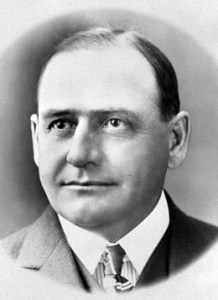
My decision to not accompany them to Everett tomorrow was made after soul-searching and a little praying. Some of the men going there were busted-up at last Monday night’s beating but are no longer confined to hospital beds. I suspect vengeance may be in the back of some their minds, but mostly they want to inform the citizenry of just what mill owners such as David Clough and Roland Hartley—backed by bankers such as William Butler—are allowing, even encouraging, to happen. I know reprisal has been on my mind, which is one of the reasons I’m not going. (I’ve prayed for God to erase notions of vengeance from my heart—not something I can do on my own.)

I shall spare you, Dad, descriptions of the “event” that happened outside of Everett last Monday night—from which I emerged less stove-in than many—but will here give you a summary of its aftermath. Early Tuesday morning a few of Sheriff McRae’s deputy-goons returned to the scene of the night before, where they met with the Ketchum brothers. These two men had heard the ruckus from their farmhouse a quarter-mile away. From them the deputies learned no bodies were found—relieving these forces of law and order of fear that they could be charged with murder. They then made an attempt to clean up the scene of their drunken bloodlust.

Apparently they didn’t do a very good job. Soon after they’d returned to town, an impromptu committee went out to examine the site. Led by Ernest P. Marsh, President of the Washington Federation of Labor, the group included two well-respected ministers—one from Seattle, one from Everett—along with Jake Michel of the Trades Council, Snohomish County Prosecutor William Faussett, Commissioner W.H. Clay, and other prominent Everett citizens. Mr. Marsh reported:


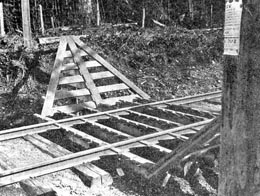
“Hearing of the occurrence I accompanied several gentlemen, including a prominent minister of the gospel in Everett, next morning to the scene. The tale of that struggle was plainly written. The roadway was stained with blood. The blades of the cattle guard were so stained, and between the blades was a fresh imprint of a shoe where plainly one man in his hurry to escape the shower of blows, missed his footing in the dark and went down between the blades. Early that morning workmen going into the city to work, picked up three hats from the ground, still damp with blood. There can be no excuse for nor extenuation of such an inhuman method of punishment.


A Mr. J.M. Norland, part of Marsh’s committee, states:


“There were big brown blotches on the pavement which we took to be blood. They were perhaps two feet in diameter, and there were a number of smaller blotches for a distance of 25 feet. In the vicinity of the cattle guard the soil was disarranged. Some of these were shoe marks. …You could also notice where, in their hurry to get across, they would go in between, and there would be little parts or shreds of clothing there, and on one there was a little hair.”


Returning to town, Mr. Marsh and his committee proposed a mass meeting—such as was held Sept. 20—to inform the people of Everett exactly what their county sheriff and his Commercial Club “citizens’ army” had done at the crossing near Beverly Park. No word of the Monday night occurrence appeared in the following day’s Everett Herald or Tribune. Marsh suggested the coming Sunday, Nov. 5 (which is tomorrow), as a day for a general citizens’ meeting. In an effort to inform all involved parties, he notified our Seattle I.W.W. office. Whereupon our local, as I mentioned, decided to “shirttail” a free speech demonstration onto Marsh’s proposed meeting. Certainly I have no objection to a Spokane-style free speech event. But it should not upstage a citizens’ meeting—hosted by Everett’s most respected labor leaders, ministers and other prominent citizens—whose purpose is to further expose, and hopefully disgrace, McRae and the Commercial Club. This, it would seem, would most benefit the striking shingle weavers, whose plight inspired I.W.W. intervention in the first place.

In any event, by the time you get this letter, Dad, Sunday the 5th of November will have come and gone and you’ll be able to read about it in the Industrial Worker and Solidarity—though likely not in the big dailies, not so long as there is war news to report from France. Along with a presidential election.

I need to go to bed now. I know you’ll say nothing to Mother about any of this. But I’m still sore from a few glancing pick-handle blows inflicted last Monday. But luckily nothing hit so as to worsen my previous injuries. And unlike a goodly number, I didn’t end up in the hospital. Which is what I fear may happen to quite a few more tomorrow.


Goodnight, Dad

Your longtime wayward son,

Mike

To be Continued.
Posted in Everett WA, history, labor, social protest | Tagged , , , , , , , , , , , , , | Leave a comment

A Mill Town Under Siege: Everett, Washington – 1916 (Part One)


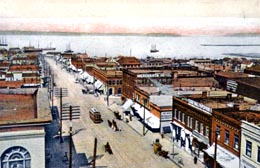
everett_hewitt-ave_1900


Hewitt Ave., Everett, WA., ca. 1910  Everett Public Library


On May Day, 1916, every shingle mill in the bay-side city of Everett, Washington, shut down. The men who saw, grade and pack the cedar shingles were striking. The mill owners had promised long-withheld wage increases when the price of shingles rebounded–which they had, thanks to the World War going on in Europe. Instead, the leading industrialists of the “city of smokestacks” saw an opportunity to break the back of the International Shingle Weavers’ Union.

As summer progressed into fall, the Industrial Workers of the World (I.W.W.) put out the call to support the locked-out workers of Everett. The Everett Commercial Club, backed up by the Snohomish County Sheriff’s Department, with co-operation from the Great Northern Railway, established a virtual blockade of the city, with orders to turn away any-and-all suspected “Wobbly” transient workers and activists. Men were rounded up at the railroad yards and junctions, at county roads and on the waterfront docks, to be sent away or jailed. 

Exactly a century later, it can still be disputed whether it was the city that was under siege, or the locked-out mill workers and their supporters. And still disputed is who fired the fatal shots, when the events led up to the awful climax occurring on November 5th, 1916–since known as the Everett Massacre.

Excerpted from the manuscript of The Dark And Strange Flow, by J.P. Kenna. (Not Yet Published).

The Seattle I.W.W. office has concluded that a Grand Gesture is needed. The shingle weavers’ strike is being lost, while the Everett war on free speech—and freedom of association and travel—isn’t attracting the national attention it should, along with many other noteworthy events being usurped by daily press coverage of the European war.

The blockade must be broken and a Spokane-style Free Speech fight must be re-ignited.

October 30, 1916

The time to storm the Everett Blockade is now. The last of the harvest hands that fan out across the West and the Northwest have returned from the fields and orchards to the Seattle Skid Road. I joined with a group of 42 who boarded a steamboat for an afternoon run from the Colman Dock in Seattle. Our destination—Hewitt Avenue in Everett, and likely the city or Snohomish County jail.

George Reese, the member of our Seattle local who frequently advocates violence and is not well liked, did not board. I supposed he was just there to see us off and wish us well. As we backed out of the dock, he ducked into the waiting room. Though I couldn’t verify it, I had a hunch he was heading toward the nearest telephone.

As we approached the Everett City Dock, waiting for us were at least 200 men sporting white scarves—behind them, a lineup of at least 20 autos and a few motor trucks. Likely we would not be setting up soapboxes on the Hewitt and Wetmore corner. As the whistle blew its one long and two shorts approach signal, and the engine room bell rang for a reverse, I recognized among the figures on the dock Sheriff Don McRae, and Clough-Hartley logging camp manager Joe Irving. Both were armed and many of the men carried clubs. As our spring line was tossed to the dock and hooked over a piling, I detected on the faces of McRae and Irving menacing anticipation, likely exacerbated by alcohol. Murmurs went up among the passengers–those who were not a part of our group–who gathered in clusters, expressing surprise and concern over the unexpected shore-side greeters.

If any were expecting a scene, they weren’t about to be let down. As soon as the first of us set foot off the gangway onto the dock, McRae informed us with studied politeness that we would be able to meet at Hewitt and Grand, not Wetmore—an obscure corner removed from the downtown center. Our men began to file off. Next, a runty little fellow, just returned from picking apples in Wenatchee, appointed himself our spokesman. Essentially, with words and cocked head and a sneer, he told McRae to go to hell. The reaction was immediate. The melee began, with the sickening sound of clubs and revolver buts striking human heads and backs and shoulders, accompanied by utterances of grunts and growls from the deputies and cries and groans of pain from our own men and boys, unarmed and outnumbered six-to-one.

The other passengers watched in horror. Irving managed to club one of his fellow deputies. I was among the lucky ones not to be clubbed as we were herded toward the line of waiting autos and trucks. Once filled, the grim motor procession lumbered off, with McRae, three deputies and our mouthy “spokesman” leading in the six-passenger Reo, the car well-remembered from our recent encounters at Snohomish and Maltby. We soon observed we weren’t headed to either of the jails. As evening turned to darkness, our “motorcade” rumbled into the thinly-populated farm and woodlands south of the city.

At a place called Beverly Park, where the concrete county road crosses the Seattle-Everett interurban railroad track, we were herded out of back seats and truck beds and made to form a line along the track. Since leaving the boat, there’d been no more songs from our spirited group. All joking and wisecracking had given way to stony silence. It looked as though we weren’t simply about to be merely turned loose, to walk the tracks back to Seattle. I noticed the man next to me, who on the way over had quietly introduced himself to me as C.H. Rice, now could not control a trembling in his hands. “We’d better stay close together, ’bo,” he quietly uttered. “It looks like we’re about to get tamped up.”

Remembering back at the dock, there’d been looks of concern coming from a few deputies. Perhaps they were fearful McRae or Joe Irving might commit murder in front of witnessing boat passengers. I looked around now and, in the glare of electric auto headlights, saw not a single expression reflecting humaneness. Any deputy with misgivings must have either left the group or gotten further liquored up.

In the rain, we were made to form a line, leading from the road crossing, then down along the tracks to a cattle guard. I saw the deputies were forming a gauntlet for us to run, lining up on both sides of the track, holding aloft gun-butts, black-jacks, loaded saps, devil’s club stalks and pick-handles. Some of our group were mere boys, white-faced with terror. One attempted to run off into the woods, but was picked up by 260-pound Deputy Hawes and, with help from a few other white-scarf wearing assistants, was beaten into insensibility. When one of our men pleaded, “Have a heart, man! He’s just a kid,” he too was hauled out for a beating. Some had their pants yanked down, to be whipped with the spiny devil’s club. Down along the track we stumbled, trying to shield our heads from the blows. Joe Irving gave the most savage beatings, with utterances about each of us paying for his accidental clubbing of fellow-deputy Joe Shoefield, back at the dock. Deputy Fred Luke (I’d learned a number of names from my time spying) swung his club so hard the leather thong parted and the implement went flying off into the dark woods.

beverly_park_cattleguard_wobblies_1916

Beverly Park Cattle Guard  The Everett Massacre

Bullets wizzed over the heads of a few more men who attempted escape. Like most of the men, by the time I reached the cattle guard I was bloody and aching, but was one of the less-severely beaten. Now, a cattle guard is like a fence across a road or railroad track. No hoofed beast will walk over its narrow steel strips and spike-like projections. Over this, one-by-one most of us torturously crawled. A few tried to walk or run the obstacle. As I crawled across I saw in the lantern light a shoe stuck between the steel strips. On and around the spikes were patches of hair. On the track ballast were dark splotches that had to be blood, and what looked like a few teeth. I watched through a bloodied eye as Deputy W.R. Booth ran off into the trackside brush. Above the piteous cacophony of outcries and groans, I heard him retching—the only one of our oppressors to display any sign of humanity. Managing to glance back, I saw yet a few more men being led from the autos toward our gauntlet, a deputy on each side holding up each victim’s arms, as two more pummeled with fists their unshielded faces.

McRae and Deputy Hawse picked out a few men and quizzed them as to whether they were I.W.W.s. “Say you ain’t, and we’ll let you go.” Some recanted and were rewarded with further blows to their faces. A Dr. Allison, part of the Commercial Club group, instead of looking after the more severely injured, gleefully administered some of the most savage punches and kicks.

A man appeared along the tracks shining an electric-torch. “What in God’s name is going on here?” he demanded. “We heard the ruckus from our house a quarter-mile away!”

“It’s okay, fella,” Deputy Lukes replied, “we’re just beating up a bunch of I.W.W.s.”

Six men, three on each side, rained pick-handles on our heads if we attempted to straighten up and walk across the cattle guard. I took my chances crawling with the steel strips and spikes cutting into my palms, knees and shins.

With the last man across, the scene eerily quieted. Men lay groaning in the rain in contorted positions. CH. Rice had an obviously dislocated shoulder. Dr. Allison, hearing his pleas, looked him over and told him there was nothing wrong with him, that he best hurry up and beat it back to Seattle.

mccrae_donald_sheriff_snohomish-cty_nd

Snohomish County Sheriff Donald McRae (1886-?) Everett Public Library

There were still sporadic outbursts. I heard McRae shouting to a man named Sam Rovinson—who’d been beaten with a length of gas pipe—“to hell with your constitutional rights! You came here to Snohomish County. Well, we are the County!” As Rice continued to plead in agony that he needed help for his shoulder, two deputies argued over whether to “shoot him or to burn him.” McRae finally sauntered over. “Oh, let him go,” he said. “We won’t be seeing him or any of this bunch up here again.” Those of us who could pull ourselves up tied together a makeshift sling for Rice, using handkerchiefs and neck ties.

The man who’d come over from a nearby farmhouse to investigate, whose name was Ketchum, said he’d return with his brother with bandages and iodine and pain pills. We looked around after the last of the Commercial Club deputies had skulked off and the last auto had chortled off into the chilly night rain. Nobody was dead. An interurban trolley car approached and made a stop at the crossing, its headlight shining on crawling, limping men, on bloodied men and boys. The motorman inquired if there’d been some sort of wreck. With the help of the handful of passengers, we bundled the most injured into the car, laying them out on the seats. Those of us who could still manage to walk, choosing not to take up precious space, watched the car go clattering down the track toward Seattle, the trolley pole sparking under the wire in the night rain. Being told it was the last car for the night, we began the 25-mile walk.

To be continued:

Sources: Mill Town, by Norman H. Clark; Revolution in Seattle, by Harvey O’Connor; The Everett Massacre, by Walker C. Smith


Posted in Everett WA, history, labor | Tagged , , , , , , , , , , , , | Leave a comment

Joe Hill–Not Forgotten

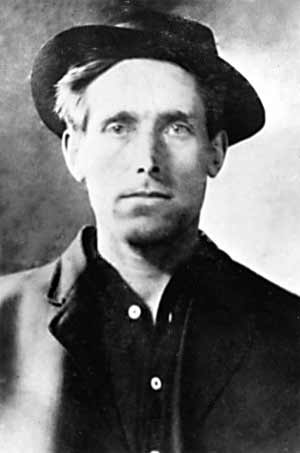
On November 19th, 100 years ago, Joe Hill was executed by the state of Utah. A fitting time to re-publish this post.

On January 10th, 1914, A Salt Lake City grocer (a former policeman) named John G. Morrison and his son were murdered. A Swedish-born itinerant laborer went on trial for the crime, and was convicted and sentenced to death.

The young laborer was born Joel Emmanuel Hagglund in 1879. After emigrating to the United States he took the name Joseph Hillstrom, then let it be shortened to Joe Hill. Working as a machinist and at various laboring jobs, he drifted his way West, where he joined the Industrial Workers of the World (I.W.W.).

Joe_hill002Though he had already begun making a name for himself as the unofficial songster for the I.W.W., he may not have achieved legendary status had not the State of Utah executed him by firing squad on November 19, 1915. While on trial for murder, unable to afford a capable defense counselor, Hill refused to properly defend himself, though the evidence against him was flimsy. Among those pleading for his life was Helen Keller, the blind-deaf activist. The Swedish embassy in Washington, D.C., intervened to have him spared. President Woodrow Wilson requested the governor of Utah to postpone the execution, pending further examination of evidence. The request was spurned.

While working on the West Coast, Hill had taken popular songs of the day and inserted his own lyrics–satirical, irreverent, often humorous–commenting on the plight of the working class in America. The I.W.W. proved to be a perfect fit for Hill.  A loose organization of young, rowdy itinerant workers in the woods and in the mines and on farms, factories, and wherever else cheap labor was sought, the “Wobblies” used songs and street corner oration to denounce the economic and political system they saw as being skewed against them. In “free speech” demonstrations, in cities such as Spokane and Portland, they let themselves be hauled off to jail in droves, driving their captors to distraction with their songs and antics.

In 1910, Joe Hill wrote “The Preacher and the Slave,” borrowing the melody from the hymn “In the Sweet By and By.” Also called “You Will Eat By and By,” it was sung on the street corners of Portland, Oregon. Copies were sold for 10 cents each.  A verse ended with:

Work all day, live on hay.                                                                                              You’ll get pie in the sky when you die.

Likely Hill didn’t know when he wrote that last line that he was coining a phrase soon to become commonplace in American speech.

The ranks of people whose lifetime overlapped the times when Joe Hill lived, and died, are drastically thinning. The I.W.W. was decimated not long after Hill’s execution, a consequence of President Wilson and his crackdown, through the Espionage Act, on those opposing our entry into World War One. The counterculture of the late 1960s revived, for those who were not too drugged out, an interest in not-to-distant past movements–such as those of the Wobblies, and their spokesmen and heroes such as Joe Hill. At the Woodstock festival of 1969, Joan Baez reverently sang “I Dreamed I Saw Joe Hill Last Night.” The Vietnam War, racial inequality and the nuclear arms race prodded a younger–and arguably more pampered–generation to question the corporate-government establishment; much as economic inequality and the insanity of World War One had energized the young to protest in decades past.

With an emerging revival of class-consciousness–spurred on by the exportation of jobs, leading to union busting and stagnant wages, as the corporate sector and its executives and speculators profit mightily–it may be time for a new generation to find inspiration from those who fought similar injustices 100 years ago.

Posted in history, labor, social protest | Tagged , , , , , , | 2 Comments

Happy Birthday Eugene Debs


Originally posted November 10, 2014


“Remember, Remember, the fifth of November!”

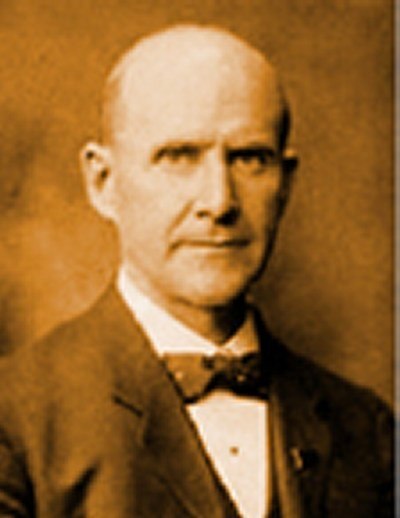
Eugene Victor Debs Born November 5, 1855 courtesy Eugene V. Debs Foundation

Eugene Victor Debs
Born November 5, 1855
courtesy Eugene V. Debs Foundation


The old school-child chant of course refers to Guy Fawkes, sometimes dubbed as “the only honest man ever to enter the Parliament.” This date–celebrating the foiling of the 17th century plot to bomb the in-session workings of the English government–might also acknowledge a less sinister and more recent figure of history, who should be celebrated as one of the most honest men ever to run for President of the United States.

Eugene Debs ran for president first in 1900, as candidate for the Social Democratic Party, a reorganization of his old American Railway Union. In 1904, 19o8, 1912 and 1920, he ran as the candidate for the American Socialist Party–his 1920 campaign being run from the federal prison in Atlanta, while serving a sentence for opposing U.S. entry into World War One.

Eugene Victor Debs came from Terre Haute, Indiana. His French-Alsaceian immigrant parents ran a grocery store and imbued in their children a love of such writings as Victor Hugo’s Les Miserables. Young Gene Debs’ early heroes included Patrick Henry and Tom Paine. He felt no attraction to foreign revolutionary movements and found Karl Marx to be “tedious.” Among his best friends was revered Hoosier poet, James Whitcomb Riley.

Starting work as a painter at age 15 for the Vandalia Railroad, Debs’ speaking and organizational abilities soon led him into leadership positions with the Brotherhood of Locomotive Firemen and editorship of its journal, The Locomotive Firemen’s Magazine. Though he rode many miles shoveling coal into the fireboxes of the big black locomotives, in his early 20s he was already spending more time travelling to organize fellow workers. And expanding The Magazine into the most widely-read labor journal of the time, adding features on history, law, and even a women’s section.

In his new found pulpit as associate editor, Debs stated the purpose of their union was “…to give to railway corporations a class of sober and industrious men…. To give to our superior officers trained and intelligent labor shall be our highest aim.” He spoke out against class conflict and lent no support to the great railroad strikes of 1877.

As the “guilded age” matured and rising industrial productivity worsened rather than improved the lives of the working people, Debs and other observers became disillusioned–watching corporate power becoming more concentrated in the hands of a rising class of the super-rich, more often than not aided–rather than regulated–by Washington, D.C.

The counteracting rise of a labor movement, dominated by the Railroad Brotherhoods and the American Federation of Labor (AFL), favored organization by craft. Efforts to better workers’ conditions led to futile strikes where various labor organizations often worked against each other–even as corporate owners and managers colluded for their own benefit. To Debs, the only solution was a labor union inclusive of all crafts–and ideally, without regard to nationality, gender or race. And so in 1890 he formed the American Railway Union (ARU).

As the worst depression up to that time paralyzed the economy in 1893, workers saw themselves and their families as the ones bearing the punishment for the excesses in speculation and stock overvaluing brought about by the gamblers and idlers of Wall Street.

James Jerome Hill The "Empire Builder" of the Great Northern Railway courtesy Minnesota Historical Society

James Jerome Hill
The “Empire Builder” of the Great Northern Railway
courtesy Minnesota Historical Society

In May of 1894, The American Railway Union shut down the Great Northern Railway. The road remaining profitable, its owner James J. Hill had decreed wage cuts. In St. Paul, Gene Debs and Jim Hill met face-to-face, impressing each other as worthy adversaries, but neither willing to compromise. A suggestion was made to have the labor-management disputes arbitrated by a group of prominent St. Paul business leaders, led by flour-milling magnate Charles Pillsbury, a major shipper on Hill’s Great Northern line. Surprisingly, the ad-hoc jury of leading mid-western industrialists ruled in favor of the American Railway Union. Wage cuts were recinded and trains between the Twin Cities and Seattle began to roll again.

But while Debs and the ARU were relishing what was considered the first successful labor strike ever in America, trouble was brewing in sleeping-car maker George M. Pullman’s company town of Pullman, Illinois. With wages being pared while cost of groceries, coal and other essentials at Pullman’s company stores increased, in late May of 1894 the thousands of employees at the car manufacturing works, adjacent to the company town, staged a walkout. The newly-victorious American Railway Union voted to support the strike with a nationwide boycott on railroad sleeping cars operated by the Pullman Company. Debs had advised against the move, fearing it would destroy the union he’d so recently created. But as leader of a democratic organization, he felt obligated to support the rank and file of the ARU. He advised members to stay away from railroad property, to not impede passage of the mails, which would trigger an injunction. He stated, “We must triumph as law-abiding citizens or not at all. Those who engage in force and violence are our real enemies.”

The boycott on Pullman cars resulted in disrupted rail service nation-wide. Periodic outbreaks of violence occurred. The mainstream press vilified “Dictator Debs” and added to the clamor for intervention by the U.S. Army. President Grover Cleveland, a Democrat, gave in. As many had predicted, including Debs, violence escalated once federal troops became involved. Cleveland issued an injunction, which Debs ignored, landing him and the rest of the ARU leadership in jail, then to 6-month prison terms.

The strike was settled with more losses than gains for the Pullman employees and for the railroad workers who supported them. Acquitted of conspiracy charges, Debs served six months in prison for violating a federal injunction. He emerged from his term a celebrity, who had defied the railroad companies, the President of the United States, and the U.S. Army. He now officially espoused Socialism, though his conversion had been long coming.

American Railway Union strikers (foreground) face the Illinois State Militia in Chicago. from Wikipedia

American Railway Union strikers (foreground) face the Illinois State Militia in Chicago.
from Wikipedia

By 1900, the American Railway Union had morphed into the Social Democratic Party (SDP). Reluctantly, Eugene Debs ran for president under its banner. The SDP evolved into the Socialist Party of America, with Debs as its standard bearer, gaining strength with each presidential election until 1912, by which time many of the reforms pushed for by the Populists and the Socialists had been co-opted by the Progressive wing of the Republican Party–its standard bearer being “Trust Buster” Theodore Roosevelt, known for his statement decrying the “malefactors of great wealth.”

Like Lincoln, Debs was a reluctant presidential candidate. He had also resigned from earlier positions with the Locomotive Firemen and the American Railway Union, thinking other men could better serve. When his resignation was refused by the membership, he tried to refuse the salary they offered, ending up negotiating for a lower figure.

Eugene Debs had his inconsistencies. He could be self-righteous and uncompromising. With a flare for the dramatic statement, he sometimes wrote things that would come back to haunt him. There was the “dynamite editorial” in 1885, and in 1900, his  support for a plan hatched by Washington state Governor John Rogers to colonize the entire state with laid-off American Railway Union workers and other socialist sympathizers. A movement, he predicted, that would likely bring on the intervention of the U.S. Army (as had happened in the Pullman strike), wherein “300,000 patriots” would then confront the federal troops at the Washington state borders. Governor Rogers found himself having to “tone down” such statements to the likes of the Spokane Spokesman-Review, the leading newspaper of eastern WashingtonAnd soon after, Debs began distancing himself from the “colonization” movement.

As with most of those who rise above the ordinary, Eugene Debs was both adored and vilified. But his words rang true for those who felt that neither the “mainstream” political parties nor labor organizations really represented them. His words deserve to live on.

I am not a labor leader. I don’t want you to follow me or anyone else. If you are looking for a Moses to lead you out of the capitalist wilderness you will stay right where you are. I would not lead you into this promised land if I could, because if I could lead you in, someone else would lead you out.

While there is a lower class I am of it, while there is a criminal class I am of it, while there is a soul in prison I am not free.

Eugene Debs with wife Kate Debs, 1926

Eugene Debs with wife Kate Debs, 1926  courtesy Eugene V. Debs Foundation

Eugene Debs died in 1926, five years after a presidential pardon released him from his second prison term.


Posted in history, labor, railroading, social protest | Tagged , , , , , , , , , , , , , , , , , , , , , | Leave a comment

The I.W.W. is 110 Years Old

By the 1890s, in reaction to the unprecedented power concentration of corporations, a labor movement had formed. The Railroad Brotherhoods and the American Federation of Labor (A.F.L.) dominated the movement, divided into crafts. Eugene Debs in the early 1890s formed the American Railway Union (A.R.U.), an industry-wide organization not given to craft distinction. He saw how craft divisions had been dividing the labor movement, especially during strikes. Debs led the A. R.U. to victory in the Great Northern Railway Strike of 1893–only to face immediate defeat, and prison, in the disastrous Pullman Strike which soon followed.

He came out of his prison term convinced that the only hope for working-class America lay in the formation of One Big Union.

The following line appeared in the “Today in History” column of the Saturday, June 27th, edition of our local newspaper:

In 1905, the Industrial Workers of the World was founded in Chicago.

 That was all. But I found it a pleasant surprise that any acknowledgement was made in a corporate-owned small city daily.

The following is excerpted from the historical novel Lost Utopia, by J.P. Kenna   –(not yet published)

William Dudley Haywood (1869-1928) Founder of the Industrial Workers of the World   —from Wikipedia

Spring, Summer  –  1905

At 10 o’clock in the morning, on June 27th, in Chicago’s Brand’s Hall, Big Bill Haywood looked about for a gavel to call together the meeting planned back in January. Finding only the stub of a 2×4 left behind by carpenters working on the stage, the lumbering “Cyclops” rapped it on the table. Facing the 203 delegates at a ¾ angle, his one good eye on them, he boomed over the crowd, creating a near-instant hush:

“Fellow workers, this is the Continental Congress of the working class.”

Nearly half of the delegates represented an assortment of labor unions. Along with Haywood, Charles Moyer and Vincent St. John represented the Western Federation of Miners; Father Thomas Hagerty, a Catholic priest, represented the American Labor Union; William Trautmann, the Brewers; Charles O. Sherman, the United Metal Workers. Among the 60 individual delegates were Eugene Debs, now 50 years old, of the Socialist Party of America; “Mother” Mary Harris Jones, organizer for the United Mine Workers; Algie M. Simons, editor of the International Socialist Review; and Lucy Parsons, widow of Albert Parsons, executed for his role in the Haymarket riot of 1886. And there was Daniel DeLeon, founder of the old Socialist Labor Party, representing the scant 1,600 members of the Socialist Trade and Labor Alliance—like Father Hagerty’s American Labor Union, meant as a rival to Gompers and the A.F.L.  Haywood looked at DeLeon with interest, having never before met him in the presence of fellow workingmen. Openly critical of DeLeon’s pedantic, doctrinaire ways, Haywood nonetheless harbored an admiration for intellectuals and men of learning and cultural refinement. Like many rough-hewn miners, Haywood himself was an avid reader of literature and enjoyed poetry. DeLeon, foreign-born, a lawyer by trade, had been educated at the University of Leyden in the Netherlands and taught international law at Columbia. With his aristocratic air and argumentative, sarcastic manner, Daniel DeLeon tended to arouse among those who knew him either revulsion or lifelong discipleship.

To create a unified organization from such a group before him seemed to Bill Haywood a challenge far more daunting than his years of organizing and leading his fellow miners. A constitution was drawn up. Thomas Hagerty wrote the preamble, beginning with:

The working class and the employing class have nothing in common.

Named the Industrial Workers of the World (I.W.W.), the organization would have 13 labor departments, each including a number of national industrial unions. The 13 departments in total were to include every different trade or craft, along with the unskilled. The constituent unions would answer to an executive board in Chicago. There would be restrictions on member unions’ imposition of initiation fees and dues. Likewise, they would be forbidden to make contracts with their employers; officials wouldn’t serve in the same capacity for more than one year; and they would be paid a salary based on the wages of their regular occupations.

Samuel Gompers cph.3a02952.jpg

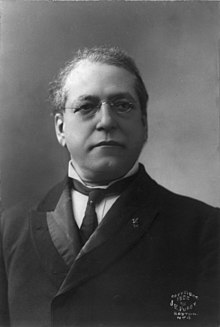
Samuel Gompers (1850-1924). founder of the American Federation of Labor (AFL).  — from Wikipedia

Haywood did his best to infuse the themes he’d adopted serving with the Western Federation of Miners. He excoriated Samuel Gompers, who not surprisingly wasn’t in attendance, for the A.F.L. policy of refusing membership to African-Americans and immigrants.

Regarding the low-paid and unskilled, Haywood said:

“We came out of the West to meet the textile workers of the East. We men of the West are getting more wages per day than these men are getting. We must recognize the fact that unless we bring them up to our condition they of necessity will drag us down to theirs.

“We are going to get at the mass of workers and bring them to a decent plane of living…. When we get the unskilled laborer into this organization, the skilled worker will of necessity come here for his own protection.”

Thomas Hagerty drew a wheel representing the 13 “constituent unions,” with the central union, the new I.W.W., as the hub. On seeing the representation, Samuel Gompers dubbed it “Father Hagerty’s Wheel of Fortune.”

Fr. Hagerty’s pamphlet, Economic Discontent and its Remedy. Published by Eugene and Theodore Debs, 1902

Much of the Socialist press likewise reacted with derision, or outright hostility—including Max Hays’ Cleveland Citizen, Morris Hilquit’s New York Forward, and the Milwaukee Social Democratic Herald of Victor Berger and Fred Heath. Eugene Debs, who had given only one speech at the I.W.W. convention, was accused of splitting the trade union movement; that he and his cohorts should “return to the labor movement and the Socialist Party.” Debs responded in a letter to the Social Democratic Herald:

Since when has the S. D. Herald become the official organ and special champion of the A.F. of L.? And since when is it a condition of membership in the Socialist Party that one must belong to the A.F. of L.? … The Chicago dailies are all–like the S. D. Herald–the champions of the A.F. of L. … They understand the rottenness of the old trade union movement … but it is good enough for them, in fact just what they want, for a rotten labor movement is their salvation and that is why they lied about the Industrial (I.W.W.) convention and why they hold up the A.F. of L. as the one organization for workingmen to tie to.

In fact, Debs had talked to reporters of the ”mainstream” Chicago dailies during the convention, hoping to clarify the structure and goals of the new industrial union. With dismay, he read their coverage, which was generally derisive and omitted any of his clarifications. At least one even got the name mangled, calling it the “International Workers of the World,” an obvious redundancy.

Additional Comments:

Eugene Debs never fully embraced the I.W.W., and continued as head of the Socialist Party of America–an outgrowth of his old American Railway Union.

Big Bill Haywood, already known as the two-fisted leader of the Western Federation of Miners, led the I.W.W. into national prominence–and fear. Though out to organize all crafts, it was chiefly among the ranks of the left-behind that most members were recruited–Itinerant loggers, farm workers, miner, immigrant textile workers, and others of the laboring classes who felt that Sam Gompers’ A.F.L. had little room for them.

Out West, the I.W.W. halls became a ‘second home’ for footloose young laboring men, especially between jobs out in the lumbering camps. When not out working, the ‘Wobblies’, as they came to be called, were often seen on the street corners of cities such as Portland, Seattle, Everett–and further east, Spokane, Missoula, Butte. They loved giving speeches denouncing the system they saw as stacked against them. And they sang, often making parodies of the hymns the Salvation Army (“Starvation Army”) would be playing and singing on adjacent or opposite corners.

They led free speech demonstrations, allowing themselves to be arrested for what they saw as the exercise of a constitutional right. With endless reinforcements coming in by boxcar or any means, they could crowd the jails and drive their captors to distraction with their singing and their antics.

Haywood took the fight back East, to the textile strikes of Lawrence, Mass., in 1912 and the Paterson, N.J., silk weavers’ strike of 1913. By then Haywood was overseeing the transition of the once-loose organization–assisted by the likes of Vincent St. John and Elizabeth Gurley Flynn–into a true industrial union. Factory owners took notice. So did the mainstream press, planting fear in the hearts of the complacent and comfortable that wild-eyed, bomb-throwing Wobbly fiends could invade their towns and cities, wreaking mayhem. The U.S. Government also took notice, especially after U.S. entry into World War One. Congress passed the Espionage and the Sedition Acts, tools for the Woodrow Wilson administration–in a turnabout from its progressive policies–to put into full use, jailing scores of I.W.W. members and imprisoning its leaders, essentially breaking the union’s back.

Big Bill Haywood, aging and in deteriorating health, was sentenced to the federal prison at Fort Leavenworth, Kansas. Skipping bail, he escaped to the Soviet Union, where he hoped to find a new society putting the I.W.W. policies into practice. He died there in 1929, homesick and disillusioned.

The I.W.W. never recovered either. Following World War One, it became a victim of the “red-baiting” hysteria of the early 1920s, a movement that gave strength to a new organization, the Federal Bureau of Investigation (F.B.I.), and its very-young leader, J. Edgar Hoover.

It took the Great Depression to revive the dream of one industry-wide union. In 1935, the Congress of Industrial Organization (C.I.O.) was formed.

Following yet another World War, an updated form of “red-baiting” occurred, supported by the recently-formed House of Un-American Activities Committee (H.U.A.C.), culminating in the “witch hunts” of Sen. Joe McCarthy in the early 1950s.

In 1955, the American Federation of Labor merged with the Congress of Industrial Organization, forming the AFL-CIO.

Posted in history, labor, Socialism, writing | Tagged , , , , , , , , , , , , , , , , , , , , , , | Leave a comment

Ivan Doig (1939-2015)–I Miss Your World

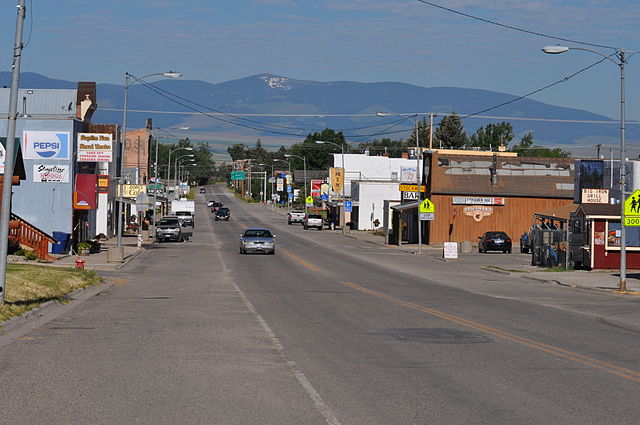
White Sulphur Springs, Montana Main Street, looking west toward Big Belt Mountains Stockmen Bar to right, on corner

Recent view of White Sulfur Springs, Montana
Main Street, looking west toward Big Belt Mountains
Stockmen Bar to right, on corner

Back about 1980, I was introduced to a town I’d never seen, reading a description by a newly acclaimed 40-year-old writer. And it stayed with me–a mid-1940s scene of a very young boy being happily dragged around by his ranch-hand, sheep-herding father to the bars on a rollicking Saturday night. It sounded as though the main street was a string of bars. The names I recall are the Mint. And the Stockmen–a favorite, it seemed, of Charlie Doig, father of little Ivan.

This town, a county seat, sat snug in the Smith River Valley–a verdant, elongated trough, settled in the mid to late 19th century by highland sheepherders from Scotland. Way to the south are the Crazy Mountains. Walling off the Missouri River to the west are the Big Belt Mountains. To the east loom the aptly named Castle Mountains, with their rocky parapets. More distantly north, the Little Belt Mountains mark the northern end of a frontal range running east of the main Rockies, stretching up from Mexico.

Ivan Doig’s  1979 memoir, This House of Sky, brought it all to life–both the geographic, historical setting and the intriguing details–in flowing, wide-open prose.

In the 1990s I was driving U.S. Highway 12 east, crossing the Missouri River  at Townsend, Montana. Leaving the Missouri River Valley, the two-lane “blue highway” began twisting upward, crossing and re-crossing the downward-tumbling Deep Creek. Suddenly the ascent was over. The trees gave way to grassland, a valley dropping off before us, stretching left and right. Ahead, looking toward the Castle ridge, the browning grass gave way to blue-green blanketing of conifer forests at the higher elevations–a timberline in reverse. Far to the left in this CinemaScopic view–some twelve miles to the north–one could make out a whitish cluster, marking a town. That would have been White Sulphur Springs.

Having read This House of Sky over a decade before, the experience of arriving at a place never before seen was a little like a homecoming. True to Doig’s description, the town is shaped like a tee. The mountains surrounding it were in their proper places. On Main Street, there was the Stockmen, and the Mint–both still in business. Though now, incongruously in this sea of grass, it was a logging town, not a sheep-ranching center. There were trees up toward the mountain tops, accessible by new logging roads.

The railroad, The White Sulfur Springs & Yellowstone Park, had been pulled up. A grandiose vision of circus-founder John Ringling, it had never gotten near Yellowstone, getting no further south than its junction with the also now-gone Chicago, St. Paul & Pacific Railroad, at a flag-stop town called Ringling.

Where the combined Highways 12 and 89 turn right onto Main Street, forming the tee, a motel surrounds the hot spring–its healing waters still an attraction, the one that enticed John Ringling’s effort to link it with Yellowstone Park. South of the motel, I observed where the playground of the red-brick elementary school abutted the exercise yard of the county jail. Ivan Doig had attended the school. An incident in his book recalls him seeing a boy at play in the school yard looking across the fence to where the prisoners were out getting fresh air, suddenly looking horror-struck and shouting, “There’s my daddy!”

For one who grew up in industrial northeast New Jersey, This House of Sky portrays a boy growing up in a world unimaginable in anything other than history or fiction. The young Ivan spent summers camped out with his father Charlie and mother Berneta, herding and tending sheep in the higher elevations. The boy was six when his mother died of asthma. He then lived much of the time with his doting grandmother Bessie Ringer in her little house by the tracks in Ringling. Later his father remarried and for a time partnered with Ivan’s stepmother running a cafe’ in White Sulfur Springs, across Main Street from the Stockmen bar.

As a teenager, Ivan has a revelation while driving sheep with Charlie to a more northerly pasture, that this is not the kind life he wants to lead. Charlie is saddened but not surprised. Ivan goes on to study journalism at Northwestern University, where he meets the woman–a fellow journalism student–with whom he’ll be spending the rest of his life. They move to Seattle. In a rental house at University Village, east of the University of Washington campus, Ivan pursues his P.H.D. in history while Charlie, dying from failing lungs, comes to stay with them.

In his youth, Charlie Doig had come to the Gray’s Harbor area and worked in a lumber yard. He was appalled when the foreman expected him to continue working when the rain started. “God-almighty, the rain!” was his impression of western Washington. He spent the rest of his working life in the dry lands of central Montana.

Later settled in, with his wife Carol, near the Puget Sound shore in the Edmonds area, Ivan wrote The Sea Runners, a novel filled with salt spray rather than dry mountain dust. He never returned to Montana to live, but most of his subsequent novels took place in the area of his youth–from the Smith River Valley, then ranging up to the “high line” area along the eastern front of the Rockies. This was the setting for his McCaskill trilogy, tracing generations of a fictitious Scottish family going back to the late 19th century.

Ivan Doig passed away this past week, at age 75, succumbing to the cancer that had stalked him for eight years. Just a year and a half ago, Victoria and I saw him at Village Books, Fairhaven (Bellingham, Washington). Reading from his recent novel, Sweet Thunder, he presented a vigorous-enough appearance. We had no idea he was a dying man. He talked of having spent a long enjoyable night before (over Scotch whiskey, I believe) renewing his longtime friendship with Village Books owner and founder Chuck Robinson. To his audience, with self-deprecating humor, Ivan talked of being a ranch hand at heart, who happened to love Shakespeare and Keats. He recalled his years as a newspaperman, an inspiration for Sweet Thunder, a story that takes place in the copper-mining city of Butte, in the 1920s, in the heyday of newspaper rivalry.

It was gratifying over 20 years ago to see snippets of the real world Ivan Doig had sprung from. And more recently, to see and hear him in person. And to receive a signed book from him. But I couldn’t help noticing there in the basement of Village Books, filled to capacity as it was, that those of us in attendance presented a sea of white and gray hair. The thought crossed my mind that not only has the world Ivan Doig written about–and to a large extent, lived in–passed. Could it be his kind of writing is also passing?

Called The Dean of Western Writers, a title informally inherited from Wallace Stegner, like Stegner, Ivan Doig  wove meticulously-researched history with engaging fiction.There were romances in his stories. But they didn’t always come to happy endings. And there were rich people. But mostly he wrote about those who got up everyday and went to work. These included ranch hands, school teachers, newspaper reporters and editors, and copper miners. Lives that in retrospect might be considered romantic–but didn’t seem so at the time, by the people living them.

I’ve never really lived in the world Ivan Doig wrote about,  yet somehow I miss it. As I miss much of the world I grew up in. Is this just the normal path of aging? Or is the world really on course toward a celebrity-obsessed digital dystopia? Where only the rich and glamorous are worth reading or writing about. Where best-selling books must have Hollywood-sexy models on the cover and promise a happy ending.

It would be fun to sit down over a bottle of Scotch–or Irish–whiskey, and talk about such things with Ivan Doig.


Posted in history, labor, love, Montana, nostalgia, social criticism, writing | Tagged , , , , , , | Leave a comment

Up the Inside Passage

from Wikipedia

from Wikipedia

July, 1898.  16-year-old Mike Scanlon has let himself be detained, quite willingly, at a new Utopian socialist colony along the upper reaches of Puget Sound, north of Seattle. He is now “back on track” following the original plan of his journey West–to meet up with his brother Jimmy in Skagway, Alaska, to work on construction of the new Gold Rush railroad, the White Pass & Yukon. With much reluctance, he has left Anna behind in Washington state, at the Equality Colony. (see previous post, “A Day Trip to New Whatcom”)

Excerpted from Chapter 3 of Lost Utopia (not yet published), part of an Irish-American epic. Two prequels, Cinders Over The Junction and Beyond The Divide, from Shamrock & Spike Maul Publishing Co., are available in paperback from Village Books, Fairhaven (Washington, U.S.A.), and in paperback and Kindle from Amazon.

 *  *  *

The trip up the inside passage took less time than he expected. Only once did Mike feel the onset of seasickness, when crossing the open waters of Queen Charlotte Sound, the dreaded symptoms immediately subsiding after passing Cape Calvert to the west, where once again forest-thick island-mountains sheltered them from the swells of the Pacific.

 Mike writes (inspired by an entry from his informal journal, enhanced by his memories and the perspective of many subsequent years):

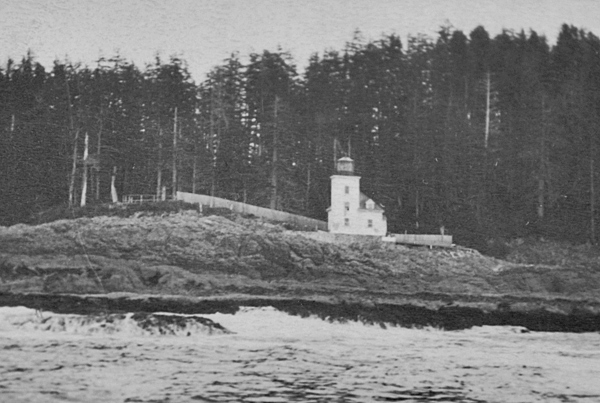
Egg Island in Queen Charlotte Sound The lighthouse was built August to October of 1898 Canada Library and Archives

1902 view of Egg Island in Queen Charlotte Sound.
The lighthouse was built August to October of 1898.
Canada Library and Archives

The weather was clear crossing Queen Charlotte, with steady swells riding in on a moderate Northwesterly. We passed Egg Island close to the east (where construction of a lighthouse was about to commence), as I hung onto the rail, in case my increasingly distressed stomach needed to empty the contents that had so recently filled it—which fortunately it didn’t. I had the novel, disquieting vantage as we passed the shore of Egg Island of seeing the hind side of waves breaking onto the the rocks. To see the swelling, rounded humps of breakers rolling away from your vantage, white-rimmed and plunging, the spray sailing shoreward behind them, the effect was so unsettling I had to cast my gaze north or south or I would have certainly cast my recent meal toward the lee shore. I decided then and there, though I’ve come to love boats and inland bays, and always enjoyed rivers, that I had no taste for open-water voyaging. Perhaps some lingering effect, whether consciously gained through my father’s spoken and written memories [of the horrors of the 1840’s voyage across the Atlantic to escape famine] or something more subliminal in the back of my mind from ancestral memories [as the Irish, though surrounded by water, never became noted as a seafaring people, as did, for example, the Scandinavians], further prejudiced me against plying the open oceans.

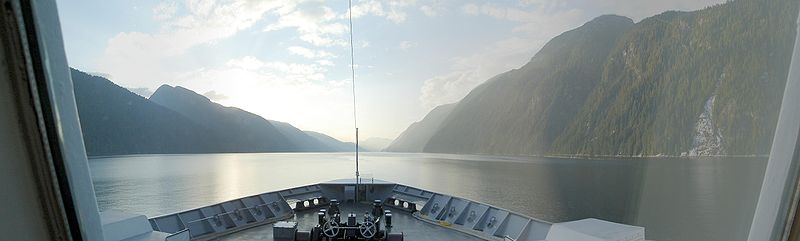
Again, at Milbank Sound, we were exposed to the western swells, but so briefly as to have no adverse physical effects—though at the time I credited myself with gaining “sea legs.” From there we went into the shelter of Cone Island, the conical effect, as with Lummi Island far to the south, seen only when the landmass is viewed from its narrow end. After Finlayson Channel came the long passage of Grenville Channel, with sheer timbered mountain slopes on either side and so straight that the helmsmen could throw a loop on a spoke and lash down the wheel for many minutes at a time.

A present- day view of the Inside Passage, south of Prince Rupert,  British Columbia. Such vistas vistas have  changed little since the 1890s. from Wikipedia

A present- day view of the Inside Passage, south of Prince Rupert, British Columbia.
Such vistas vistas have changed little since the 1890s.
from Wikipedia

It was here that Captain Johnny O’Brien invited me up into the wheelhouse and let me take the helm while the quartermaster sat nearby on a stool, ready to grab a spoke should the need arise. I’d seen Capt. O’Brien in the salon evenings at one of his favorite activities, poker playing (though not for money while on duty). When he was up supervising the watch during evenings I would hear him belt out a voluminous rendition of “Sweet Rosie O’Grady,” which the passengers below loved but I soon learned the crew found to be as little novel and uplifting as the blasting of the whistle or the hourly clanging of the ship’s bell. Capt. O’Brien said he’d given my brother Jimmy his word he’d look after me. When I related a little of my discomfort and general misgivings when crossing Queen Charlotte, he told me his friend Mike Heney, for whom I’d soon be working, had a similar feeling regarding open waters. It was nothing to do with being Irish, he said—he himself had done his share of open water voyaging. He said he’d seen the same trait in Jimmy and remarked that a railroad man would much prefer to follow a river than venture out across “blue water.”

Again, past Prince Rupert, we felt a Pacific swell as we made heading to Duke Island, the sentinel beckoning us back into United States of America territory. Yet Alaska from the ship’s rail looked no different from British Columbia, the endless mountains and spruce, fir and cedar-clad shores and islands becoming almost oppressive, especially when the weather turned gloomy—which I was told was the rule, except in the height of summer. The occasional fishing or Indian village, with dock, a few shingled buildings, sometimes a cannery, provided visual relief, along with the reassurance of human habitation, appreciated all the more due to its sparseness—as did a passing Indian canoe or the sail of a trim boat towing trolling lines, or the exchange of whistles and waves when passing a southbound screw-steamer or paddlewheeler.

Capt. O’Brien explained my observation of the absence sailing ships. What with the restricted channels, the bends, and the fast moving, shifting tidal currents, any bulky sailing vessels without an auxiliary engine would have a hard time of it in the Inside Passage. “The open ocean is their domain,” he said, then added, grinningly, “Though ‘tisn’t such for some of my railroad-building passengers.”

And there was the cavorting of porpoises, often darting back and forth, with their incessant smiles, across the onward-plunging bow, and the gushing dorsal exhale of killer whales, the spray at times felt on deck, and the pointing and “ahs” of newcomer passengers—a group in which I must include myself—at the sight of the twin tail flukes turning upward, to disappear under the rippling surface.

Any oppressiveness I felt by the passing land and waterscapes must not be confused with monotony. I was never bored. Rather it was a touch of homesickness—augmented by the vastness, the endlessness of it all, similar to the impression gleaned from staring hours out a train window, while rolling through much of the continent between the Red River of the North and the Rocky Mountains—except that here, the vistas were often restricted by the nearness of forested slopes.


In the confusion of the Skagway arrival, the passengers, mostly prospectors, disembarking amid a plethora of blanket rolls, backpacks, banded and labeled mining tools, grip bags, suitcases and even steamer trunks, Mike recognized Jimmy, the same broad grin of heartfelt greeting—though now about equal in size, no longer the towering boy-man remembered from 12 years earlier, when as a squealing 4-year-old Mike would run up to greet his big brother up from the Shore, home for a rare weekend off from his trackmen’s job on the New York & Long Branch.

They grinned at each other now from equal heights, with a touch of shyness, pumping each other’s hands, then surrendering to a brief man-to-man embrace. Mike was relieved this now 32-year-old man, who once scooped him up as easily as though he were a cat, was not a stranger to him. The lean muscular body, though now equal in size, felt familiar. There was a recalled smell, part soap and hair tonic, with a hint of tobacco and sweat. And there was the voice and the laugh, just as he remembered. “Well just look at you, if you haven’t grown into quite the young rooster! And a journeyer of many miles!” Trying to say something fitting for a well-traveled young man, Mike could only beam and stammer back.

“You’re here none to soon, little Mike,” Jimmy continued. “The engine came just last week. We’re now an operating railroad. I was thinking we’d have it all built before you got here!”

Posted in history, labor, love, nostalgia, railroad construction, Utopian Movement, writing | Tagged , , , , , , , | Leave a comment

A Day Trip to New Whatcom


Logo of the Brotherhood of Co-operative Commonwealth, the entity behind Equality Colony in Washington state from Wikipedia

Logo of the Brotherhood of Co-operative Commonwealth, the entity behind Equality Colony in Washington state
from Wikipedia

In May of 1898, 16-year-0ld Mike Scanlon travels west from New Jersey to meet up the with his brother Jimmy in Skagway, Alaska, to work on building the White Pass & Yukon Railway. The brief war taking place in the Philippines and Cuba will soon end, leading to a Spanish defeat.

There’ve been signs of recovery from the economic depression–brought on by Wall Street speculation and over-valuing of railroad stocks and real estate–that had been ravishing people’s lives since 1893. Still, the working classes were reeling from five years of wage and job cuts. Many were flocking to the Yukon region to find quick riches in gold strikes rather than continue toiling for what was being increasingly seen as a system mostly benefitting the already “filthy-rich.” Concurrently, the Populist and Socialist movements were gathering up the discontented. An offshoot of the latter was the move to set up Utopian colonies in western Washington state–and even a vision, backed by its governor,  to “socialize” the entire state.

Enroute to Seattle, on the train Mike meets 18-year-old Anna Smithson, journeying to meet up with her transplanted New Jersey family at the Equality colony, building along the upper reaches of Puget Sound. Accepting an invitation from the Smithson family to join them at Equality, Mike postpones meeting his brother in Skagway, where gold seekers are thronging before making the arduous trip inland to the Klondike strike along the Yukon, a trip the new railroad promises to make easier–and at the same time making enormous profits for its English investors.

Excerpted from Chapter 3 of Lost Utopia (not yet published), part of an Irish-American epic. Two prequels, Cinders Over The Junction and Beyond The Divide, from Shamrock & Spike Maul Publishing Co., are available in paperback from Village Books, Fairhaven (Washington, U.S.A.), and in paperback and Kindle from Amazon. 

*   *   *

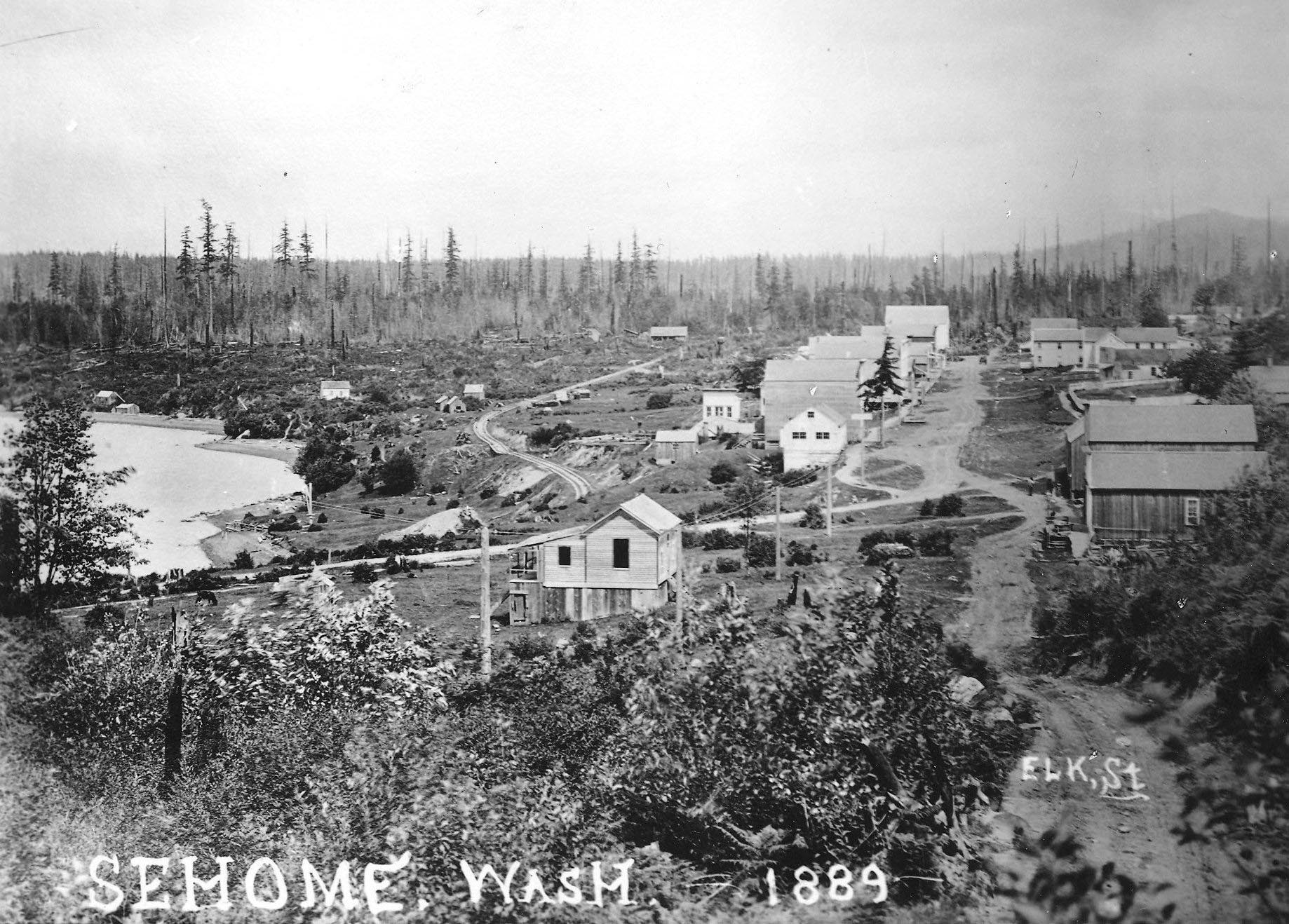
The town of New Whatcom. Washington, had its beginnings as Sehome, seen here in 1889, the year Washington became a state. Centered around Elk Street, and the new Bellingham Bay & British Columbia Railroad--off to the left--the town grew toward the forested background of this scene. In 1904, New Whatcom merged with Fairhaven to become Bellingham. courtesy Whatcom Museum, #2008.57.198

The town of New Whatcom. Washington, had its beginnings as Sehome, seen here in 1889, the year Washington became a state. Centered around Elk Street, the town grew toward the forested background of this scene. By 1898, it was looking more like a city. In 1904, New Whatcom merged with Fairhaven to become Bellingham.
courtesy Whatcom Museum, #2008.57.198

Mike and Anna left under a pre-dawn purple sky for the long round trip to New Whatcom, expecting to return past dark that evening. They angled back across Oyster Creek as it tumbled to Samish Beach below. Cresting the headland jutting out to Pigeon Point, north of the beach, the lake-smooth surface of Chuckanut Bay before them lightened to gray-blue. Sunlight touched the east slope of Lummi Island, rising as twin cones when viewed endwise, and, toward the west, bathed the rounded heights of Orcas. Rounding a hairpin turn and descending to the bay’s edge, hunger overcame them as they followed the sweeping curve of a sandstone-strewn beach. Unwrapping from a towel fried egg sandwiches on colony-baked bread, they passed to each other a fruit jar of still-tepid cereal coffee.

Toward noon they plodded through Fairhaven. Following the trolley line, they reached the hardware store on Elk Street in New Whatcom. Mr. Morse, the store’s owner, oversaw the loading of the wagon with crated sheet-iron stoves. Beginning the return, Mike and Anna stopped at the small hospital in Fairhaven run by the Sisters of St. Joseph of Peace, to pick up medical supplies from the nuns.

The sun was low over Orcas Island when, hours later, the wagon again coursed the water’s edge. When not talking, they sat easily in each others’ company, close on the high spring seat, their hips touching, Anna taking the reins on the level stretch along the beach where there was no precipitous drop-off. The approaching sunset cast a newly melancholic air, realization sinking in of Mike’s scheduled departure in a few days, a mood till then kept at bay by the brightness of the day and the at-times lively talk—such as contrasting agnostic rationalism with Christian, especially Catholic, faith; on whether or not Karl Marx was correct that socialism went hand-in-hand with an atheistic view of the world; on whether or not the teachings of Christ, with which Anna was thoroughly familiar (having labeled her family as “non-religiously Christian”), were antithetical to the capitalist system of economics. In agreement on this last matter, it had become obvious to Mike that Anna was a “debating society” veteran.

Tying the team to a wind and salt stunted fir tree, they stepped out over sand and sandstone rocks to a short point, formed of boulders and dune-like humps, and sat down on a bleached drift-log, clasping hands. Mike admired how the afternoon northwesterly breeze ruffled her hair.

“You don’t have to go,” she said after an agreeable silence. “You can stay here and be part of…the changes. You do believe we’re ushering in a new and better way to live, don’t you? Do you really want to go to Alaska and work on a railroad being built to satisfy men’s greed?” The response on Mike’s face caused her to further explain. “I mean, isn’t its purpose to make it easier for fortune-hunters to reach the goldfields…and to fatten the coffers of English capitalists?”

While not feeling a need to defend a commitment to go work with his brother Jimmy, Mike felt a pang in seeing twin tear-streams on Anna’s cheeks. When they first met on the train coming West, she’d caught him crying—but until now he’d never seen her cry. Sure, they’d done hand-holding and a little smooching, but he felt a thrill of disbelief as now she clasped her arms around his waist and buried her head against his chest. Could this older girl, soon to be a schoolteacher, actually feel something akin to adult love for him? Her hat had fallen off and he stroked her sand-colored hair. She turned her face up toward his. “I don’t want you to go!” she said, after a sniffle. “You can write your brother. I think he’d understand.” Looking into her upturned face, child-like with tear-reddened eyes, it occurred to him he could do exactly that.  Instead of finding his little brother at the Skagway dock, Jimmy would be greeted with a letter. Mike would pay him back the cost of the steamer tickets. Conflicting thoughts fled his mind as their faces converged into a lingering kiss. Distantly hearing the lapping of gentle waves, he felt his hand taking on a life of its own as it began straying over female contours totally novel to his touch.

She gently grasped his hand and pulled it away, breaking the kiss. “No, little boy, no,” she said. “We mustn’t. We shan’t shame ourselves…and dishonor the colony. They trusted us to be together today.”

Feeling chastised, Mike began to stammer an apology. Anna put a finger to his lips. “It’s okay” she said, in a sweet near-whisper. “No need. You’re a good boy…. We’d best be getting back.”

Jouncing along the beachfront road, they soon again relaxed with each other, overtaken by a yet-more-intense euphoria as the sun set. Threading the switchback and crossing the Pigeon Point headland in the oncoming darkness, they made plans. He would be gone for two years, working hard and saving money. He would be 18 when he came back, work-hardened and no longer a boy. They would get married and have a room in Apt. House #2, and later, when they started raising a family, they would be entitled to a lot on which to build a house. He would further expand his skills in the wagon shop, and perhaps learn boatbuilding—and start a new shop. The colony would build boats for its own use, and to sell for cash. She would teach, perhaps take charge of the school—a woman in the colony could raise a family and continue to teach, once each little one was beyond a few months of age. They would both write, not only for the Industrial Freedom, but for national publications such as the Coming Nation and Appeal to Reason. Together they might write a book about colony life; or perhaps a socialist novel. They might refurbish a beach cottage on Eliza Island.

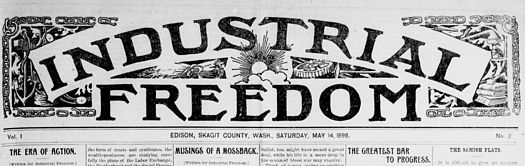
Industrial Freedom, the official newspaper for Equality Colony published 1898 to 1904 from Wikipedia

The Industrial Freedom, the official newspaper for Equality Colony
published 1898 to 1902
from Wikipedia

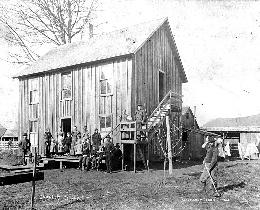
Apartment house at Equality Colony, ca. 1898. courtesy Historylink.org  University of Washington Special Collections #U W1054 0

Apartment house at Equality Colony, ca. 1898.
courtesy Historylink.org
University of Washington Special Collections #UW1054 0

They were secretly engaged now, but as he was still a boy they would wait till his return to make it known. Then they would wait a proper number of months to be married. Secretly, Mike hoped that during the two year-plus hiatus she would convert to the Catholic faith. Though they weren’t discussing it now, he knew she wouldn’t object to their children being raised in the Church. Now the kisses they were sharing between happy banter were those of a couple with a planned life ahead—kisses playful, sometimes a bit passionate, but not lustful. By the time he let her off at Apt. House #1, a half-moon in the west gently illumed the contours of Colony Hill.

 *   *   *

They sat in the back of a colony wagon as Harold Smithson drove. Up front with him, Mrs. Smithson mildly rebuked Anna’s giggling younger brother and sister as they took kitten-like swats at each other. The parents registered no displeasure at Mike and Anna holding hands while waiting at the crossroads for the Edison-Belfast stage, nor for the not-too-brief kiss their daughter gave him as he boarded the coach. Mrs. Smithson gave him a hug, followed by a hearty handshake and well-wishes from Mr. Smithson. Too soon Mike found himself curving up the hill at Brownsville, no one at his side, then over the flat summit through summer-dense woods and down the east slope, to catch the Great Northern train to Seattle. From there he would board the steamer Utopia for the inside passage trip to Skagway.

Posted in history, Populism, Socialism, Utopian Movement, writing | Tagged , , , , , , , , , , , , , | Leave a comment

Trains (large and small) and Christmas

First Posted December 20th, 2013

Our regional shopping mall here in Bellingham, Washington, dating from the late 1980s, recently had a grand re-opening showing off its multi-hundred thousand dollar face lift.

I didn’t attend. I’ve got nothing against shopping malls. It’s just that I can’t stand them. I’m glad I grew up in a time when the acres of asphalt and lookalike big box buildings–spreading over former farm fields–weren’t the main association with Christmas. That, and all the flimsy junk on sale inside, passing as gifts for kids and necessities of modern life.

Not so long ago, Christmas commercial activity was still more about Main Streets in towns and cities. Like many such places, our own “downtown” in Northeast New Jersey had taken nearly three centuries to evolve. True, by the early 1950s, these districts had absorbed the trappings of a commercialized, electrified post-war modern Christmas season. Housewares and toys featured in the Five and Ten’s and the hardware stores included items made of plastic. Elaborate “plug-in” games were marketed for the kids. But to kids, and I suspect to many adults, the garlanded light strings stretching crosswise over street and sidewalk in patterns of stars and bells, the decorated stores offering warm refuge from the late-afternoon winter chill, still heralded a magical season. Even the canned carols coming from loudspeakers added to the spell. Back then people weren’t so self conscious about locally-assembled hokeyness.

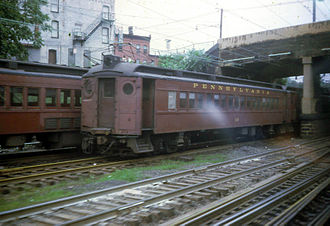
Pennsylvania Railroad electric trains. Dating back to pre-Worldd War one, they were used in New Jersey suburban service until the early 1970s

Pennsylvania Railroad electric trains. Dating back to pre-World War One, such cars were used in New Jersey suburban service until the early 1970s. 

But we also had the less-homespun grandness of Christmastime New York City. Our yearly family sojourn started out right, with a half-hour train ride in the well-heated, well-worn confines of a Pennsylvania Railroad local. Nose pressed against the pane provided a procession of normally prosaic urban, industrial, and often-shabby residential scenes turned exotic when viewed from a train window. I pitied the deprived souls out there riding in automobiles and buses.

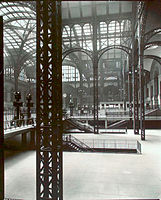
Penn Station Concourse

Penn Station Concourse

Next came the fitting entrance to arguably the world’s greatest city when, after passing under rocky Bergen Hill and the bottom muck of the Hudson, safe in a decades-old tunnel, we de-trained at a high-level platform and ascended the stairs from subterranean track level into the soaring glass-and-steel concourse of Penn Station.

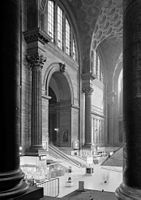
Main Waiting Room, Penn Station

Main Waiting Room, Penn Station

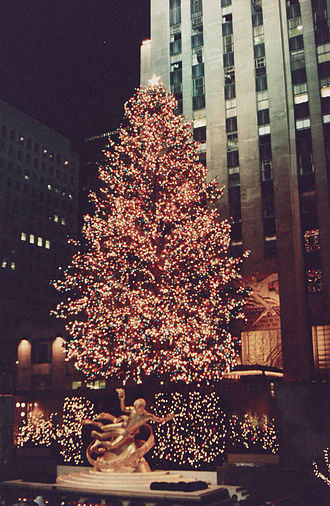
Timelessness hovered over the scurrying crowds. A bank of automatically opening doors led into the mall-like arcade, then into the granite halls of the waiting room, modeled after the Roman Baths of Caracalla. Years of grime–by then the pink granite was washed only up to eight feet above the floor–couldn’t totally diminish the grandeur of  vaulted ceilings and lofty, sunlight-filtering lunette windows . Stepping out through the Corinthian columns onto 7th Avenue was almost a letdown. But the Statler Hotel tree, the parade of animation at Macy’s window, didn’t disappoint. Rockefeller Center and the Radio City Music Hall Christmas girded us with enough seasonal cheer and warmth to face the walk back down Fifth Avenue through the biting chill of New York City’s  windy street-canyons.

Norwegian Pine Christmas Tree, Rockefeller Center

Norwegian Pine Christmas Tree, Rockefeller Center

Darkness had fallen on the New Jersey side of the Hudson, as we headed home, again cozily ensconced in a rattletrap train. Darkness dimmed, but failed to obscure, the landscape of cattail marshes, rail yards and buildings of grimy industrial brick. Man-made light was everywhere. Past Newark, the lofty neon toy soldier–standing guard over America’s foremost zipper manufacturer–and the neighboring Pabst Blue Ribbon icon–would have obliterated the Star of Bethlehem. Seasonal lights festooning the Esso refinery at Bayway further chased the gloom of Winter Solstice.

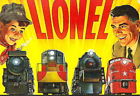
Lionel Trains Catalog, 1954

Lionel Trains Catalog, 1954

In the early part of those magic weeks following Thanksgiving, my father would bring home the latest Lionel Trains catalog. Every boy could dream about owning the ultimate train set, Lionel’s Santa Fe Super Chief streamliner, with its red and yellow “warbonnet” -faced diesels pulling silver cars, including a “vista dome” and a rounded-end observation car. The thought of riding such a train in real life, way out West, was an equally unattainable fantasy. But we did have short hops on our threadbare but lovable locals, that took us to Newark, New York, or the Shore. And I loved my 027-gauge set that enlivened the gloom of our cobwebby cellar, complete with black engine that puffed white smoke. But the dear and familiar didn’t preclude dreaming of the far away; and of grander trains, big and small.

Thankfully at Christmastime we can still indulge in unabashed sentimentality. Christmas cards now show 1950’s downtown street scenes that look as remote and picturesque today as did the snowy scenes of horse-drawn sleighs wending though bucolic landscapes of Christmas cards from childhood years. The “good old days” seem to follow about three generations behind the more jaded present. Will today’s young children someday see scenes of shopping malls as evocative of a golden past? Will they remember navigating freeway exits in SUVs with fondness? Playing with the latest video console under the flickering of a 58-inch wall-mounted flat screen TV?

Maybe so. Personally, I would feel vindicated to live long enough to see our regional shopping mall fall to the wrecker’s ball. It would help make amends for the savage wrecking of my beloved Penn Station in the 1960s. But the analogy doesn’t completely hold up. Penn Station preceded the throwaway society. Built for the ages, it didn’t demolish easily.

To whomever reads this…Merry Christmas!

photos from Wikipedia

Posted in history, nostalgia, railroading, social criticism, writing | Tagged , | 2 Comments

Joe Hill–Not Forgotten

The execution of Joe Hill by the State of Utah took place on November 19th, 100 years ago.  A fitting time to re-post this entry.

On January 10th, 1914, A Salt Lake City grocer (a former policeman) named John G. Morrison and his son were murdered. A Swedish-born itinerant laborer went on trial for the crime, and was convicted and sentenced to death.

The young laborer was born Joel Emmanuel Hagglund in 1879. After emigrating to the United States he took the name Joseph Hillstrom, then let it be shortened to Joe Hill. Working as a machinist and at various laboring jobs, he drifted his way West, where he joined the Industrial Workers of the World (I.W.W.).

Joe_hill002Though he had already begun making a name for himself as the unofficial songster for the I.W.W., he may not have achieved legendary status had not the State of Utah executed him by firing squad on November 19, 1915. While on trial for murder, unable to afford a capable defense counselor, Hill refused to properly defend himself, though the evidence against him was flimsy. Among those pleading for his life was Helen Keller, the blind-deaf activist. The Swedish embassy in Washington, D.C., intervened to have him spared. President Woodrow Wilson requested the governor of Utah to postpone the execution, pending further examination of evidence. The request was spurned.

While working on the West Coast, Hill had taken popular songs of the day and inserted his own lyrics–satirical, irreverent, often humorous–commenting on the plight of the working class in America. The I.W.W. proved to be a perfect fit for Hill.  A loose organization of young, rowdy itinerant workers in the woods and in the mines and on farms, factories, and wherever else cheap labor was sought, the “Wobblies” used songs and street corner oration to denounce the economic and political system they saw as being skewed against them. In “free speech” demonstrations, in cities such as Spokane and Portland, they let themselves be hauled off to jail in droves, driving their captors to distraction with their songs and antics.

In 1910, Joe Hill wrote “The Preacher and the Slave,” borrowing the melody from the hymn “In the Sweet By and By.” Also called “You Will Eat By and By,” it was sung on the street corners of Portland, Oregon. Copies were sold for 10 cents each.  A verse ended with:

Work all day, live on hay.                                                                                              You’ll get pie in the sky when you die.

Likely Hill didn’t know when he wrote that last line that he was coining a phrase soon to become commonplace in American speech.

The ranks of people whose lifetime overlapped the times when Joe Hill lived, and died, are drastically thinning. The I.W.W. was decimated not long after Hill’s execution, a consequence of President Wilson and his crackdown, through the Espionage Act, on those opposing our entry into World War One. The counterculture of the late 1960s revived, for those who were not too drugged out, an interest in not-to-distant past movements–such as those of the Wobblies, and their spokesmen and heroes such as Joe Hill. At the Woodstock festival of 1969, Joan Baez reverently sang “I Dreamed I Saw Joe Hill Last Night.” The Vietnam War, racial inequality and the nuclear arms race prodded a younger–and arguably more pampered–generation to question the corporate-government establishment; much as economic inequality and the insanity of World War One had energized the young to protest in decades past.

With an emerging revival of class-consciousness–spurred on by the exportation jobs, leading to union busting and stagnant wages, as the corporate sector and its executives and speculators profit mightily–it may be time for a new generation to find inspiration from those who fought similar injustices 100 years ago.

Posted in history, labor, social protest | Tagged , , , , , , | Leave a comment