Easter Rising, 1916- Days 2, 3, and 4

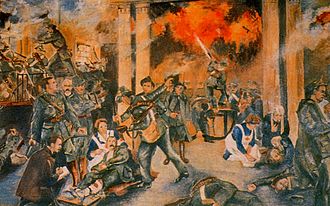
Shelling of the General Post Office, Dublin from Wikipedea

Shelling of the General Post Office, Dublin
from Wikipedea

Mike Scanlon’s journal entries continue, written in faraway Seattle, Washington, as he followed the events of that long-ago but not-forgotten week.

Tuesday, April 25, 1916

Outside the General Post Office (G.P.O.) looms Nelson’s Pillar—obstructing Sackville Street, as it has for decades. Only now the admiral’s granite nose is missing—a casualty of the uprising, now in its second day.

While the rebels hold the G.P.O., military strategists—professional and hobbyists alike—are wondering why no effort has been made to seize the more strategically located sites south of the River Liffey, mainly Trinity College and Dublin Castle. Nor have any bridges or railway lines been destroyed.

Further south of the river, the Countess Markievicz, Michael Mallin and a contingent of Connolly’s Citizen Army have set up the Royal College of Surgeons as a hospital. Nearby, British troops—with a spectacular display of firepower—took the unoccupied City Hall. Back up on Sackville Street, watched over by statues of Charles Stewart Parnell on its north end, and by Daniel O’Connell on its south, and the now nose-less Admiral Horatio Nelson in the middle (three famous adulterers, it’s been said), the looters by mid-morning were again out in full force.

The rebels in the G.P.O., directed by James Connolly, were fortifying their defenses with barbed wire and pilfered newsprint bales.
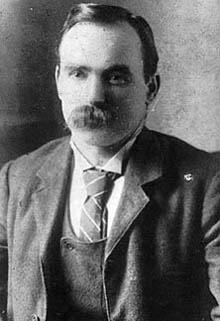
James Connolly from Wikipedia

James Connolly, President- Transport Workers’ Union
Vice President- Provisional Republic of Ireland. from Wikipedia

By afternoon it’s obvious that the rebel force in the G.P.O. is fully cut off from the Citizen Army group to the south occupying the Royal College of Surgeons. The British have bisected the city east-to-west as effectively as the River Liffey has for ages.

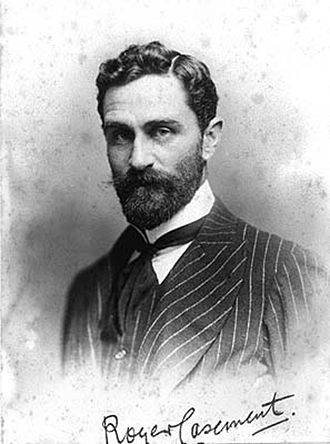
In London, the House of Commons was deliberating on whether or not to shoot Sir Roger Casement for treason. As an interim measure, he is being held in the Tower of London. Reports are that Scotland Yard interrogators have discovered papers on him proving his homosexuality. “It’d be better for the poor bugger to be shot,” people are saying.

Evening reports tell that Skeffy Skeffington—after spending two days trying to stop the looting, while his suffragette wife Hanna Sheehy was bringing bread to various rebel posts—was arrested as he walked home. Though a civilian with no connection to Sinn Fein or the Irish Volunteers, authorities recognized him as the infamous pacifist who went on a hunger strike while imprisoned for opposing British army recruitment, sharing time with Sean McDermott—a known Sinn Feiner and signer of the recent Proclamation of the Republic—for the same offense.

With night coming on, General Lowe of the Irish Command reports that the rebellion is successfully contained, with his native troops remaining loyal to the Crown. Martial law has been declared in Dublin City and County.

After a long day of giving rousing reports to his men holding the General Post Office, Patrick Pearse allowed in, through the barricades, 60 Republican Volunteers needing safety and sustenance. On the roof, Connolly has had his exhausted men maintaining their positions in the rain, in response to rumors of an immanent English bayonet charge.


Wednesday, April 26, 1916

In Portobello Barracks, a Captain Bowen-Colthurst—whose family owns Blarney Castle and is said to have a fanatical hatred for fellow Irishman who oppose the English—is watching over his prisoner, Skeffy Skeffington. A member of the Royal Irish Rifles, Colthurst fought against the Dutch in the Boer War; and more recently had refused an order to retreat before Von Moltke’s advancing Germans at Mons. Just the other night he lead a march through South Dublin, parading a handcuffed Skeffy before him as hostage, while randomly shooting unarmed, unthreatening civilians, including a teenaged boy.

At Boland’s Bakery, Eamon de Valera—mathematics teacher turned Commandant of Irish Volunteers—kept his men constantly on the move, causing observing British officers to greatly overestimate their numbers.
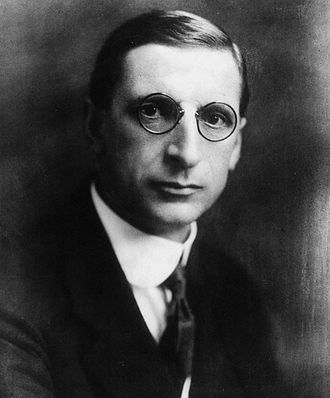
Eamon de Valera MathematicsTeacher Turned Rebel Commandandt Later- President of Irisn Free State from Wikipedia

Eamon de Valera
Mathematics teacher turned rebel commandant
Later- President of Irish Free State
from Wikipedia

On the west end of the city, Commandant Ned Daly—brother-in-law to Old Tom Clarke—marshaled his men past the St. John’s convent, stopping to receive the good wishes of the Sisters of St. Vincent de Paul. A Capuchin friar, Father Albert, blessed them. Elsewhere in the city, the rebels are gaining a modicum of grudging admiration from their mostly-disapproving countrymen—the sentiment being that remarkably the rebels are holding out for their third day, that to have been put down by the English within the first hour would have been a bit of a shame. Pearse must be using this as support for his exaggerated claims that at last, after seven centuries, Ireland is in the throes of a successful revolution.

The rain chased by early-morning sun, a shell from the British gunboat Helga signaled the bombardment of the mostly-empty Liberty Hall. General Lowe has set up his headquarters in the rebel-spurned Trinity College. In the southeast section, de Valera’s detachment of 13 men guarded Mount Street Bridge over the Grand Canal, aided by two rooftop snipers, Michael Malone and James Grace—each armed only with a single-shot rifle.

At Portobello Barracks, Skeffington has refused to eat, on grounds that he is vegetarian. After requesting a sympathetic Lieutenant Monk Gibbon to return his handkerchief, confiscated the night before, and to inform his wife Hanna of his whereabouts, he was marched across the prison courtyard, looking, as others had observed, like a miniature version of fellow-vegetarian George Bernard Shaw. From a corner of the courtyard, Captain Bowen-Colthurst gave an order to shoot. “Skeffy”—in the sight of two newspaper editors arrested the night before—crumpled to the ground, fatally shot in the back. Next, the two editors were similarly dispatched. A report says the horrified Lieutenant Gibbon saw Captain Colthurst give a soldier a “vote for women” button—found on Skeffington’s person—as a souvenir.

Francis Sheehy Skeffington from Wikipedia

Francis Sheehy Skeffington
from Wikipedia


There are rumblings that the incident and others, so-far among a handful, are nonetheless beginning to affect public opinion as to how the English are handling the rebellion.

Other areas are erupting with machinegun-fire and shelling, though the English 18-pound guns are unable to directly hit the General Post Office. Instead of looting, crowds along the Liffey are watching the “fireworks” show. A report in from the late afternoon says the house where snipers Grace and Malone were holed up was finally stormed by Colonel Fane’s men. The two snipers are now dead, though it appears so far English casualties far outnumber those of the rebels. They’re saying Connolly—holed up with Pearse and the Volunteers for the third day in the G.P.O.—is ecstatic. And that he has sent his only son, Roddy, on a contrived mission to lead him out of the post office to safety. Meanwhile, Connolly directed the digging of escape tunnels leading to adjacent buildings.

Captain Colthurst, who shot Skeffington that morning, is on another random-killing rampage, in defiance of the orders of his superior at Portobello Barracks, Major Francis Vane.

As daylight waned at Boland’s Bakery, de Valera released the hungry delivery horses, that they might find scant forage along hedges and the canal. Learning that the dogs and cats at the pound were also going unfed, he ordered them released—into the city streets—where likely they are now feasting on increasing numbers of dead horses and human corpses.

On the west end, Ned Daly’s men are fighting a spreading fire they themselves had started, with the intention of burning down Linenhall Barracks—in which they succeeded, only too well.

We wonder what Patrick Pearse is thinking now. Surly he must be wrestling with misgivings. But as a man who takes his inspiration from history and legend, he must be strengthened by the thought that this is the longest-lasting Irish rising since 1789. And that his students, some with him in the General Post Office, could look back many centuries to the boy-warrior Cuchulain. Hadn’t at St. Enda’s their teacher, Pearse, many times inspired his students—in Gaelic—with words from 700 years ago? I care not if my life have only the span of a night and a day, if my deeds be spoken of by the men of Ireland.


Thursday, April 27, 1916

The General Post Office is taking gunfire from all directions, but as of early morning there were no artillery hits. Rebels from rooftops are returning fire.
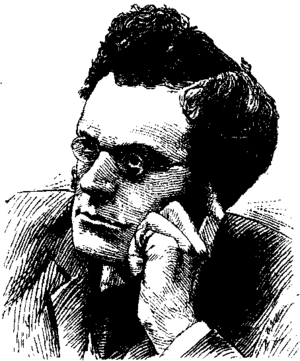
Augustine Birrell Chief Secretary of Ireland from Wikipedia

Augustine Birrell
Chief Secretary of Ireland
from Wikipedia

The destroyer H.M.S. Dove arrived at the Customs House. Chief Secretary of Ireland Augustine Birrell is back from London, said to be appalled on hearing that artillery bombardments from his fellow Englishmen will soon be pounding the city he’s learned to love. General Sir John Maxwell is being sent over from London to take charge of putting down the rebellion. A soldier of impeccable credentials with little time or taste for fine distinctions and political interference, photographs of him show a bushy mustache—said to be nicotine-stained yellow—under an enormous nose, which has earned him the nickname “Conky.”

Dead horses are being loaded onto wagons and trucks for the city zoo, where the ravenous lions are threatening a rampage brought on by lack of meat. De Valera has issued an order forbidding the bringing of food into the city, except for milk to the hospital. Tom Clarke had Father John O’Flanagan smuggled back into the G.P.O., where the strangely-cheerful besieged rebels have appointed him chaplain. However, the request to hear yet more confessions can only be taken as a sign that sooner or later artillery will pound them, or fire will smoke them out or consume them.

Late morning, a one-pound cannon—taken from the gunboat Helga by truck—was trained on Boland’s Bakery. To draw fire away, de Valera had a green flag hoisted from the tower of a nearby distillery. The flag, emblazoned with gold harp, continued to wave as the Helga’s transposed gun missed both Boland’s and the distillery but managed to land shells alarmingly close to the gunboat from which it had been recently removed.

Briefly leaving the questionable safety of the post office, in a maneuver to spread out his men by sending a detachment over to the offices of the Irish Independent, Connolly in early afternoon was shot in the foot, shattering his lower shin bone.

In the House of Commons, John Redmond, referring to the Home Rule cause he championed (which, though approved by Parliament, was “tabled” in 1914, upon England’s entry into the war against Germany), asked, “Is the insanity of a few to turn all her marvelous victories of the last few years into irreparable defeat?” Sir Edward Carson—Dublin-born Protestant, leader of the Ulster Unionists—who’d done more than any other single person to squelch Home Rule and ‘those marvelous victories’ to which Redmond alluded, intoned, “…we should be ready to put down these rebels now and for evermore.” This is coming from the man who once said he would resist “Rome Rule” even if it meant taking on the British Army.

Back in Dublin, later in the afternoon, Commandant Eamonn Kent evacuated his James Street Garrison men form the Nurses’ Home at South Dublin Union, expecting to momentarily to be mowed down by half a company of British army men in pursuit. The pursuit, however, was checked for two hours by one man behind a barricade, armed only with an automatic pistol. Charles Burgess, who went by the Gaelic version, Cathal Brugha, taunted the Tommies as they tried to pass through the passage which he now controlled. Singing old Irish battle songs, Cathal Brugha was shot 25 times, and hit by bomb splinters as the British tried to smoke him out with grenades. Eventually, the Tommies took another route, thereby saving Kent and his men, who found Brugha in a pool of blood, still singing “God Save Ireland.” Though seeming a futile gesture, they patched him up to slow the blood flow and moved him to nearby Union Hospital, where he could be given morphine and Last Rights. At last report, Cathal Brugha was refusing to die.
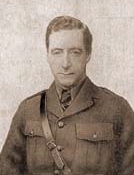
Cathal Brugha from Wikipedia

Cathal Brugha
from Wikipedia

De Valera was making his last stand at the granary at Guinness’ brewery, his men with their backs to the canal.

At 5:30 a shell hit the Imperial Hotel across the street from the General Post Office, causing it to burst into flames. Other surrounding buildings soon caught fire. By 10:00 p.m., Hoyt’s Oil Works was raining exploding drums and terror down onto the G.P.O.  Sean McDermott and Tom Clarke, present in the post office since Easter Monday but eschewing uniforms and military titles, took charge of the fire fighting in the doomed G.P.O.  From his sickbed inside, Joe Plunkett was heard to say this is the first time a capital city has been set ablaze since Moscow in 1814—excepting Paris, in 1871.

That night, Seattle time, I received a telegram from back East, from my sister Mary. In it, she gave a quote attributed to Irish Volunteer co-founder Michael O’Rahilly, regarding the incineration of much of central Dublin. “This is to show us exactly what the English think of poor old Ireland.”

The heat surrounding the G.P.O. caused Pearse to order all explosives to be removed to the cellars. Connolly, wracked with pain from his foot wound, gave up trying to sleep, groaning as the smell of rotting horse flesh wafted in form the streets. As James Connolly took solace in the fact that he was suffering for Ireland, young Michael Collins was chafing that things were being run by military amateurs—and that they were trapped, because no one had thought of an escape plan.

 Reference: Rebels, by Peter De Rosa

Posted in Easter Rebellion, history, Ireland, labor, writing | Tagged , , , , , , , , , , , , , , , , | Leave a comment

April 24, 1916- Easter Monday

Flag flown over the General Post Office- Dublin from Wikipedia

Flag flown over the General Post Office- Dublin
from Wikipedia

Mike Scanlon continues in his journal:

Easter Monday is a holiday in Ireland, marking the second day of the ending of Lent, the end of self-induced prohibitions from such activities as drinking, gambling and smoking. By all reports the weather there today is in keeping with the festive atmosphere, ending a normal spate of gloomy days that the people of Seattle would be habituated to. Eight hours ahead of Seattle time-wise, we’re anticipating newspaper updates and wires directly from Philadelphia and New York to apprise us of the latest events unfolding in Dublin.

By evening here in Seattle, men at the I.W.W. hall down on Washington Street—Irish-American and otherwise—are scanning and commenting on the reports in the evening papers.

“So the rebels have taken over the General Post Office?”

“By golly—it’s like when Haywood declared the “Continental Congress of the working class” in Chicago, back in ’05.  ’Cept they’re taking it way beyond talk. These guys are wearing military uniforms and carryin’ guns. People are getting killed.”

“They say Pearse and his young brother showed up to lead the fight, decked out in full gear carrying guns and swords…but not on horseback, like General Lee…but on bicycles.”

“Sure, ’twould ’ave made a sight to see their greatcoats floppin’ over the wheels!”

“A comedy to some, maybe—but not to the brothers’ poor widowed mother. ’Tis said she saw them off in the morning, thinking she’ll never see her boys again.”

“Connolly led the charge into the Post Office—with fellow Irishmen inside—employees and customers—begging them not to shoot.”

“They’re now calling themselves the Irish Republican Army. MacNeill’s Volunteers and Connolly’s Citizen Army combined.”

“No match for the Tommies, they’ll be—who’ll soon be storming the city—followed by his His Majesty’s gunboats steaming up the River Liffey.”

“It’s like as if Vincent St. John and Big Bill Haywood and a bunch of us Wobblies put on surplus uniforms and took on the U.S. Army.”

“Making a wreck of things in central Dublin, they are—so I here…shame, in a way. They say it’s a beautiful city. Grand buildings, parks, monuments.”

“And miles of teeming tenements. They make New York’s slums look like Newport, Rhode Island. There’s a higher percentage of poor than in the U.S.—and worse off.”

“They’re out looting now. Pearse said to shoot…over their heads. That funny little fella Skeffy Skeffington is out there trying to stop the looters.”

“The people aren’t behind the uprising. They only see free food and liquor and clothes—and maybe some real furniture. They’re tired of sittin’ on crates. They’ve had no country to fight for going on 700 years. Lots of ’em are fighting for the English over in France so’s they can send home grub money to their wives and kids and mothers.”

Easter_Proclamation_of_1916

There are dead horses and wrecked wagons and overturned tramcars in the streets. It’s getting impossible to buy food. Both holiday revelers and day-to-day shoppers are angry at the disruption of what promised to be a beautiful Monday.

British soldiers, the “Tommies,” are beginning to roll into Kingsbridge Station from Athlone and Belfast, reinforcing those stationed at the Curragh and the national police force—the Royal Irish Constabulatory. (I’ve heard that real crime is almost non-existent in Ireland, and that the main purpose of the R.I.C. has been to keep the population from turning rebellious). In the yard of Dublin Castle—seat of English power—machine guns and artillery are being readied.

By nightfall, four battalions of the rebel Irish Republican Army—led by Pearse and Connolly—were holding the General Post Office, and were able to prevent Richmond Barracks from sending British troops. The rebels have also taken some of the less-important railway stations. In the darkening Post Office, bereft of electricity, the young Father John O’Flanagan was hearing confessions and administering communion to the wounded and non-wounded alike.

The rebels hold no positions in the provinces. In County Kerry, with Tralee leader Austin Stack in jail, they are said to be especially demoralized, what with the failure of the German arms shipment to arrive.

Somehow, the story is unfolding that the communication to Germany, by way of New York, for the shipment of arms to arrive not before Sunday night or Monday morning had been changed to not later than Sunday night or Monday morning. Arriving off Tralee Bay on Holy Thursday—with no communication saying they were too early (the ship had no wireless set)—the German captain and crew of the gunrunner, disguised as Norwegian tramp steamer Aud, must have experienced their own despair when no one on shore signaled with a green lantern (as was the plan) for the arms to be offloaded. They had volunteered for the mission at known risk of life and assumed they were concluding it successfully.

 Reference: Rebels, by Peter De Rosa

Posted in Easter Rebellion, history, Ireland, writing | Tagged , , , , , , , | Leave a comment

Countdown to an Uprising- Easter week,1916

 Mike Scanlon–worker, wanderer and dreamer–kept an informal journal during his years spent out West. In spring of 1916 he was working in the engine room of the Hyak, one of the Seattle-based “mosquito fleet” of small steamboats plying the waters of Puget Sound, carrying everything from fish and farm products to well-dressed commuters.

Through letters from his father Francis and his sister Mary, Mike’s been keeping up on events in Ireland; even as the war of aging European empires unfolds on the shell-pocked fields of France, threatening to pull in a reluctant America.

The following excerpts are from Book 4, as yet unnamed and unpublished, of the I’ll take You Home Kathleen series. Mike’s earlier years are followed in Beyond the Divide (available from Amazon and Village Books, Fairhaven- Bellingham, Washington, USA), and Book 3, Lost Utopia (not yet published). 

 330px-Hyacinth_-_Anglesey_Abbey

Seattle, Wash.  1916

The exaltation of Easter Sunday Mass, for me, is always tempered by the 3,000 mile separation from the family I was born and raised in. But the joy is still there on seeing the statues no longer draped in the purple of Passion Sunday—and the purple vestments of the celebrating priest now replaced with gold, resplendent as the lilies flanking the altar tabernacle. And with both sexes and all ages of the congregation sporting their finest attire—the children mostly scrubbed and combed to perfection—with greening and blooming outdoors heralding the onset of mild weather, all is magically unchanged since childhood as we immerse ourselves in the celebration of the Resurrection. The mundane mixes with the reverent, as I recall walking up to the communion rail, my feet grandly enveloped in the stiff leather of my yearly pair of new dress shoes—still not fully grown into—to receive the Body of Christ in my heart on this day of the most glorious of the Glorious Mysteries.

Then, from a home surrounded by golden daffodils and forsythia, fresh foliage and early fruit blossoms banishing the stark Lenten grayness of winter sleep, new smoke from the kitchen chimney wafts skyward as a precursor to the aroma of Easter ham soon to be baking. Grandfather James and Grandmother Mary would be plodding up the Leesville Road, their carriage woodwork, brass and leather scrubbed and polished, little marred by a thin coating of road dust. As Grandfather tugged the horse to a gentle stop, I would scurry out through the front half-door, across the porch and down the steps and over the short walk where bordering hyacinths sent there heavenly scent—then tie the horse to the post, as Grandmother, rustling in yards of taffeta, alighted and stooped and gave me a warmly crisp hug, the wool of her shawl tickling my nose. Grandfather, in starched collar and cravat, his generous belly enfolded in knee-length morning coat, reached a beefy hand down for a manly shake before rumpling my combed and oiled hair, his face creased in a smile over gray beard, the early-afternoon sun glistening off his top hat.

This Easter, soon following my 34th birthday, I’m still sporting new—but better-fitting—shoes. And I shall be having a fine dinner at Mrs. O’Grady’s—made all the more satisfying knowing my wages have contributed to it. And she and Marty and his little sisters Ann and Beth will be my family.

Later, my pal Marty O’Grady and I will walk downtown to the Irish-American storefront meeting place not far from Chinatown. Hooked to a network of telegraph and long-distance telephone connections, we’ll hope to learn of verified developments, in contrast to flowing of contradictory rumors we’ve been hearing over Holy Week. And with the time difference, by late Sunday afternoon, Easter Sunday in Ireland will already be over.


Good Friday- April 21, 1916

I attended a service for the Passion of Christ at 3 p.m. at the Church of the Immaculate Conception up on 18th Avenue. Each time the priest chanted flectamus genua, kneeling with the rest of the congregation I closed my eyes, holding my right fist to my heart, and had visions of crates of rifles floating in the waves off of what I assumed was the coast of Kerry. I saw a ship exploding, perhaps detonated by its own crew. I saw ragtag groups of men, in what I visualized as the streets of Dublin, being shot by professional looking soldiers in khaki. I heard wailing from women and children… I saw Christ being taken down from the cross, bloodied and lifeless.

At the conclusion, I prayed for the mortal life and immortal soul of Patrick Pearse.

That evening, at his Pioneer Square newsstand, I asked Red O’Hanrahan if there were any front page articles about an Irish uprising. “Not a thing, man,” he answered.


Holy Saturday- April 22, 1916

Still only rumors are drifting in. Sir Roger Casement swam or was washed ashore on the Kerry coast at Banna Strand near Ballymacquain Castle, at the mouth of Tralee Bay. In one version he lay on the beach dead, with a beatific look on his face, to be at last on the home shore of Ireland, after exile in the United States and Germany. In another version he was apprehended by the Royal Irish Constabulatory near McKenna’s Fort, in the same area—wet and bedraggled but alive. And that he is now in custody at the Tralee police barracks. A 12-year-old boy, Marty Collins, had found a washed-ashore rowboat. A ghostly-looking freighter had been spied on Holy Thursday night, hove to offshore from Tralee Bay. It then disappeared. Some thought they saw a submarine cruising on the surface. Word is, there are absolutely no British submarines cruising the west coast of Ireland.


Eoin MacNeill Chied of Staff on the Irish Volunteers

Eoin MacNeill
Chief of Staff on the Irish Volunteers, from Wikipedia

Eoin MacNeill was confronted, so a story is circulating, by Pearse, MacDonagh and McDermott, and told a shipload of German arms was due to arrive  imminently—part of a plot engineered by Sir Roger Casement. When informed of this, MacNeill reluctantly—after the fact—gave his assent to an Easter uprising.

The Tralee Volunteers were put on notice that the German arms shipment wouldn’t arrive until late Sunday night or early Monday morning.


Easter Sunday, April 23, 1916

Rumor is being replaced with verified reports:

The day before, Holy Saturday, the ship carrying German arms was blown up and sunk by its own German Crew, as a British cruiser was escorting it to Queensland harbor, around the southwestern tip of Ireland. Sir Roger Casement, captured outside of Tralee, was put on a train to Dublin, then a fast packet to Liverpool, connecting with a train to London, where he is being questioned by Scotland Yard. Condemnation and disgrace now loom for a man renowned for his humanitarian work with exploited natives of South America and central Africa; a man at home in London intellectual circles that included the likes of writer Joseph Conrad.

London has been in a state of vigilance, following earlier nighttime bombs dropped by German Zeppelins floating over a mile above the city—under orders by the Kaiser, it’s being said, to concentrate on docks and warehouses, avoiding his cousin King George’s home of Buckingham Palace, along with other landmarks including Westminster Abbey and St. Paul’s Cathedral.

The loss of the anticipated German arms must have led to MacNeill’s cancellation of any Easter maneuvers; but will the likes of Pearse and Connolly and Plunkett and MacDonagh choose to obey it? When word reaches the outer Irish provinces, will the Volunteers there follow MacNeill—or Pearse? Already, there are reports that Pearse and Old Tom Clarke are simply postponing the maneuvers until Monday.

Another report says Nora Connolly—oldest daughter and frequent confidante of James Connolly—has taken the morning mail train to Dublin to be with her father for an uprising.

Now into the evening, we learn that Sergeant Beverly, the third of the Irishmen who traveled from Germany by submarine (first on the U-20, of Lusitania-sinking ill fame, then the U-19, after the 20 broke down), has turned King’s evidence against his colleagues, with whom he was put ashore at Tralee Bay in a rowboat—Robert Monteith and Sir Roger Casement. Monteith has taken over the ragtag Volunteers from the Dingle, Tralee and Limerick areas. And Sir Roger, following grueling interrogation, may be sent to the Tower of London, where his captors are to keep watch on him for suicide attempts.

In defiance of Eoin MacNeill as chief of staff of the Irish Volunteers(who cancelled an Easter Sunday march after hearing of loss of the German arms shipment), James Connolly and Michael Mallin in the afternoon took their Citizen Army—made up mostly of Transport Workers’ Union men—on a Dublin march, past City Hall and the Castle Yard.

Joseph Plunkett’s Easter wedding with Grace Gifford is postponed. The operation to cure his deadly affliction of glandular tuberculosis was unsuccessful.

Commandant Thomas MacDonagh confirmed that the Irish Volunteers will be mobilized tomorrow, Easter Monday. Fellow Commandant Eamon de Valera is pleased the rising will occur without directly defying their titular leader, Eoin MacNeill.

The seven men of the Military Council, meeting in Dublin at Liberty Hall, have declared the establishment of an Irish Republic; Pearse, elected President and Commandant General; Connolly, Vice-President and Commandant General of the Dublin Division.

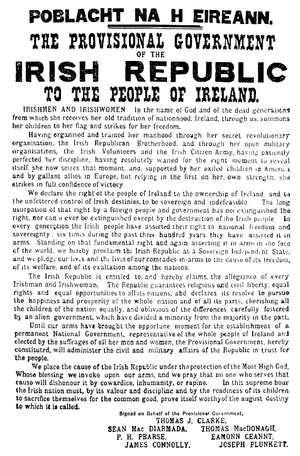
A Proclamation of the Irish Republic has been draw up. Some 2000 copies are to be printed overnight on an old hand-crank press in the basement of Liberty Hall. The first name appearing at the bottom is Thomas J. Clarke. Underneath appear: Sean McDermott, P.H. Pearse, James Connolly, Thomas MacDonagh, Eamonn Kent, Joseph Plunkett.


POBLACHT  NA  H  EIREANN

THE  PROVISIONAL  GOVERNMENT

OF THE

IRISH  REPUBLIC

TO THE PEOPLE OF IRELAND

IRISHMEN AND IRISHWOMEN:  In the name of God and of the dead generations from which she receives her old tradition of nationhood, Ireland, through us, summons her children to her flag and strikes for her freedom.

Having organized and trained her manhood through her secret revolutionary organization, the Irish Republican Brotherhood, and through her open military organizations, the Irish Volunteers and the Irish Citizen Army, having patiently perfected her discipline, having resolutely waited for the right moment to reveal itself, she now seizes that moment, and, supported by her exiled children in America and by gallant allies in Europe, but relying in the first on her own strength, she strikes in full confidence of victory.

We declare the right of the people of Ireland to the ownership of Ireland, and to the unfettered control of Irish destinies, to be sovereign and indefeasible. The long usurpation of that right by a foreign people and government has not extinguished the right, nor can it ever be extinguished except by the destruction of the Irish people. In every generation the Irish people have asserted their right to national freedom and sovereignty; six times during the past three hundred years they have asserted it in arms. Standing on that fundamental right and again asserting it in arms in the face of the world, we hereby proclaim the Irish Republic as a Sovereign Independent State, and we pledge our lives and the lives of our comrades-in-arms to the cause of its freedom, its welfare, and to its exaltation among the nations.

The Irish Republic is entitled to, and hereby claims, the allegiance of every Irishman and Irishwoman. The Republic guarantees religious and civil liberty, equal rights and equal opportunities to all its citizens, and declares its resolve to pursue the happiness and prosperity of the whole nation and of all its parts, cherishing all the children of the nation equally, and oblivious to the differences carefully fostered by an alien government, which have divided a minority from the majority in the past.

Until our arms have brought the opportune moment for the establishment of a permanent National Government, representative of the whole people of Ireland and elected by the suffrage of all her men and women, the Provisional Government, hereby constituted, will administer the civil and military affairs of the Republic in trust for the people.

We place the cause of the Irish Republic under protection of the Most High God, whose blessing we invoke upon our arms, and we pray that no one who serves that cause will dishonor it by cowardice, inhumanity, or rapine. In this supreme hour the Irish nation must, by its valour and discipline and by the readiness of its children to sacrifice themselves for the common good, prove itself worthy of the august destiny to which it is called.

Signed on Behalf of the Provisional Government,

Thomas J. Clarke

Sean MacDiarmada                          Thomas MacDonagh

P.H. Pearse                                          Eamonn Ceannt

James Connolly                                  Joseph Plunkett

Reference: Rebels, by Peter De  Rosa
Posted in Easter Rebellion, history, Ireland, writing | Tagged , , , , , , | Leave a comment

A Prelude to the Easter Rising, 1916. Pt. 2

 28-year-old Mary Scanlon continues her narrative letter of March 31, 1916, to her brother Mike in Seattle.

With longtime family associate Steve O’Hanlon, she is in the office of John Devoy–New York-based Irish revolutionary. An imminent uprising against British rule of Ireland is being discussed.

I decided not to ask more about who this Robert Monteith is. I only knew that he was a member of Connolly’s Transport Workers’ Union, and that he had recently come ‘stateside’ with his family—that his wife Mollie and three daughters are living safely in the Bronx. And that he is somehow connected with Roger Casement in a second gunrunning expedition–on a much grander scale than that of 1914–and in the raising of an “Irish Brigade” among Irish prisoners-of-war (soldiers fighting on the side of Britain) held in Germany.

At this point it was decided I should sit out in the hall, as more sensitive matters were discussed. Through the imperfectly-closed transom I could here John Devoy’s voice rising, no doubt further discussing Roger Casement’s lack of discretion. I overheard words to the effect that Casement had offered to his German co-plotters the use his prisoner-of-war brigade to liberate not only Ireland, but Egypt. “Egypt, for chrissakes!” I heard Devoy explode from behind the closed door and transom. I also heard more than once the expletive, “the whoreson!” I gathered Casment’s efforts to raise the brigade had been faltering anyhow, and that Devoy was pinning his hopes on Monteith. And that Sir Roger had spent much of the year 1915 in a German sanitarium, suffering from nervous collapse.

A half an hour later I was let back into the office. Poppa Steve and Mr. Devoy were discussing “Skeffy” Skeffington. Though Devoy dismissed him as a crank and a pacifist, besides being a teetotaler, vegetarian and feminist, Steve pointed out that the man’s very notoriety around Dublin could make him useful. His recent hunger strike in Montjoy Jail, where he was serving six months along with Irish Republican Brotherhood organizer Sean McDermott—for opposing British army recruitment—was making him a minor hero on both sides of the Atlantic. “And we need the pacifists over here,” Steve said. “If we go to war against Germany, you know as well as I do that our government would consider the Clan na Gael a treasonous organization.”

“And do you really think, O’Hanlon, that that sanctimonious Presbyterian Woodrow Wilson would have the…guts to round us up and put us in jail? While our boys are ‘over there’…saving democracy?”

“Well, he did allow a Utah firing squad to put an end to Joe Hill last November.”

“But Steve, that was a ‘sin of omission.’ Which takes a lot less courage. He just didn’t intervene forcefully enough with the Utah governor.”

“Well, that may be true, John. But you know what power does to people—especially wartime leaders.”

“I’ll grant, O’Hanlon, that allying with the pacifists here and in Ireland can’t hurt. And there’s truth in Skeffy’s witticism about a crank being an instrument that makes revolutions…. Actually, I kind of like that!”

Francis Sheehy Skeffington from Wikipedia

Francis Sheehy Skeffington
from Wikipedia

“And I like what he says, John, about this ‘war to end wars’—as the Allies are starting to blare. ‘There’s no such thing,’ Skeffy says. ‘Each war is a prelude to the next.’ ”

“But not so our Revolution, O’Hanlon. When Ireland is free, centuries of conflict will be over. But first, men will have to be ready to die. And we’ll need a man who can inspire that readiness in others—a live hero, not another dead one. Though he may well end up a dead one.”

“So, John, are you talking about Patrick Pearse?”

“Who else could it be? Old Tom Clarke watched his way with the crowd at O’Donovan Rossa’s funeral. Why, even Clarke had to bite back tears! And like Plunkett and MacDonagh, Pearse is a poet and a teacher. They say he has the face of an angel; but a heart of iron and a spine of steel—if I may engage in some hackneyed metaphors. The fact is, he will die for Ireland if need be, and others will follow. Tom Clarke sees this—and like me, he’s not one to suffer fools gladly.”

“A pity, John…there will be more ‘horizontal’ heroes. It wouldn’t be so bad if they were geezers like you or me—or Clarke. But I daresay most will be young.”

“The young make the best heroes—and martyrs,” Devoy said. “Thank you for coming in, O’Hanlon.” Steve and I both took this as a dismissal. “And the best to you, Miss Scanlon…. And remember the name—Patrick Pearse.”

It not being quite dark when we returned to Penn Station, Steve and I took the short walk along 34th Street to join the bundled throngs gawking at the moving Christmas display in the chain of windows at Macy’s. By the time we were returning home, I felt grateful to be snug in a warm steam-heated coach. New York City streets can be especially inhospitable in the dead of winter. Unlike the trip in, Poppa Steve and I talked little. He may have been ruminating on men becoming heroes by dying. For Christmas, Daddy had given me an anthology of young Irish poets, which I took with me on our little New York excursion. I opened it and pencil-marked verses from three of the authors. I have since typewritten them and include them here, as a fitting finale to another one of my lengthy letters to you. (Note: I have added the authors’ current ages).


From THE YELLOW BITTERN:

My Darling told me to drink no more

Or my life would o’er in a little short while;

But I told her ’tis drink gives me health and strength

And will lengthen my road by many a mile.

You see how the bird of the long smooth neck

Could get his death from the thirst at last—

Come my soul, and drain your cup,

You’ll get no sup when your life is past.

In a withering island by Constantine’s halls

A bittern calls from a wineless place,

And tells me that hither he cannot come

Till the summer is here and the sunny days.

When he crosses the stream there and wings o’er the sea

Then a fear comes to me he may fail in his flight—

Well, the milk and the ale are drunk every drop,

And a dram won’t stop our thirst this night.

Thomas MacDonagh (age 37)

Thomas McDonagh from Wikipedia

Thomas MacDonagh
from Wikipedia

THE LITTLE BLACK ROSE SHALL BE RED AT LAST:

Because we share our sorrows and our joys

And all your dear intimate thoughts are mine

We shall not fear the trumpets and the noise

Of battle, for we know our dreams divine,

And when my heart is pillowed on your heart

And ebb and flowing of their passionate flood

Shall beat in concord love through every part

Of blood and brain and body—when at last the blood

O’erleaps the final barrier to find

Only one source wherein to spend its strength.

And we two lovers, long but one in mind

And soul, are made only flesh at length;

Praise God if this my blood fulfils the doom

When you, dark rose, shall redden into bloom.

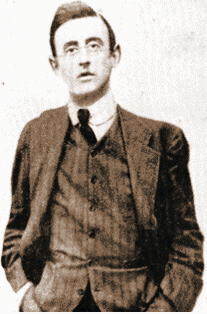
Joseph M. Plunkett (age 29)

Joseph M. Plunkett from Wikipedia

Joseph Mary Plunkett
from Wikipedia

From THE REBEL:

I come of the seed of the people, the people that

sorrow,

That have no treasure but hope,

No riches laid up but a memory

Of an ancient glory.

My mother bore me in bondage, in bondage my mother

was born,

I am the blood of serfs;

The children with whom I have played, the men and

women with whom I have eaten,

Have had masters over them, have been under the lash

of masters,

And, though gentle, have served churls;

The hands that have touched mine, the dear hands

whose touch is familiar to me,

Have worn shameful manacles, have been bitten at the

wrist by manacles,

Have grown hard with the manacles and the task-work

of strangers,

I am the flesh of the flesh of these lowly, I am bone of

their bone,

I that have never submitted;

I that have a soul greater than the souls of my people’s

masters,

I that have vision and prophecy and the gift of fiery

speech

I that have spoken with God on the top of His holy hill.

And now I speak, being full of vision;

I speak to my people, and I speak in my people’s name

to the masters of my people.

I say to my people that they are holy, that they are

august, despite their chains,

That they are greater than those that hold them, and

stronger and purer,

That they have but need of courage, and to call on the name of their God.

Patrick H. Pearse (age 36)

From IDEAL OR RENUNCIATION:

I turned my back

On the dream I had shaped,

And to this road before me

My face I turned.

I set my face

To the road here before me,

To the work that I see,

To the death that I shall meet.

Patrick H. Pearse

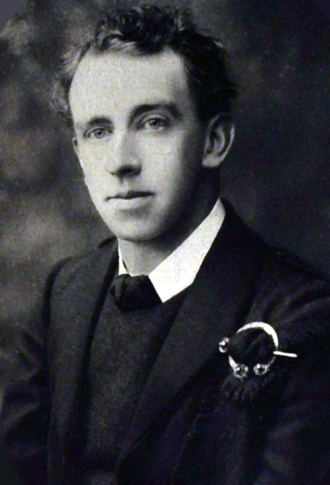
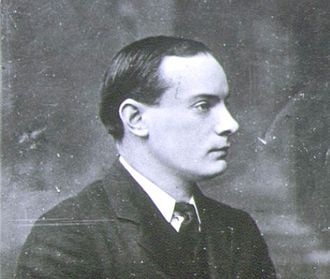
330px-Patrick_Pearse

Patrick Henry Pearse, from Wikipedia


They may not be Ireland’s best poets. Certainly William B. Yeats surpasses them. And MacDonagh’s entry is translated form the Gaelic. But—the meeting of crusty old John Devoy still fresh in my mind—I started quietly crying while reading them. Poppa Steve looked over and saw what I was reading, then smiled—giving me a pat on the shoulder and offering me his pocket handkerchief.

What strange times we’re living in, brother Mike! But I shall not be driven to foreboding thoughts—and I shall try to steer our father clear when he threatens to bump up against the wall of mental darkness. It’s really not like him. It is our mother who over the years has been stricken with the bouts of melancholia.

Well, my dear brother, till we meet again—or at least write again, I remain yours,

Mary

Posted in Easter Rebellion, history, Ireland, Irish poetry, writing | Tagged , , , , , , , | Leave a comment

A Prelude to the Easter Rising, 1916. Pt. 1

This coming week marks the 98th anniversary of the Irish Easter Rebellion, also known as the Rising. Following is an excerpt from a letter, dated March 31, 1916, sent by 28-year-old Mary Scanlon–of Riverport, New Jersey–to her older brother Mike, out in Seattle. In her letter, Mary narrates taking the train into New York City, accompanying old family associate Steve O’Hanlon, on his way to visit with Irish revolutionary John Devoy. An  uprising against British rule is to be a topic of discussion. O’Hanlon, like many Irish-Americans, has pledged monetary support to the cause.

From Book 4 (not yet named or published) of the I’ll Take You Home Kathleen series. Previous excerpts are from Book 2, Beyond the Divide.


Our train eased out of Newark, rumbling across the Passaic River into Harrison. Before we had time to gain any speed, we were stopped at Manhattan Transfer, the junction where the old line veers eastward to Jersey City and the new track, with its electrified “third rail,” runs northeasterly, to mid-town Manhattan. We were stopped for at least five minutes as our steam engine was switched off. An electric locomotive, a “tunnel motor,” was coupled on to what Steve referred to as our “head end.”

As we eased smokelessly and relatively quietly over the Hackensack Meadows (more marsh and swamp than meadow, as I’m sure you remember Mike—plus now sprouting increasing numbers of grim-looking industrial structures), Steve asked me about Margaret Sanger, whom I’d once met at one of Mabel Dodge’s salons, to which I’d gone accompanying Steve’s mother, Norah Quinn. Steve chuckled at the memory of his mother, of the eclectic element of people she’d met in her post-motherhood years of advocacy of what she termed “social justice”—at times to her son’s distress, (particularly when accompanying Mary Harris Jones on her sojourns organizing coal miners). He then turned serious while looking at me, asking what I knew about this Sanger woman and her notion of “voluntary motherhood.”

“I believe in the suffrage movement,” Steve said. “Women should certainly have full equality when it comes to being citizens. But some of this stuff coming out—feminism, I hear they’re calling it—well, it seems to me it could cause our whole society to fracture along dangerous lines. Anything that threatens the sanctity of the family…”

I composed a reply while taking in the dubious New Jersey scenery. With no barking steam engine up ahead, it was as though our train were propelling itself by some magical force—which is what electricity is to me. Out our right-side window the torpid Hackensack oozed through multiple acres of cattails and sedge grass, backed by the abrupt escarpment of Bergen Hill—the rock-solid underpinning of Jersey City, Hoboken, Weehawken—walling us off from the Hudson and any glimpse of skyward-building Manhattan. On our left side, undefined in distant haze, the cities of Kearney, the Oranges, Bloomfield, the ridge of Montclair, abounded beyond the Passaic—the river, brother to the Hackensack, draining the hills of Northern New Jersey into Newark Bay. “Margaret Sanger,” I said to Steve, “is not at all opposed to family. But as a nurse, she has seen more than enough suffering while working in the tenements of the Lower East Side. Women exhausted physically and mentally from bearing and rearing children—lives made hellish for both wife and husband, overworked trying to provide a living on inadequate wages—ten people crowded into spaces suitable for two or three. She has nursed women severely injured who in desperation tried to end their pregnancies—and in not-a-few cases have died from the attempt.”

Steve O’Hanlon was silent for a moment. Out the left window the sudden rise of Snake Hill—rock-faced island seeming to float on the green sea of marsh—flitted past. “Please don’t think, Mary, that modest success in life has made me insensitive to human suffering. Though perhaps people like Mrs. Sanger—and yourself—who enter the medical profession are…more directly affiliated with such.”

“Poppa Steve,” I said. This is what I’d been calling him—the father of our brother Ed’s wife—since I was a little girl. “I hope you don’t think I’m implying that you’re inured to human misery—especially among the disadvantaged classes. I know that would be your main motivation for taking up the cause of Irish freedom. We must choose our battles, mustn’t we? But of course you know there is suffering on a grand scale among the poor on this side of the Atlantic too.

“I would hardly deny that, Mary. And certainly my mother—bless her—never let me forget it!” Our train was now curving directly toward the twin tunnel entries piercing Bergen Hill.

“Margaret ­Higgins,” I said, “was not born poor, but she’s seen her own share of suffering. Her mother, a devout Catholic, endured 18 pregnancies, with 11 live births. In 1896—when Margaret was 17—Mrs. Higgins died of T.B. and cervical cancer. Margaret caught the T.B. from her dying mother. In 1902, she married William Sanger, an architect. They lived up at Saranac Lake, for her health, in a house Mr. Sanger designed—which burnt down four years ago. Since then they’ve lived in New York City. Three years ago she separated from her husband. Just last November, their second child, a daughter named Peggy, died at age five. Through it all—besides her work as a nurse—Mrs. Sanger has traveled and lectured, and been threatened with arrest for preaching what they’re starting to call ‘birth control.’ She’s also been threatened for writing a pamphlet called Family Limitation and for her regular columns in the New York Call—the socialist weekly—called ‘What Every Girl Should Know.’

“But,” I continued, “I think religious leaders and others of her critics have the wrong idea about her. She sees contraception not as a license for wanton sexual behavior, but rather as a means to alleviate human suffering, especially among women. In fact, her moral standards are really quite strict.”

In an instant we were in the tunnel, now enveloped in darkness outside, the incandescent-lit interior of our coach accentuating our placement in a public setting. I could see Poppa Steve was now visibly uncomfortable with the topic, especially after my airing of certain terms. In the new intimacy of the tunnel, I chose to let the topic lie…. It may have made an impression on him. I stared out the window, nothing to see but an electric bulb darting by every hundred feet or so, barely illuminating the concrete-lined conduit through which we careered. A continuous concrete platform—level with the coach windowsills—completed the monolithic scene “outside.” When I estimated we were well under the Hudson River, I said, “Poppa Steve—do you ever think of the possibility of our train running headlong into an oncoming wall of water?”

That brought him out of his dour reverie regarding feminism and birth control. He smiled as we looked around at our electrically-illuminated fellow passengers—in various attitudes of boredom, whether gazing idly out at the passing concrete, buried in a newspaper, or dozing. Besides Steve and me, only two passengers, both ladies, were actually regarding one another and engaged in conversation.

“I would imagine, Mary,” Steve replied, “that the thought may have popped into the head of everyone on this train—if only for a fraction of a second.”

“And then instantly banished,” I added. “Doesn’t it seem odd, Steve, that ten years ago men were building this tunnel and that it was the ‘talk of the town?’ How everyone marveled at the audacity of it all? Pushing through the muck under the Hudson, men drowning—or getting the bends. And now look!” I said, with a perfunctory hand wave taking in the sight of our jaded fellow riders, “Just five years after opening to train traffic, it’s become mundane…a boring interlude on the way into the City. And to think, they once feared these tubes—providing us passage through rock and mud and under water—would shift…and fracture.”

“They still might, Mary—hopefully not while we’re in them.”

I confessed to Poppa Steve that I had an urge to stand up in the aisle and start yelling at the somnambulant passengers, telling them to wake up, to realize the sacrifices that went into this travel convenience, the incredible engineering, the business acumen, the political maneuverings—not to mention the precariousness of our position, hurtling along beneath the riverbed. We should all be singing peons…and praying for our safety.

“Sure it’s the Irish in you, Mary,” he said, unable to stifle a laugh. “You’re much like my mother was—though you’re not blood-related.”

Every time I mount the stairs from the subterranean gloom of the train platforms into the welcoming concourse of Pennsylvania Station, I feel like singing peons… toward the vaulted glass roof shimmering with sunlight 100 feet above us, over soaring lattice-steel columns and arches. Tramping the glass-block floor are throngs of humanity—the immensity of space swallowing up any sense of crowdedness—pulsing in all directions, purposeful but not harried, rich and poor alike, the learned and the illiterate, each in his or her own way taking in the grandeur that awes but does not cow. A magic melding of corporate grandiosity and Whitmanesque Democracy, it belongs to us all, so long as we are on-the-move. The giant wall-mounted Benrus clocks face from the four directions of the compass; no crucifixes here, in this temple to our national religion: Transportation.

Through a phalanx of doors, leaving behind the glass and steel of the Industrial Age, we come under the pink-granite arches and lunette windows of the waiting room, evocation of the Baths of Caracalla. Next, a broad stairway shall take us up one more level, to the vaulted arcade leading to the colonnaded Seventh Avenue entrance.

“What are you thinking, Mary?” Steve asks as we make this last ascent toward street level.

“Of sandhogs and powder men, and iron workers and stone-chiselers; of corrupt Irish-American politicians—of contracts won in backroom deals; of Pennsy president Alex Cassatt, who didn’t live to see his dream completed—but whose 10-foot-tall granite effigy is at this moment watching over us.”

“Ah, Mary, your daddy was right. You too are afflicted with ‘the touch of the poet’—along with your brothers Mike, and Jimmy…poor Jimmy.”

Emerging into the real New York world through the Corinthian columns bordering Seventh Avenue, Steve hailed a motor-cab which would bear us in modern, horn-bleating fashion to the office of the Gaelic American.

Well, Mike, whether or not we have the “touch of the poet” is certainly debatable—especially in my case. I’ve always thought of myself as a hard-headed, non-romantic realist. But I will admit to being the worst-afflicted in our family of a tendency to run-on in letters to where they end up requiring an extra penny for postage (which has sparked extra criticism from Mother to the point where I will no longer allow her to do any of my mailings!). So here I am, in a letter meant to describe our meeting with Mr. John Devoy, and after multiple pages we’ve just managed to traverse the 20 miles into New York. Thus the introductory portion of my missive may surpass in length that which was meant to be the main content.

John Devoy, I understand, is around Daddy’s age, perhaps a year younger—but quite unlike him in demeanor. The man, sporting a post-Civil War style beard, looked up at me from his typewriter with what I wasn’t sure was suspicion or lizard-like indifference. The office—indeed his very person—sent to my nostrils a message redolent of paper, old varnished wood and dusty bachelorhood. He’d been expecting our dad, as a possible recruit into the Clan na Gael. “Who is this girl?” was his charming conversation-opener when I

John Devoy from Wikipedia

John Devoy
from Wikipedia

was presented instead. Conversationally, Poppa Steve handled him with kid gloves. He’d warned me in the taxi that Devoy is known to laugh about once a year (on a good year) and to smile not much more often. As with Old Tom Clarke (I learned), his 15 years of British imprisonment had hardened his heart not only to that Empire but to humanity in general—though next to Devoy, Tom Clarke was a man exuding levity. Old Devoy, Steve had told me, concentrated his passion, his entire zest for living, on one all-consuming cause—freeing Ireland from seven centuries of British domination. Only when Ireland was free would he return there to gladden his calcified heart, to revel in the green glens and rain-dappled meadows and mist-shrouded hills of his boyhood.

I stifled a giggle when I saw the unused extra hat on the rack by the door. Steve had explained that Devoy kept an extra unworn hat or two on hand, in the event a visit or a telephone call might cause an explosion of temper—which subsided only after he had stomped to shapelessness his current hat.

After the perfunctory introduction, Devoy nodded in the direction of a swivel chair at an unoccupied desk, Poppa Steve mumbling to me a clarification that I could sit there as a listener-observer until I would be asked to wait on a bench out in the dim hallway, with office door and transom shut, when talk turned to more secretively weighty matters.

I did glean that Steve O’Hanlon had the full trust and respect of John Devoy—to the extent that anyone could. Devoy listened in his lizard-like way as Poppa Steve told him I was “one of the family,” a medical student, and “had it within me to be a firebrand.” Devoy actually softened a trifle and even—for my own benefit, I’m assuming—though he looked toward me obliquely at best—reminisced a little about his old times in New York with Tom Clarke, who in 1902 had married Kathleen Daly and settled in Brooklyn for a few years, before returning to Dublin to become “the brains” of the Irish Republican Brotherhood.

Following a pause of acceptable length between Poppa Steve O’Hanlon and John Devoy, I asked Mr. Devoy if he had personally know Jeremiah O’Donovan Rossa, the early-generation Fenian whose passing last year prompted the eloquent eulogy from young Patrick H. Pearse. By now I was familiar with the Rossa legend. Joining the I.R.B. in 1858, he was later captured and imprisoned. When the British governor was inspecting the prison, Rossa tossed through the bars the contents of his slop-pail, landing it straight in the governor’s face. “Oh sir, ’tis clean water!” the mortified head warden managed to utter. O’Donovan Rossa was sent to solitary confinement for 35 days, both his hands tied behind his back the entire time.

Jeremiah O'Donovan Rossa from Wikipedia

Jeremiah O’Donovan Rossa
from Wikipedia

“After a goodly number of years he was released,” Devoy related. “In ’71, we both moved to the States. What with his drinking and his hatching of monumentally stupid schemes, I soon regretted my getting to know the man. It was a godsend when Tom Clarke came over here and more-or-less took him under his wing. He and Rossa would go out to the cemetery to pray for dead Fenians—very loudly, and in Gaelic of course.”

“I understand,” Steve interjected, “that Rossa maintained that God doesn’t listen to prayers uttered in English.”

Devoy’s face momentarily relaxed with the reminiscence—the closest I’d seen him come to smiling. His features tightened again when he added, “It was Rossa, you know, who’d first egged Clarke on in the London dynamiting schemes—netting Old Tom 15 years of imprisonment.”

“And it was Old Tom Clarke,” Steve said, “who decided O’Donovan Rossa should be sent home to Ireland to die.”

“ ’Tis so, O’Hanlon. I got hold of Joe McGarrity down in Philly and we agreed to send the old buzzard home. Though Connolly says we already have too many horizontal heroes and need more vertical ones, I had to disagree. One dead Fenian is worth 1,000 German rifles.”

I was about to interject that I knew of James Connolly and his family, due to their being former neighbors of Elizabeth Gurley Flynn’s family in the Bronx—but decided against it, after remembering Steve mentioning that Devoy felt that Connolly’s socialistic proclivities interfered with the cause of Irish freedom—and that likely Devoy didn’t have an exalted opinion of the Flynns. Instead, I asked who McGarrity was.

“Joe McGarrity of Philadelphia,” Mr. Devoy enlightened me, “is a prosperous business man and leading financier of our Clan na Gael. When Roger Casement was over here in 1914, hiding out in case word leaked over his part in the gunrunning episode, it was McGarrity who volunteered to take him in—thankfully sparing myself. I can’t stomach the fellow—Casement, that is…. Sir Roger, knighted by the king! McGarrity sees him as Wolf Tone reincarnated. I see him as a potential liability to our plans—too unstable a man, he is. Not that he would intentionally betray us…. But, you know,” Mr. Devoy continued, looking in my direction, “Sir Roger Casement is reputed to have a liking for handsome young men…if you catch my drift.” Devoy must have observed that I neither blushed nor appeared to be going into the throes of a faint. I felt like I’d just passed a test. Devoy went on. “Quite frankly, I couldn’t care a rat’s…bottom, as to what Sir Roger’s proclivities may be—but it does make him more of a risk. If the wrong people find out and threaten to expose him, shaming him before the world, he just might ‘sing like a canary’ to Scotland Yard or British intelligence. Or one of his own ‘play pals’ might betray him.”

Sir Roger Casement from Wikwpedia

Sir Roger Casement
from Wikipedia

“I’ve already heard,” Steve said, “about that young Norwegian sailor—Adler Christiansen—who accompanied him to Germany.”

“It may well be, O’Hanlon, that I made a mistake in trusting Christiansen to help get Bob Monteith over to Germany…. Ha! Wait till Sir Roger finds out that his boy Adler has a kept woman in some slum in Jersey City! But I know I can rely on Monteith, with or without Adler Christiansen’s help. He won’t let drink or women sidetrack him. And he didn’t flinch when I reminded him that failed Irish plans tend to turn men into corpses.”

Posted in Easter Rebellion, history, Ireland, writing | Tagged , , , , , , , , , , , , | Leave a comment

Along Chuckanut’s Shore

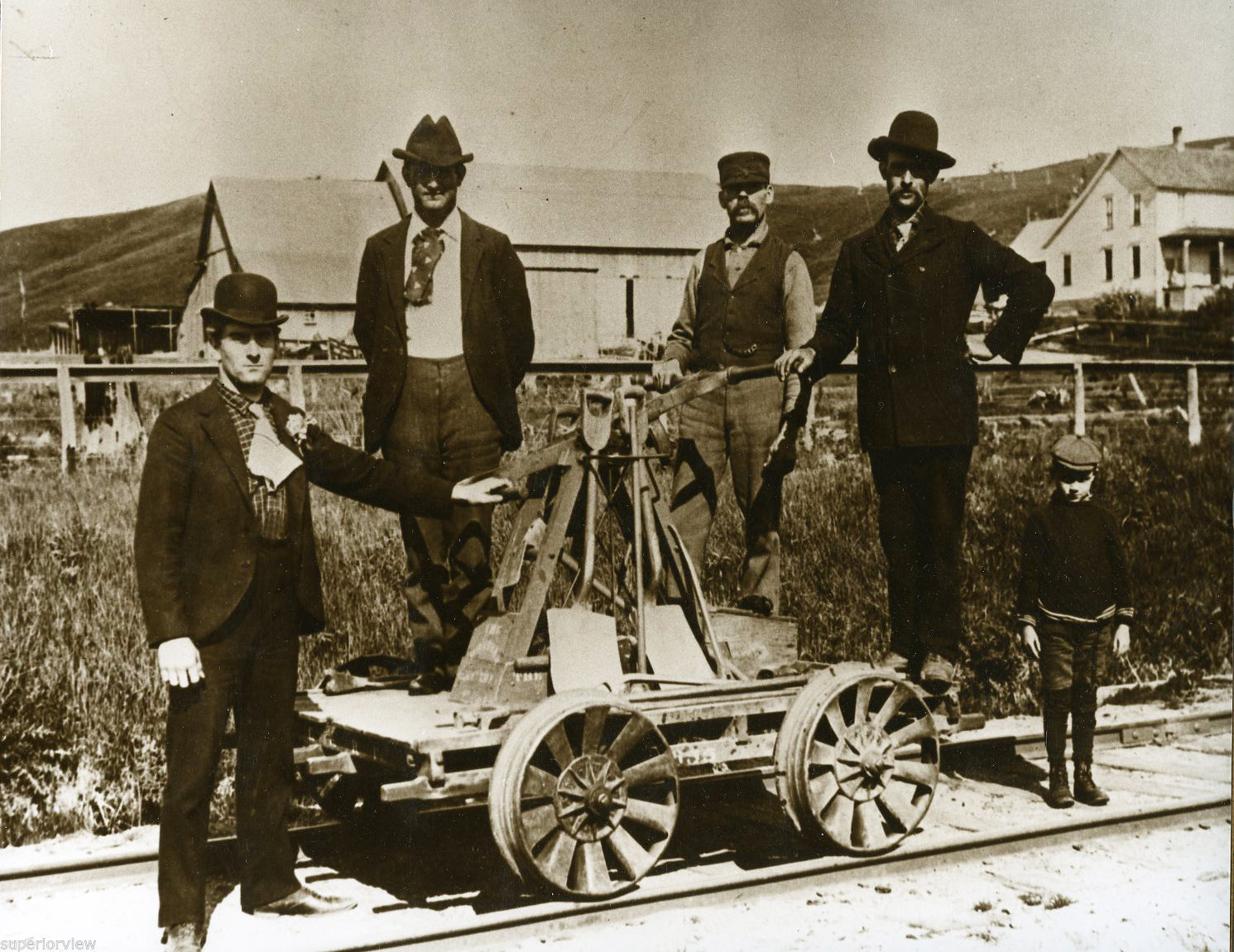
Typical railroad handcar, late 19th Century. Motion is activated by pumping handle pivoting on pedestal. photo from ebay

Typical railroad handcar, late 19th Century. Motion is activated by pumping handle pivoting on pedestal.
photo from ebay

July 4th, 1890

Following a winter of separation, Susie Taylor teaching school in Seattle and Jimmy Scanlon working railroad construction up in Fairhaven, the couple are reunited for the holiday. 

Excerpt from Beyond The Divide:

Leaving behind the throngs on Harris Avenue, along with the band concert, parades and speechmaking, Jimmy with Susie Taylor walked down into the ravine where Padden’s Creek provided a natural cut for the new tracks of the Fairhaven & Southern. Chained and padlocked to a tree where he had left it the day before, Jimmy found the handcar and set it on the tracks. Each mounting an end, Jimmy on the rear facing the track ahead, they pumped along the steady grade, the oratory and popping of firecrackers and occasional gunshots happily receding as the young man and woman rolled through lush green brush growing around enormous stumps in the newly invading sunlight. There would be no work trains on the uncompleted line today; nevertheless Jimmy by habit kept an ear tuned for the sound of a locomotive as they approached a long blind curve taking them southward, away from Padden’s Creek. Susie grinned as she worked her end of the pump, keeping her chin well clear of the handle on the upstroke.

Coming upon a treed canyon named Arroyo, they chained the car to the track. From here the line curved away to the left for the short climb to Samish Pass, from where it would run downgrade toward the Skagit. Susie and Jimmy chose the other direction, clambering down the bushy slope to Chuckanut Creek below. Following the creek for less than half a mile led them to the head of Chuckanut Bay, a dry breeze from the northwest kept the sun-brightened day temperate, even as the temperature reached well into the 80’s. The incoming tide crept toward stranded starfish—five-legged and many-legged, spiny splotches showing greenish or red, some purple—patiently awaiting their re-immersion as they decorated rocks and shallow pools. Over sandstone outcroppings and confined sand and shell-covered beaches the young man and woman moved, holding hands where the walking was easy, climbing and skittering over rocky impediments, at times resting by an isolated fir tree—some permanently arched by salt-laced winds.

Festive and summery in white shirtwaist and blue skirt barely reaching her boot-laced ankles, Susie’s unpinned hair tumbled beneath a flower-bedecked hat. Jimmy felt raffish in sailor-style straw hat and collarless shirt open at the neck—at Susie’s suggestion leaving behind jacket and tie, reminding her of pictures of Walt Whitman in his long-gone youth, complete with semi-pruned young man’s beard. Susie gasped and started, then broke into a laugh when an equally startled great blue heron fluttered from a rock-encased cove, sounding notes of raucous harshness, flapping off to shore-side treetops, draping behind stick-like legs in lieu of tail feathers, mimicking sketches of flying reptiles. Jimmy suggested they might see a whale cavorting, maybe even a pod.

At a particularly agreeable cove, where ground-up shells crunched underfoot—left by centuries of Indians gathering and feasting, Jimmy explained—they sat down and both unlaced their boots, the beach partly shaded by an outcropping capped with greenery and, at its base, grotesquely sculpted rocks. She was first to wade out into the miniature waves, gasping at the coldness as she pulled up her skirt exposing not only bared ankles but part of a calf. Jimmy rolled his trousers to his knees and followed, avoiding sharp rocks and reposing starfish.

Trouser and skirt bottoms splashed wet, they gingerly waded back to the dry beach and reclined on the sloping sand and talked as they’d been talking all day, easy and relaxed, of politics and poetry, of the ironies and mysteries of lives not that long into adulthood. When Jimmy put an arm around her waist he felt no stiffening of resistance. Remembering the rainy night streets and front porch in Seattle from six months ago, he found himself running a hand along—then up and down—her back, feeling the sculpted shoulder blades and gentle indentation along the spine. Leaning over and touching lips, her mouth opened warm and yielding.

The unbuttoning of shirtwaist which followed didn’t interrupt the mood, nor did unlacing the corset, his fingers deftly mingling with hers at the task. As more of her skin was exposed Susie managed a giggle and a chide that he seemed all too skilled in the intricacies of helping a woman undress.

The sun shone over and bathed their bared bodies, skin deliciously contacting sand and shells and pebbles underneath, oblivious to any discomfort and marred by no saggy swaying mattress or metallic protest of bed springs, no boxy confinement of musty room, only the soft lap of waves and tenor croak of a raven so aloft yet close enough one could hear the wind from the flapping of wings, and Jimmy thought he heard the sound of spray and vapor spouting through a whale’s blowhole. Sometimes side-to-side, sometimes up and down, their harmonious contraction of muscles merged into a rhythm with the swaying of branches and scudding of clouds, the wave motions of water advancing wind-driven to the shore, and a shuddering cry now welled from the person beneath him, beyond pain, beyond mere pleasure, an animal cry yet sweet and musical and so human. In himself the agonizing pleasure obliterated all sense of personhood, first a godlike feeling of universal aliveness, then easing from a unity with undifferentiated creation into a merging of two, and he joyously quenched the fires consuming them both, the sadness of a return to mortality eased by her nearness as he caressed her shoulders and kissed the tip of her nose, enjoying the sight of her hair matted in the sand.

In a moment they were again side by side. “Hold me, Jimmy,” she said, childlike.

The tide was flooding and her earlier lighter mood returned as the miniature waves merrily licked at their skins, bringing giggles. He kissed her some more and they pulled each other up and waded and splashed out to deeper water, whooping and gasping from the coldness, submerging and emerging cleansed and tingling. Perched on a rock, Susie laughed at his silliness as Jimmy flapped about the sandstone surface for her amusement and barked seal-like. When the sun’s heat banished all moist coolness from their skins, both feeling the first onset of sunburn, they returned to where their clothes were piled and helped each other dress, finishing with lacing of boots.

Retracing their steps along the beach, then up Chuckanut Creek, they returned to the handcar. With the run back mostly downhill, Jimmy stood where he could keep a foot on the brake as he held Susie by the waist, keeping clear of the pump handle flopping up and down set in motion by the coasting wheels. The sun lowering, they recited lines from the Romantic-era poets; some lines from Shelley’s “Ode to the West Wind,” then on to Keats, as they once had as young adolescents, now keeping a rhythm with the rail joints clattering under wrought-iron wheels. As the town approached, in a clear voice over the rumble of the handcar, Susie recited a verse from Shelley where he mourns the untimely death of the young John Keats:

“Oh, weep for Adonais—he is dead!
Wake, melancholy Mother, wake and weep!
Yet wherefore? Quench within their burning bed
Thy fiery tears, and let thy loud heart keep
Like his, a mute and uncomplaining sleep;
For he is gone, where all things wise and fair
Descend; —oh, dream not that the amorous Deep
Will yet restore him to the vital air;
Death feeds on his mute voice, and laughs at our
despair.”

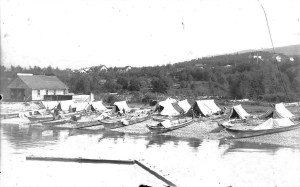
They coasted down the track along Mackenzie Avenue, all the way to the beach front past Harris’ Cove. Crowds were still much in evidence, now drawn toward the water’s edge. Susie and Jimmy saw the blue haze of cedar and alder smoke over the beach, hungrily inhaling its aroma mixed with salmon baking by the score—Indian fashion, staked upright in the sand; the conical woven hats of the visitors from across the bay conspicuous in the throng, their 40-foot war-canoes reposing on the beach.

19710093000007

Lummi Indian canoes, beached below Fairhaven.  Courtesy Whatcom Museum

The young man and woman, happily unnoticed, set the handcar off the track, ready to blend in the crowd and partake of salmon and clams and oysters. The early-July evening sunlight hung about as though ready to forego the habit of setting, in no hurry to disappear behind the mountain that was Lummi Island. They laughed when Jimmy took out his cheap pocket watch and found it broken by the day’s activities.

Posted in history, labor, love, railroading, writing | Tagged , , , , | 2 Comments

Mike, growing up back East

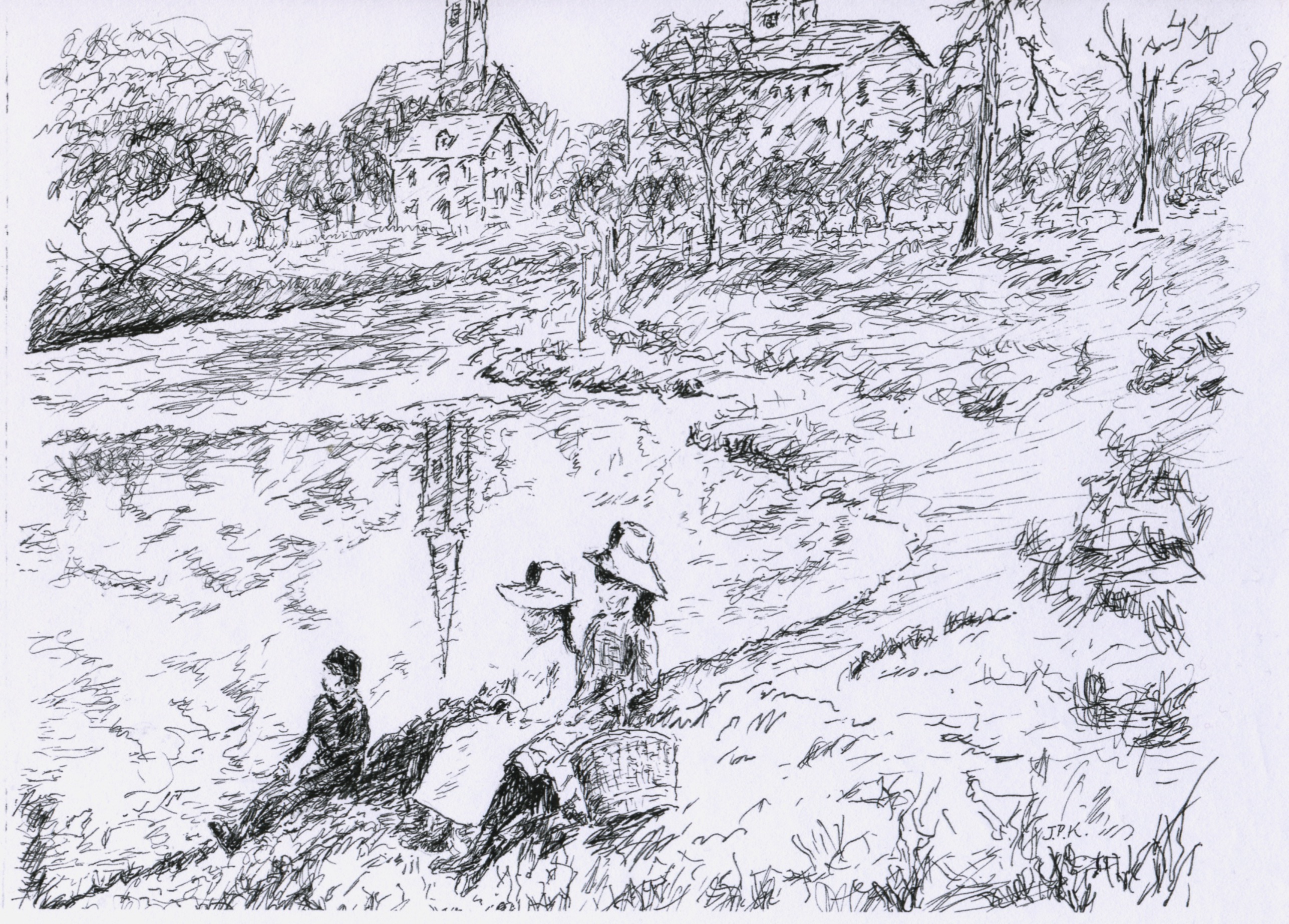
Sunday picnic along the Robinson's Branch. Steeple of German Catholic Church reflected in stream. Sketch by J.P. Kenna from photo appearing in Rediscovery of Rahway, by F. Alexander Shipley

Sunday picnic along the Robinson’s Branch. Steeple of German Catholic Church reflected in stream.
Sketch by J.P. Kenna
From photo appearing in Rediscovery of Rahway, by Alex Shipley


As Seattle begins recovery from a June fire that leveled nearly its entire commercial district, Jimmy Scanlon continues working railroad construction in the booming, more-northerly Puget Sound city of Fairhaven. Learning his girlfriend Susie Taylor came through the Seattle fire unscathed, he continues writing her and longs for a visit. Likewise, struck by unexpected bouts of homesickness, he finds himself pining for his family left behind on the opposite coast–especially his father Francis and little brother Mike.

An excerpt from Beyond The Divide:

That fall of 1889, in New Jersey, Mike Scanlon entered 2nd grade at St. Joseph’s School, a 7-year-old with gaps in his front teeth. His play area widened, a favorite spot now being along the banks of the Robinson’s Branch, its winding course separating Central Avenue from Hamilton Avenue—along with the city’s two Catholic churches, ethnically divided into Irish and German.

The year before Sister Katherine Dominic had taught him to write letters and words in a neat hand, to read, to add and subtract, and to learn through the Baltimore Catechism and vivid storytelling the mysteries of the Catholic faith that he’d taken to heart in his First Holy Communion. Confession was now a monthly ritual, interrupting late Saturday afternoon play with an examination of conscience and, if playing near home, a walk uptown to the church on Central Avenue; or, if he caught the driver Bill O’Hanlon, and the conductor was amenable, a ride from Hazelwood Avenue and up through the center of town on the streetcar. When times were slack and no official looking persons were in sight, Mike used his gap-toothed charm to stand next to the blue-and-brass uniformed driver and jangle the bell, or even take the reins in the less populated areas near his home.

Emerging from the darkened mysteries of the purple-curtained confessional, praying his penance as the stained glass windows on the west wall revealed their episodes of the life of Jesus illuminated by the lowering sun—a boy teaching elders in a temple, a young man pouring clear liquid from one vat turning purple as it entered a second—Mike felt a pleasing mixture of relief and cleansing, heightened by anticipation of supper, as he thought of the three bottles of water on the sister’s desk, props for a classroom demonstration, one clean and pure, as his soul now was again, restored by the sacrament of Penance, in preparation for tomorrow’s Eucharist; the next bottle lightly mottled by drifting ink, a soul in the normal state of venial sin, as his was an hour earlier, the small disobediences and occasional fib; and the third bottle, after the sister poured in a copious amount of ink, stained to deep blackness, mired in mortal sin, a loathsome condition he resolved he’d never reach.

When walking home from school, he often stopped at the Dunlap works to visit his father. Occasionally Francis would get off work early and he and Mike would walk toward home, the boy contentedly taking striding steps to keep up with the man with graying hair and mustache, Francis exchanging a hello with a passersby on the sidewalk, with a shopkeeper in a doorway. Sometimes it would lead to a verbal exchange of pleasantries, to comments on the weather or politics. Having known nothing else, Mike could only take for granted that the man next to him—his father—both protected and admired him, and was well-liked by the people they ran into. The boy also sensed that people liked him too, that just a smile and maybe a few words uttered with a hint of bashfulness would elicit a soft chuckle and a hair ruffling from a big masculine hand; or a returned smile from a woman, and perhaps a comment on his pretty eyes and whether they favored his father or his mother. There were similar reactions when he’d go to the stores with his mother, but sharing the world with his father was yet more special, a world of strong scents, of sweat and tobacco; of political talk and the telling of jokes he didn’t really understand; of background noises of screeching, chugging trains and clattering wagons; of sights of barrels and coal shoots and large tools of wood and iron; of firehouse horse teams stomping on stall floors during idle hours, the animals behind great arched doorways, as ponderous and impressively housed as locomotives in a roundhouse; of livery stables and noisy shops, of the forbidden saloons; all part of a world belonging to men he was already sensing would someday be his, a world that, as in his present state of being well-loved and fed and safe, he had no reason to think would ever change. Things inexplicable, ink-blackened swirls of the feared and unknown did impinge on occasion, such as the disappearance from his life—from all life—of the little black boy he had once played with at the Quinn’s. And the more venial, such as the tolerable torments of his 11-year-old brother Eddie, and his once being buried in a snow bank; and before that, before she became Mrs. Quinn, the cutting of his head on Mrs. O’Hanlon’s porch railing, somehow intertwined with a string of events that led to Jimmy’s leaving. Jimmy, why have you gone from us? Where is this world you write letters from, that they call the West? Is it the final place the trains lead to?


Posted in history, labor, writing | Tagged , , , , , | Leave a comment

Paddle, Paddle, George E. Starr

Twice I’ve made the approximately 600-mile trip up the inside passage from Puget Sound to Southeast Alaska in a salmon troller–and one return trip. Averaging 5 to 6 knots, anchoring or tying up each night, seven to ten days from Seattle to Ketchikan was about right. Not much more than wagon-train speed.

My 1914-built troller probably skirted over the water at a little over half the speed of the old Puget Sound side-wheel steamboat, the George E. Starr. Not known as a speeder, even in the closing years of the 19th century, the Starr was soon eclipsed by propeller-driven steamers such as the Flyer and the Tacoma–the latter capable of 20 knots. (A more modern-day Puget Sound ferry such as the Hyak travels at 16 knots). To sum up–none of these are breath-taking speeds. But each in its time and place did (or does) its job.

There is little new to say about our obsession with speed in travel. But as an introduction to an excerpt herein from my novel Beyond The Divide, I’d like to admit that my writing isn’t high-speed either. My goal is to keep it engaging even if it plods along at 10 to 20 knots. If you’re looking for lightning-fast action and constant cliff-hanging suspense, you may want to look elsewhere. Certainly there are moments when the pace quickens. But I like to read and write a story that is on par with the steady rate at which human life and historical drama unfold–or at least did, until the recent hyper-speedup in the media and seemingly everything else we do. All to what end?

A little “back-story” here:

It is early 1889. Jimmy Scanlon, age 23, made his way West following railroad construction. He’s just left Seattle on the Starr, leaving behind his girlfriend Susie Taylor–a school teacher–and best friend and mentor Johnny Driscoll, also a railroad worker. Jimmy is seeking new fortune and opportunity at the boomtown of Fairhaven, some 80 miles north of Seattle. He’s hoping Susie will soon follow him.

Jimmy in the second week boarded the elegant—if not speedy—side-wheeler George E. Starr for Bellingham Bay. Leaning on the rail absorbing the subdued steely-gray water and mountain scenery, he listened to the swishing paddle wheels and steady thump of the walking beam oscillating over the upper cabin. From inside the main cabin came the singing of early-in-the-day merry makers, the childhood tune familiar:

Paddle, paddle, George E. Starr
How I wonder where you are.
You left Seattle at half past ten
You’ll be in Fairhaven, God knows when.

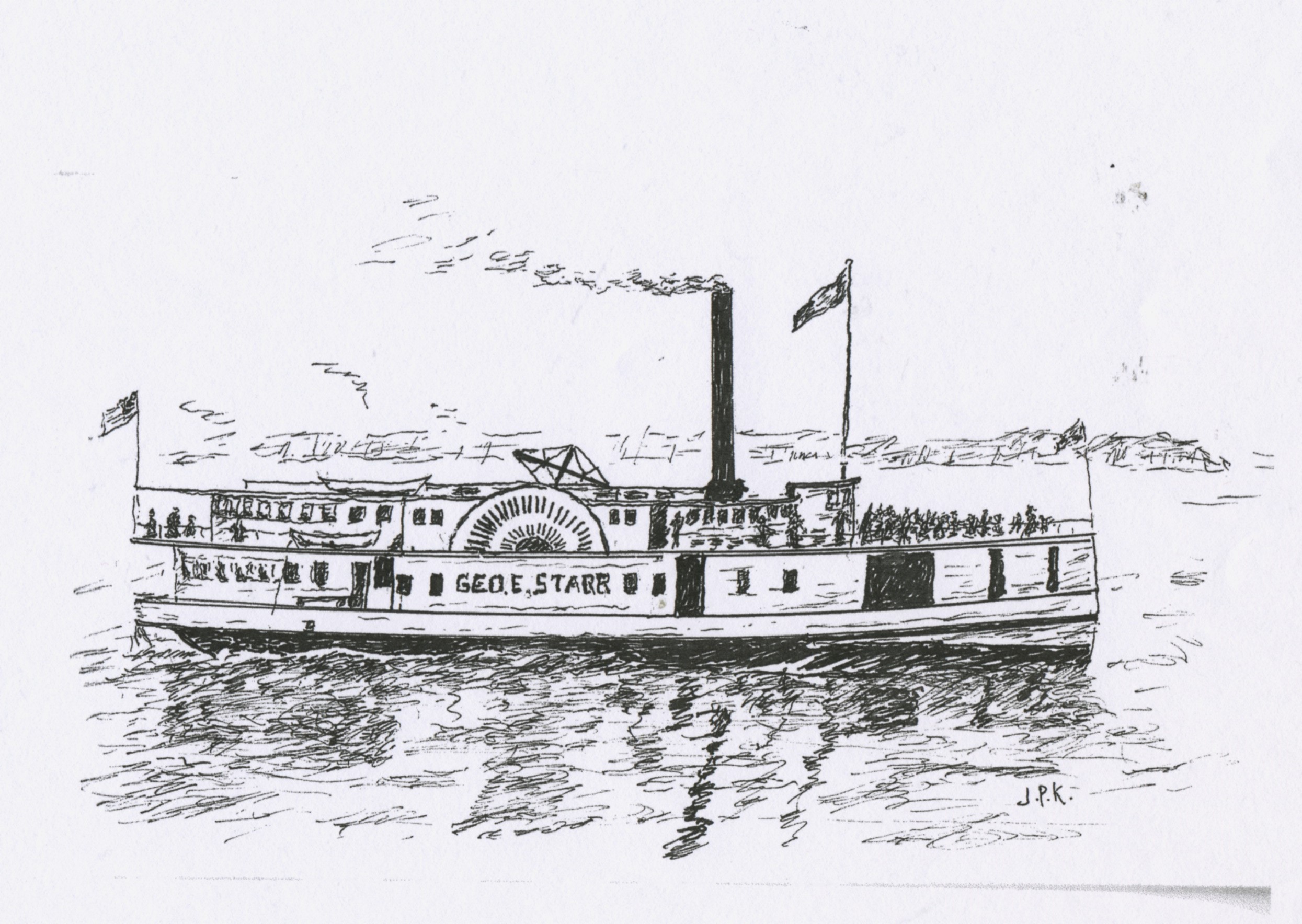
Sidewheeler Geo. E. Starr plods up Puget Sound on as overcast day. Sketch by J.P. Kenna

Sidewheeler Geo. E. Starr plods up Puget Sound on a calm, overcast day.
Sketch by J.P. Kenna

With plenty of railroad construction going on, Jimmy finds a niche in Fairhaven as winter gives way to spring, while keeping up with the happenings of the larger city–and the woman–he’s left behind.

More interested in his own activities and the world immediately around him than in distant news, Jimmy welcomed the coming of spring of 1889, though the rainy days frequently continued to intrude. With memories of springtime “back East” as a profusion of warmth and color under blue skies, he adapted to the unfolding of greenery and flowering of bulbs and fruit blossoms subjugated to days that more often than not continued chilly and gray. On the downtown streets, brightly painted storefront signs did their part to dispel the somberness as pedestrian and horse-drawn traffic plodded about its daily business oblivious to the slick wooden walks, soggy sawdust paths and muddied streets. Human activity continued to proclaim its presence in the richness of burning fir and cedar and maple drifting their scented clouds above brick chimneys and sheet-metal stacks pushing haphazardly over moss-coated shakes and shingles. Never far from the ear were the sounds of sawing and nailing of boards and the slap of mortar and chink, chink of the bricklayers hammer, the laughing and banter and sometimes barked orders of men working, mingling with the squawk of seagulls or the lordly croaking cry of a raven overhead, background sounds for a new city rising.

Jimmy and Susie Taylor exchanged letters weekly and, less regularly, a missive from Johnny Driscoll would describe among other things the latest in Seattle politics and the progress of the Seattle, Lake Shore & Eastern, pushing toward the Canadian connection at Sumas—as was Captain Cornwall’s Bellingham Bay & British Columbia. Also sustaining Jimmy that spring was the memory of huddling close to Susie on a late December evening, sheltered from the worst of the weather by the porch of the house where she boarded. Illuminated by the electric-arc streetlight, he could study her face—so close to his between kisses, her mouth partly open, softening the firm contour of her lips as her breathing quickened, the light sending a straight line down her nose under arched eyebrows as her nostrils widened. Beneath the bundling of winter coats he felt the pliant warmth of slender body, as again they would bury their faces in kisses, breathing in the scent of damp wool and the floral essence of her soap.

~

On the 6th of June, during a spell of premature dryness, men and women mingled and huddled around the Fairhaven telegraph office as the news arrived that Seattle was in flames. The following day Jimmy read past the headlines into details of how the “Queen City” of Puget Sound had burned to the ground. A pot of heating glue had caught fire in a shop and kindled nearby wood shavings and sawdust. From Yessler and Coleman wharves up to Third Avenue, from the Skid Road up to Pike Street, all were embers and ashes and lonely standing chimneys. The arch-rival city of Tacoma was sending up special trains loaded with tent canvas, food, medical supplies, along with tools and scores of people ready to help commence the rebuild.

Posted in history, social criticism, writing | Tagged , , , , , , | Leave a comment

Blizzard of Books, Queries, Reviews, Blogs

jpkenna's avatarJ.P. Kenna

Waiting  for the train from Jersey City. Aftermath of the Blizzard of '88 Sketch by J.P. Kenna Waiting for the train from Jersey City. Aftermath of the Blizzard of ’88
Sketch by J.P. Kenna

OK, the accompanying sketch–from a photograph of the Pennsylvania Railroad depot in Rahway, New Jersey, following a late-19th Century snow storm (likely the legendary Blizzard of 1888)–might strain the metaphor a bit. Certainly it’s undeniable that in our early 21st Century, the unleashing of digital self-publishing is drowning us in a deluge. But in the sketch, the worst appears to be over and life is getting back to normal. The trains are beginning to run again. While in our present-day onslaught, no shakeout is seen coming down the track. The trains are not going to run again. The times-past abundance of independent publishing houses, willing to take on unproven authors who show promise, is not coming back.

A confession–I sneaked in the sketch to help promote my book. It’s one of three appearing…

View original post 770 more words

Posted in writing | Leave a comment

Where Have You Gone, Maxwell Perkins?

jpkenna's avatarJ.P. Kenna

Was it easier to get a book published before the recent onset of mass-digital (mostly self) publishing? It may depend on the type of book. Media celebrities, no matter how vacuous, seem to have no trouble getting book deals with mega-publishers. If, like the rest of us, you start out as an unknown, then you have to demonstrate to agents or publishers that you have on your flash-drive the next Harry Potter series, or 50 Shades of Gray. A tall order indeed.

I’m not sure how this situation measures up to the not-too-distant past, when a plethora of publishers and agents, mostly based in New York, might have looked at a manuscript and, with judicious in-house proofreading and editing, decide to take it on, under the premise that–if not the next multi-million-dollar best seller–the process of setting up the plates for a limited run might at least yield a modest…

View original post 689 more words

Posted in writing | Leave a comment