
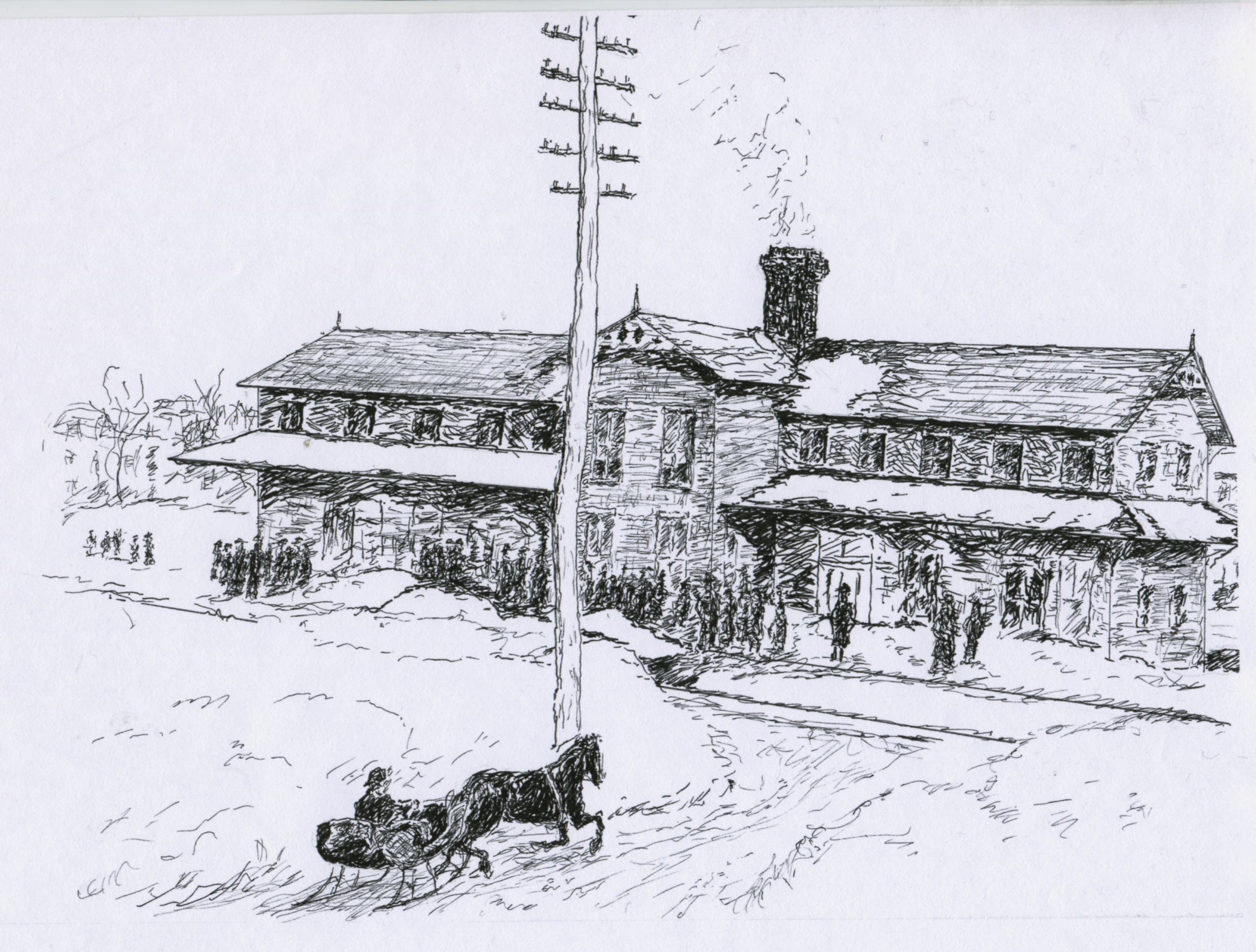
Waiting for the train from Jersey City. Aftermath of the Blizzard of ’88
Sketch by J.P. Kenna
OK, the accompanying sketch–from a photograph of the Pennsylvania Railroad depot in Rahway, New Jersey, following a late-19th Century snow storm (likely the legendary Blizzard of 1888)–might strain the metaphor a bit. Certainly it’s undeniable that in our early 21st Century, the unleashing of digital self-publishing is drowning us in a deluge. But in the sketch, the worst appears to be over and life is getting back to normal. The trains are beginning to run again. While in our present-day onslaught, no shakeout is seen coming down the track. The trains are not going to run again. The times-past abundance of independent publishing houses, willing to take on unproven authors who show promise, is not coming back.
A confession–I sneaked in the sketch to help promote my book. It’s one of three appearing in Beyond The Divide, the second book of an Irish-American epic. And I’ve taken up blogging to help in promotion. And–another confession. I hate self-promotion. Handing out bookmarks with blurbs on them makes me feel like a religious fanatic handing out tracts. And projecting myself out to strangers on Social Media feels–at least to this introvert–a bit creepy. By the way, for more info, please click on the adjacent Facebook link.
Not that it’s all bad news for aspiring authors. If you’re driven to write, you can now see your results in print relatively cheaply. By locating–and paying for–qualified assistance, you can with tolerable effort produce a handsome book, printed on demand. But then, this means that literally millions of writers now have books to give away, to promote through sympathetic book stores, and/or to be placed in inventory in some lonely Amazon warehouse–along with millions upon millions of other lonely volumes.
Most people who go through this not-effortless process think they have a worthwhile product. I know I do. And you start out with this rosy view that browsers (the original, human kind) in your local independent book store–if you’re fortunate enough to still have one–will see your work on the shelf, and that some will be enticed and tell others about it, and a “positive feedback loop” will result. And a grander–but spookier–version of the process will happen online. You anticipate the day when orders coming from Amazon will begin to overwhelm.
You are encouraged by initial interest shown by friends and acquaintances, but discover a sad truth. Of those who say they are going to run out and buy or order your book, only a small percentage actually get around to doing it. And for those who get around to buying and reading your work who say they’ll write a heartfelt, good review of it, again–the percentage of those who actually do is small.
And you start hearing that for agents and reviewers, your treasured work is just part of a “slush pile,” adding to their onerous task of wading through untold numbers of submissions day-after-day. And you force yourself to get more involved in social media and to set up a blog. As millions of others are doing. And you fear your time becoming squandered, wading through mindless cyber-chatter. Instead of writing, or reading a book, or perusing a favorite magazine (which, even if you’re wasting time, can be enjoyable and relaxing) you slog deeper into the murk of on-line talk and rant, and trip over postings with such inspirational titles as “No One Wants To Read Your Shit.”
This is not to say that on-line experience is always a voyage through the doldrums. The results aren’t always depressing. And though being a Luddite at heart, I don’t see all technological innovation as the work of the devil. Word processors are great. I’m using one now, and have been since 1986. On-demand printing is a concept to be harnessed for the good. Professional quality books can be printed and bound in small neighborhood shops, and on machines that can be fitted into a small room. There are services out there for proofreading and editing, for designing covers. There are book review services, some even free. And there is assistance available in sending out e-queries to agents and publishers.
But here’s the rub. Outside of “subsidy publishing,” normal procedure has been to land a publisher who would take on editing, proofreading, printing; and then marketing and distribution–as a partner, with a vested interest in the outcome of your work. By contrast, the self-publishing writer fully pays for such services, often upfront. The providers of these services of course deserve their fees, and generally speaking strive to establish and keep a professional reputation by doing good work. But it’s still not the same as having a partner financially committed to the success of your work. This was traditionally the role of the publisher, through in-house editors such as Maxwell Perkins.
Might the successors to Max Perkins and his ilk even now be out there, forming or taking part in a new wave of independent publishers, using the best of new technology? We can hope. Though rejection followed by persistence will always be the lot of those who are serious about becoming successful authors, there ought to be a better way than facing sure-rejection by mega-publishers; or the time-consuming effort of self-publishing, which, more often than not, leads to another kind of rejection–that of being spurned by the public. Not because your work is bad. Rather, you just don’t get noticed. You’re just one easily-melted flake in a blizzard


Reblogged this on Blue Collar Author.