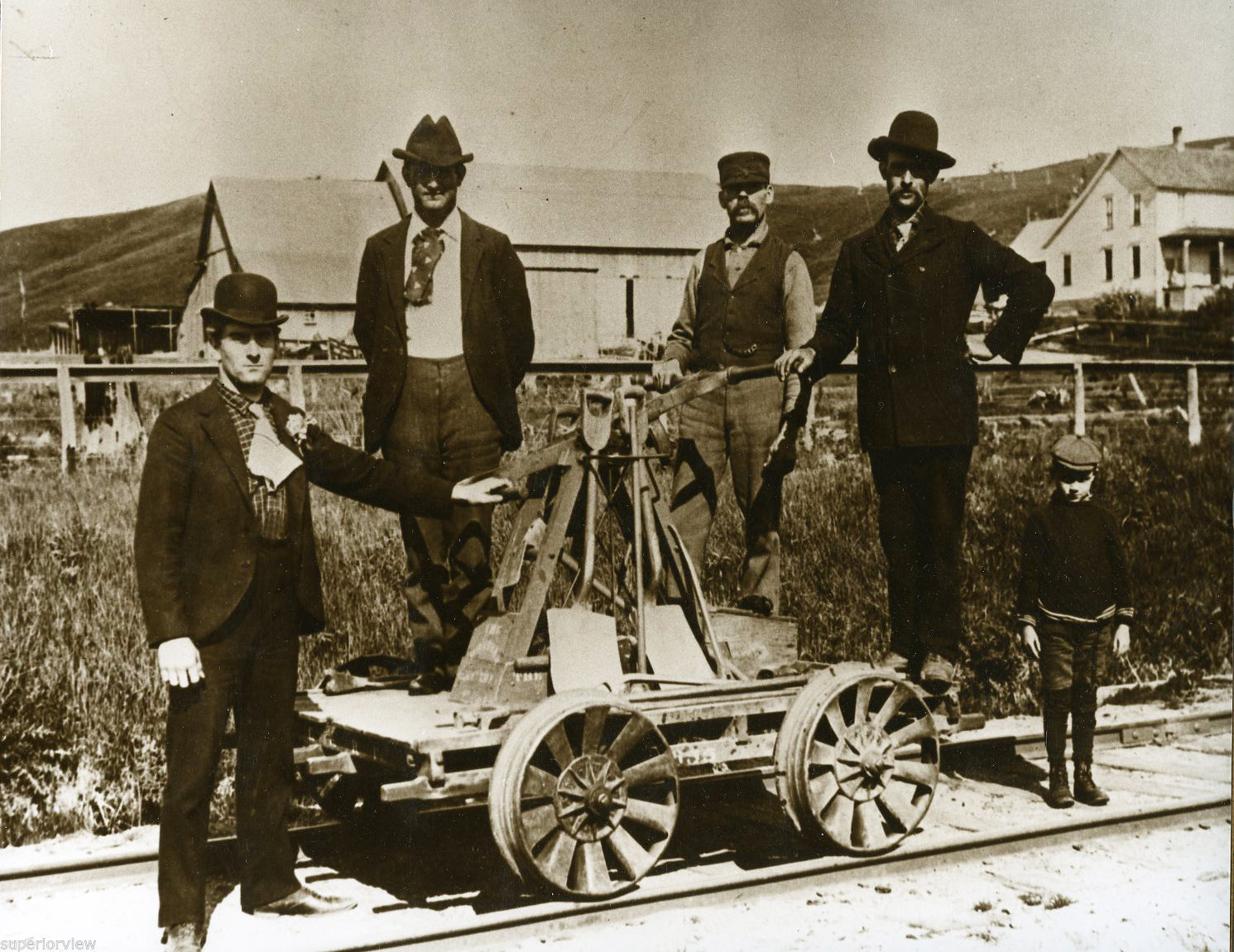
Typical railroad handcar, late 19th Century. Motion is activated by pumping handle pivoting on pedestal.
photo from ebay
July 4th, 1890
Following a winter of separation, Susie Taylor teaching school in Seattle and Jimmy Scanlon working railroad construction up in Fairhaven, the couple are reunited for the holiday.
Excerpt from Beyond The Divide:
Leaving behind the throngs on Harris Avenue, along with the band concert, parades and speechmaking, Jimmy with Susie Taylor walked down into the ravine where Padden’s Creek provided a natural cut for the new tracks of the Fairhaven & Southern. Chained and padlocked to a tree where he had left it the day before, Jimmy found the handcar and set it on the tracks. Each mounting an end, Jimmy on the rear facing the track ahead, they pumped along the steady grade, the oratory and popping of firecrackers and occasional gunshots happily receding as the young man and woman rolled through lush green brush growing around enormous stumps in the newly invading sunlight. There would be no work trains on the uncompleted line today; nevertheless Jimmy by habit kept an ear tuned for the sound of a locomotive as they approached a long blind curve taking them southward, away from Padden’s Creek. Susie grinned as she worked her end of the pump, keeping her chin well clear of the handle on the upstroke.
Coming upon a treed canyon named Arroyo, they chained the car to the track. From here the line curved away to the left for the short climb to Samish Pass, from where it would run downgrade toward the Skagit. Susie and Jimmy chose the other direction, clambering down the bushy slope to Chuckanut Creek below. Following the creek for less than half a mile led them to the head of Chuckanut Bay, a dry breeze from the northwest kept the sun-brightened day temperate, even as the temperature reached well into the 80’s. The incoming tide crept toward stranded starfish—five-legged and many-legged, spiny splotches showing greenish or red, some purple—patiently awaiting their re-immersion as they decorated rocks and shallow pools. Over sandstone outcroppings and confined sand and shell-covered beaches the young man and woman moved, holding hands where the walking was easy, climbing and skittering over rocky impediments, at times resting by an isolated fir tree—some permanently arched by salt-laced winds.
Festive and summery in white shirtwaist and blue skirt barely reaching her boot-laced ankles, Susie’s unpinned hair tumbled beneath a flower-bedecked hat. Jimmy felt raffish in sailor-style straw hat and collarless shirt open at the neck—at Susie’s suggestion leaving behind jacket and tie, reminding her of pictures of Walt Whitman in his long-gone youth, complete with semi-pruned young man’s beard. Susie gasped and started, then broke into a laugh when an equally startled great blue heron fluttered from a rock-encased cove, sounding notes of raucous harshness, flapping off to shore-side treetops, draping behind stick-like legs in lieu of tail feathers, mimicking sketches of flying reptiles. Jimmy suggested they might see a whale cavorting, maybe even a pod.
At a particularly agreeable cove, where ground-up shells crunched underfoot—left by centuries of Indians gathering and feasting, Jimmy explained—they sat down and both unlaced their boots, the beach partly shaded by an outcropping capped with greenery and, at its base, grotesquely sculpted rocks. She was first to wade out into the miniature waves, gasping at the coldness as she pulled up her skirt exposing not only bared ankles but part of a calf. Jimmy rolled his trousers to his knees and followed, avoiding sharp rocks and reposing starfish.
Trouser and skirt bottoms splashed wet, they gingerly waded back to the dry beach and reclined on the sloping sand and talked as they’d been talking all day, easy and relaxed, of politics and poetry, of the ironies and mysteries of lives not that long into adulthood. When Jimmy put an arm around her waist he felt no stiffening of resistance. Remembering the rainy night streets and front porch in Seattle from six months ago, he found himself running a hand along—then up and down—her back, feeling the sculpted shoulder blades and gentle indentation along the spine. Leaning over and touching lips, her mouth opened warm and yielding.
The unbuttoning of shirtwaist which followed didn’t interrupt the mood, nor did unlacing the corset, his fingers deftly mingling with hers at the task. As more of her skin was exposed Susie managed a giggle and a chide that he seemed all too skilled in the intricacies of helping a woman undress.
The sun shone over and bathed their bared bodies, skin deliciously contacting sand and shells and pebbles underneath, oblivious to any discomfort and marred by no saggy swaying mattress or metallic protest of bed springs, no boxy confinement of musty room, only the soft lap of waves and tenor croak of a raven so aloft yet close enough one could hear the wind from the flapping of wings, and Jimmy thought he heard the sound of spray and vapor spouting through a whale’s blowhole. Sometimes side-to-side, sometimes up and down, their harmonious contraction of muscles merged into a rhythm with the swaying of branches and scudding of clouds, the wave motions of water advancing wind-driven to the shore, and a shuddering cry now welled from the person beneath him, beyond pain, beyond mere pleasure, an animal cry yet sweet and musical and so human. In himself the agonizing pleasure obliterated all sense of personhood, first a godlike feeling of universal aliveness, then easing from a unity with undifferentiated creation into a merging of two, and he joyously quenched the fires consuming them both, the sadness of a return to mortality eased by her nearness as he caressed her shoulders and kissed the tip of her nose, enjoying the sight of her hair matted in the sand.
In a moment they were again side by side. “Hold me, Jimmy,” she said, childlike.
The tide was flooding and her earlier lighter mood returned as the miniature waves merrily licked at their skins, bringing giggles. He kissed her some more and they pulled each other up and waded and splashed out to deeper water, whooping and gasping from the coldness, submerging and emerging cleansed and tingling. Perched on a rock, Susie laughed at his silliness as Jimmy flapped about the sandstone surface for her amusement and barked seal-like. When the sun’s heat banished all moist coolness from their skins, both feeling the first onset of sunburn, they returned to where their clothes were piled and helped each other dress, finishing with lacing of boots.
Retracing their steps along the beach, then up Chuckanut Creek, they returned to the handcar. With the run back mostly downhill, Jimmy stood where he could keep a foot on the brake as he held Susie by the waist, keeping clear of the pump handle flopping up and down set in motion by the coasting wheels. The sun lowering, they recited lines from the Romantic-era poets; some lines from Shelley’s “Ode to the West Wind,” then on to Keats, as they once had as young adolescents, now keeping a rhythm with the rail joints clattering under wrought-iron wheels. As the town approached, in a clear voice over the rumble of the handcar, Susie recited a verse from Shelley where he mourns the untimely death of the young John Keats:
“Oh, weep for Adonais—he is dead!
Wake, melancholy Mother, wake and weep!
Yet wherefore? Quench within their burning bed
Thy fiery tears, and let thy loud heart keep
Like his, a mute and uncomplaining sleep;
For he is gone, where all things wise and fair
Descend; —oh, dream not that the amorous Deep
Will yet restore him to the vital air;
Death feeds on his mute voice, and laughs at our
despair.”
They coasted down the track along Mackenzie Avenue, all the way to the beach front past Harris’ Cove. Crowds were still much in evidence, now drawn toward the water’s edge. Susie and Jimmy saw the blue haze of cedar and alder smoke over the beach, hungrily inhaling its aroma mixed with salmon baking by the score—Indian fashion, staked upright in the sand; the conical woven hats of the visitors from across the bay conspicuous in the throng, their 40-foot war-canoes reposing on the beach.
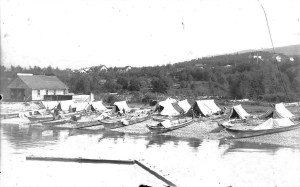
Lummi Indian canoes, beached below Fairhaven. Courtesy Whatcom Museum
The young man and woman, happily unnoticed, set the handcar off the track, ready to blend in the crowd and partake of salmon and clams and oysters. The early-July evening sunlight hung about as though ready to forego the habit of setting, in no hurry to disappear behind the mountain that was Lummi Island. They laughed when Jimmy took out his cheap pocket watch and found it broken by the day’s activities.


 J.P. Kenna
I love this. Will it be available at Barnes and Nobel?
Thank you for your comment, like, and follow. Beyond The Divide is available from Amazon and from Village Books, Fairhaven (Bellingham, WA), from where it can be purchased online. I’ll have to look into Barnes & Noble!
The best to you, and I look forward to following your blogs.