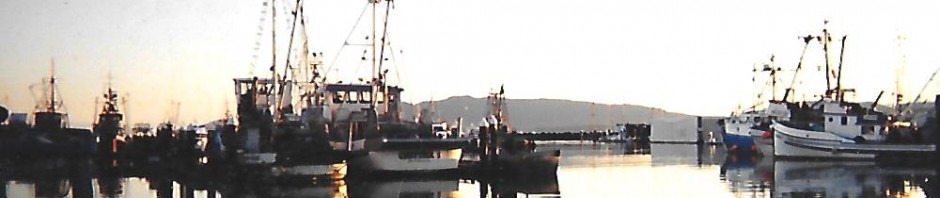
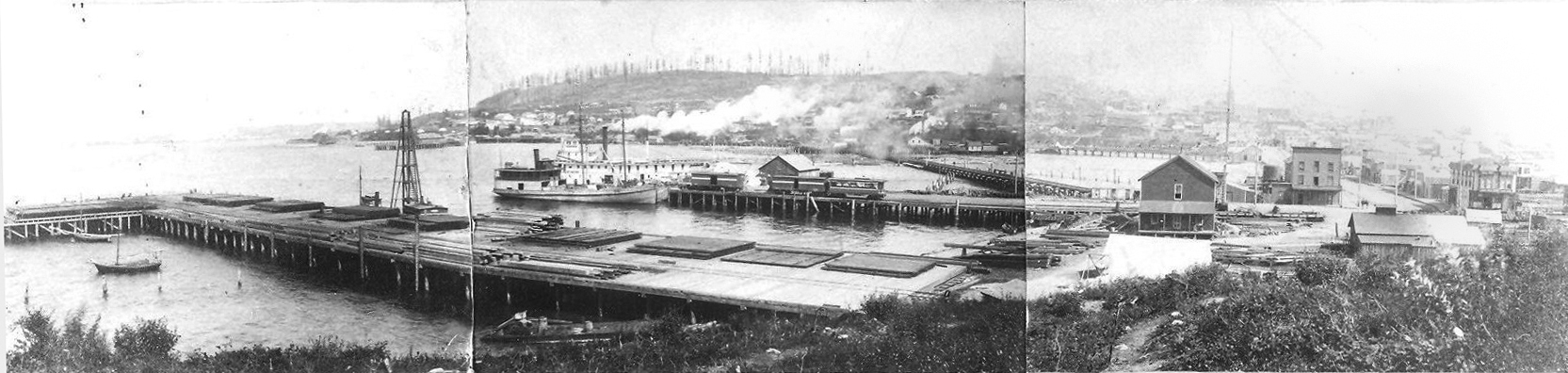
Fairhaven waterfront
Summer of 1892. Two years have passed since Jimmy Scanlon’s July 4th beach-side idyll with Susie Taylor (see “Along Chuckanut’s Shore,” posted April 5, 2014). Sharing in the optimistic spirit of the time, Jimmy purchased three building lots in Fairhaven, the city’s promoters convinced Jim Hill’s Great Northern Railway would locate its western terminus there. As it turned out, Jim Hill had his eye on Everett, closer to Seattle.
The Great Northern Railway is poised to reach the Puget Sound shore at the growing port city of Everett, some 30 miles north of Seattle. To the east, crews are laboring to breach the summit of the Cascade Mountain, laying track in a westerly direction, up the eastern slopes. From Everett, the Cascade Mountains to the east appear as an impenetrable wall, snow-covered even in mid-summer. It is toward this barrier that a final gang is being hired to lay track, to meet the approaching westward-building gangs.
Excerpted (with some minor editing), from Beyond The Divide– available from Village Books, Fairhaven; and from Amazon.
With still some days before start up of construction, Jimmy decided to spend his last pocket money on a quick trip on a new railroad extending north to Fairhaven, by way of farm-marketing towns Stanwood and Mt. Vernon. With the Great Northern mainline route finalized as coming over Stevens Pass and reaching the Sound shore at Everett, he thought it might be a good time to sell his three lots, now that it was certain Fairhaven would not be the western terminus of the G.N., but only a stop on a branch from Everett north to Vancouver, B.C. He could pay back his grandfather and bank the remaining proceeds for a time when he might yet go to college and study civil engineering.
Arriving in Fairhaven, walking up Harris Avenue to Ralph Stillwell’s office, Jimmy noticed a number of shuttered storefronts and more “for sale” and “for rent” signs than he’d expected to see. Sitting down in Stillwell’s office, he learned that the city’s de-selection as terminus by the growing Great Northern empire hadn’t only caused land prices in Fairhaven to level off. They were falling precipitously and businesses were shuttering. Construction had virtually halted. Jimmy felt a sickened sensation as Stillwell explained that his lots were worth considerably less than the balance owed on them.
“I like you, Scanlon, but I’ll save you the expressions of forced sympathy,” he said in a tone warmer than the words themselves. “Believe me, you’re not alone in this. You’re in good company—Wardner, Larrabee, Waldron; our losses are comparable to yours but multiplied on a grand scale. We’ve got fallbacks, we’ll keep going; but many in this city are totally wiped out. I did attempt to contact you, by the way, to apprise you of the situation, but you were quite unreachable. You did wire me payments regularly, but when I attempted to wire you back, well…you’d moved on.”
The sensation in Jimmy’s stomach was moving to his head. Thinking how embarrassing and effeminate it would be to faint, he forced himself to come around.
“Now, Scanlon, you’re turning green! Get a grip on yourself, man, and I’ll explain your choices…. There now. Sorry I have nothing stronger than water to offer you. I make it a habit to not drink during business hours…. Now, as to your choices: You could just hold on and keep making payments, as you have been. I’m not much older than you but I’ve been trying to look at this through the eyes of an old fossil like Jim Wardner. He’s learned that losing fortunes is only a prelude to making a new one. It’s like they say, ‘there’s always another deal.’ And there’s Bennett. He’s lost more money here than I’ll likely make in a lifetime, and I’d hazard a guess he’ll be a rich man again in a few years. He’s now back down in Tacoma, running the Ledger. And by the way, Will Visscher’s back there too, working for the Tacoma Globe again. They say he and Bennett have become sworn enemies!
“But, as I was saying, if you can watch your holdings go up, then go down, then go up again, I can guarantee you’ll come out far ahead in the long run. They’re excellent lots and this city still has a grand future. I expect by year’s end they’ll be going up again. If you’re ready to settle here, a move I’d highly recommend, you can build on them. Builders around here’ll work darn cheap right now. Or you could build for rental income and sell when the town booms again, which is only a matter of time. You could approach it like a businessman.”
“I don’t know if I have a head for business,” Jimmy said, getting his voice back. “It may be I’m cut out just to be a working stiff.”
“Now don’t belittle yourself, Scanlon. You got high approval from the likes of Nelson Bennett, and he’s no easy taskmaster. But I suspect you may not have the stomach for business. You’re the kind of man the likes of Wardner and I rely on—the kind who can do the real work to make our schemes succeed!”
“I got the sense on 4th of July last year that nobody here knew or cared if I even existed.”
“I suspect, old boy, that you’ve got that sensitive nature more suited to a poet than a businessman—although old Visscher managed at both, but I wouldn’t say he was very good at either. But as to last year, you oughtn’t to forget that you’d left Bennett’s employ and made no effort to keep up an association. You might say your “in” with us was through him. Not that we don’t like you, but with all the people you run into in life—with time being less plentiful than people—sometimes you have to set priorities…speaking of, let’s get down to business…. I suspect your preferred choice would be to wash yourself of the whole deal.”
“But my grandfather…he’ll see me as failing him.”
“Ah, my man! I’m seeing more and more you were never hard-boiled enough to make it as an entrepreneur or speculator. I don’t think you really care that much about money…. Oh, you like what it can do…it can create grand things, it can make life far more pleasant. When I’m again awash in it, I plan to cross new varieties of roses, and organize a yacht club…. Yes, and it can win people’s approval of you, make them envious. But money as a means to an end? No, no, dear boy! The accumulation of money is an end in itself! For the most afflicted among us, it is life itself.”
“Seek first the acquisition of money, and all these things shall follow.”
Stillwell leaned back in his swivel chair and laughed. “Yes, the gospel according to Mammon! And the churches are full of rich men who actually claim to be worshiping God…but, I digress. Now then, here’s what I propose…and it’s the best I can do for you. I can take the lots off your hands and free you from any obligation to continue payments. And I can pay you a percentage of what you made as a down payment—an amount, as I recall, equivalent to what your grandfather contributed. If you so choose, you can then pay him back…and chalk the rest to experience.”
He agreed to Stillwell’s proposal, again with the disquietude of feeling like a child when engaging with someone just a little older than himself; and accepted an invitation to a noonday meal. The nearby restaurant they entered seemed filled with the well-heeled people about town, by all appearances living as comfortably as ever. Jimmy decided to leave unanswered the question of how one reached a level of security whereby, even with huge economic setbacks, one’s manner of living continued in undiminished style. He also suspected that had he acted more the sharp “horse trader,” instead of the hat-in-hand nobody, he could have cut a far better deal in letting Stillwell buy him out—and that Stillwell had probably expected to do some bargaining.
Around the corner at Waldron’s bank, Jimmy cashed the draft Stillwell had given him and had it wired back to his Grandfather James, with only a terse note that he’d decided to sell the properties. Leaving town, he bought a ticket for Sedro-Woolley instead of Everett, choosing not to worry about his own diminishing supply of money. The more circuitous route would allow him to observe the Seattle, Lake Shore & Eastern Railroad’s more inland route, and the country it traversed.


 J.P. Kenna