Sitka Spruce
Summer of 1892. Leaving behind Fairhaven, Washington–the railroad boom town gone bust–Jimmy Scanlon is returning to Everett, after unloading his Fairhaven lots at a disastrous loss. He will be signing on to work track construction as the Great Northern Railway is completing its final link to Puget Sound.
The congenial farm couple who give him a lift will again appear in his life.
Excerpted from Beyond The Divide–available from Village Books, Fairhaven; and from Amazon.
Gratefully the train arrived, with its promise of hypnotic motion and ever-changing view inducing trance-like forgetfulness. Barely out of town, it crossed the broad Skagit on the multi-spans of the steel draw he’d seen constructed two years earlier. The train skirted Big Lake—Mt. Baker still looming to the northeast—then cut through a narrow pass before emerging on the east side of little Lake McMurray, the parallel wagon road a visible shelf curving higher along the hill above the opposite shore. Another narrow valley followed, then a graceful curve on fill and pilings leading to a second steel draw—this one spanning the Stilliguamish—on whose south bank the former river port of Arlington had sprouted some years before. It had since transformed itself into a substantial railroad town, at the point where flatland transitioned into foothills.
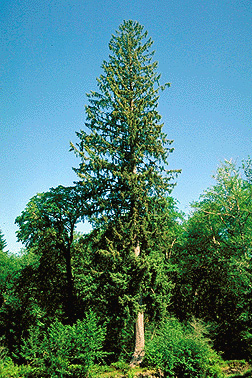
Jimmy stared out the window as his train moved south, toward Snohomish, covering the miles toward Seattle—Judge Burke’s vision of a road built to spite the Northern Pacific, now a part of that system. Alighting at Snohomish, it being late, and the weather warm and fair, he walked a mile westward toward Everett, then found a comfortable spot of soft ground under the wide-reaching branches of a commodious old Sitka spruce, where he bunched the contents of his grip bag into an acceptable pillow and curled catlike against any night chill.
Dawn brought the promise of a yet warmer day, the sparse dew already drying, as Jimmy was gradually overtaken by a farm wagon. A chat ensued and when the man and wife learned that he was, or soon would be, working on the railroad construction, he was immediately invited on for the ride to Everett. The man proved quite taciturn—the woman, in her mid 30s, quite voluble, flashing eyes at Jimmy in a manner that, given the proximity of her bull-necked husband, he had to assume as friendly but not flirtatious. The wagon loaded down with vegetables—sacks of new potatoes, baskets of eggs, a few smoked hams—she related, they would be selling the entire load to the provisioners for the railroad construction contractors he would soon be working for. With the proceeds, she would update her “sewing notions” and kitchenware and hopefully have enough left over for calico for a new dress. Beyond necessary supplies and tools, they both hoped to haul home a new piece of furniture or two, maybe a few books. Their two young sons left home to take care of the days’ tasks, the couple saw it as a bit of a holiday, with the first cutting of hay all now in the barn. The only animation the husband showed was when the topic of the railroad came up. He seemed to Jimmy to have a strong animus toward his local merchants at Snohomish, whom he said were in cahoots with the Northern Pacific and were out to gouge the farmers on costs for all supplies brought in, and that the N.P. was also in league with the produce houses and creameries in Seattle, charging exorbitant rates and paying them little—that they could get better deals in Everett, where the railroad still had competition from the boats.
“And it’s the Northern Pacific that brought us out here,” the wife said. “Looking for land in Wisconsin we were; then we saw one of their brochures.”
“I was the youngest of eleven kids,” the farmer interceded, “raised on a farm in Ohio—built up by my grandfather. My father’s getting on now so my brothers are fighting over the place. There was no room there for me.”
He viewed the coming of the Great Northern through the Snohomish Valley as a godsend, bringing competition practically to their doorstep—giving Jimmy indirect credit for his minor role in the process, though in the long run the farmer said he saw nationalization of the railroads as the only hope. “Once Jim Hill gets his road up and running out here, you think he’ll stand for all that competition from the N.P. right under his nose? No sir. He’ll control ‘em both, there’ll be a Great Northern Pacific. Then we’ll be right back where we are now. And speaking of Hill, did you know he was in Everett last February? And there was Colby and Hewitt and the boys just falling all over themselves, trying to impress the man, playing up their Rockefeller connections…with their notion of a booming industrial city—hoping of course Hill would put his terminal facilities here instead of Seattle.”
“I’ve worked for Jim Hill before,” Jimmy interjected. “He’s not an easy man to impress.”
“So Hill—in a hurry to eat his dinner instead of listening to these gasbags—tells them the Great Northern is not a ‘real estate road’ and that they had better put all their dreams into timber. And all the Everett boys got from Hill was a promise he wouldn’t bypass the place entirely and cut straight to Seattle—that is, so long as they promised him a “school section!” One square mile, supposedly reserved in every township for public education—as spelled out in the Ordinance of 1787. And he hinted it wouldn’t hurt if they elected a conservative Democrat for mayor.”
The wife added they were both active in their local Grange, advocating for the Populists, the People’s Party. That as far as they were concerned both the Republicans and Democrats favored the monopolists and definitely couldn’t care less about the farmers.
“Hill supposedly has an interest in farming,” the husband continued. “Especially on a scale that can produce freight revenues. He says the country out here will make great farmland after the trees are cut…. I think he’s wrong on that. Ourselves, we got us some nice river bottom land—great for truck gardens and cows. ‘Course, it’ll flood now an’ then. But most of the woodland soil is too loose and acidic. Fit only for growing trees. And when the trees are gone, we might just get flooded out.”
Jimmy asked about the railroad already in place between Snohomish and Everett, visible from the wagon road they were following along the north shore of the river.
“Ha!” the farmer snorted. “That’s the Snohomish, Skykomish & Spokane Railway. All eight miles of it! The ‘Three S Road’—another venture of Hewitt and Colby and the Everett Land Company. The Rockefeller interests are taking it over…tying it into the line they’re building up to the mine at Monte Cristo…. Got a Canadian contractor name of Heney putting in the track. None of it helps us any. There’s still no regular freight or passenger service between Snohomish and Everett. We do have steamboats, such as they are, running up to Monroe and Gold Bar. Could be they’re the ones blocking the rail service.”
Apparently talked out, the husband again gave all his attention to the road and his team. The wife said when the G.N. was finished it would be nice to get to Everett in comfort in ten minutes instead of eating dust or getting rained on for over an hour. Jimmy felt a blush coming on when she turned to him with an amused look to inform him her “backside” was already getting sore bouncing on the spring seat. Crowded as they were on the seat, her hip brushing his, Jimmy became aware of a familiar and at times awkward sensation, shifting his legs so as to camouflage any visible indication. When it had thankfully subsided, he offered to go sit in the back with the hams and the sacks of potatoes but she insisted he stay up front. Her husband then intervened, saying the young fellow looked a bit rumpled and tired, like he hadn’t had a real comfortable night’s sleep, and he might just want to lay down in the wagon and catch a wink or two. Gratefully Jimmy climbed back into the wagon bed.
With no sense of time passing, he awoke to a face smiling over him, backlit by blue sky and sun. The effect hiding any lines and furrows brought about by hard work and weather and care, he saw over him an angelic vision. With all his moving about, it had become routine to awaken not knowing where he was, but now he lay unsure of if he was awake or dreaming, or even alive. The smiling angel was now gently shaking his shoulder and the halo turned out to be the rim of a sun bonnet. “We’re by Nelson’s Saloon,” the apparition spoke. “You slept back there so sound you could have been dead! There now, you are alive…. Time to part ways.”
In the heart of Everett, only a short walk to his rooming house, as the farm couple lurched off to conduct their day’s commerce, Jimmy—still befogged—realized he didn’t even know their name.
Impatient to begin working, Jimmy was tempted to seek out Mike Heney on the Monte Cristo railroad project, but waited another day; and then—following his original plan—hired on to work building the final link of the Great Northern Railway.


