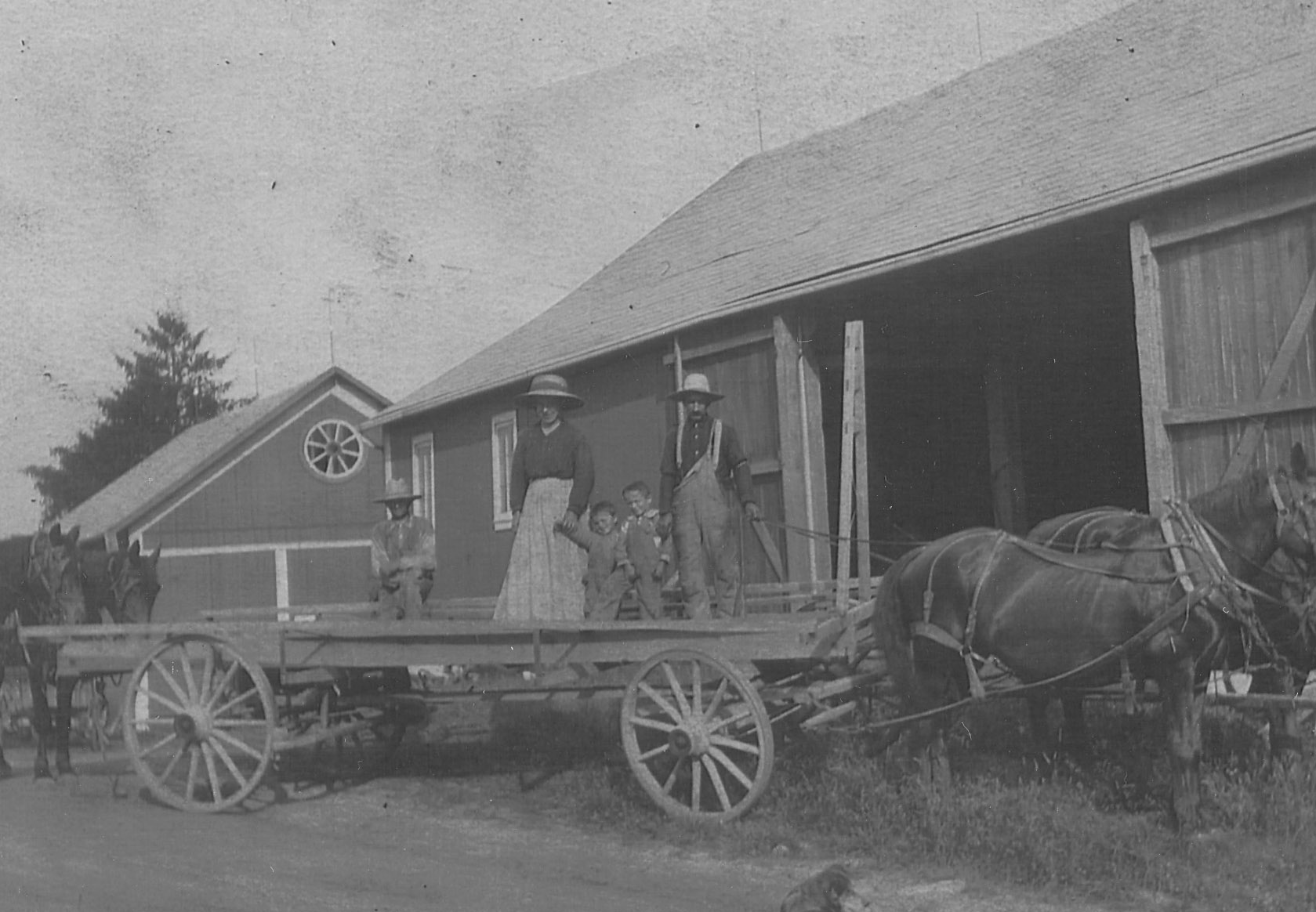
Farm family on hay wagon. Late 19th, early 20th Century.
Summer 1894: During the two years following his ride into Everett, picked up by an accommodating farm couple, Jimmy had run into the farm wife on a train–finally learning her and husband’s names. In spring of 1894, the nation fell into its most severe economic collapse to date. Brought on by Wall Street speculation and over-valuing of railroad stocks, the working classes saw no upcoming relief from privation stemming from continued wage-slashing and unemployment.
Excerpted from Chapter 26, Beyond the Divide–Available from Village Books, Fairhaven (Wash., U.S.A.); and from Amazon.
There was little wage-earning work available for Jimmy Scanlon the summer of 1894 in Everett, Washington. The saw and shingle mills weren’t hiring. The nail factory, the paper mill, the barge works and shipyard–all were struggling to avoid shutting down. To the young city it was a cruel irony that the long-sought entry of the Great Northern Railway just a year prior coincided not with prosperity, but with a nationwide financial panic leading to an ongoing depression.
The Everett Land Company was forced into indebtedness, issuing bonds at 8% interest to pay off its considerable remaining debts. The story gained circulation that John D. Rockefeller had bought most of the bonds and that the Everett Land Company was unable to meet even the 8% interest payments; that an increasingly angry Rockefeller was threatening to liquidate assets vital to the city. In a desperate attempt to raise cash, the Land Company offered to sell to the city the waterworks, the electric light company and the streetcar line. Though touted as a rare opportunity to put these services into public ownership, the voters turned it down.
But even the cloud of Rockefeller couldn’t shadow the fine summer weather, or stifle the outpouring of the bountiful land and water. Work needed to be done, an advantage for the young and able-bodied. Though no longer with enough cash to pay for a room, Jimmy seldom went hungry. He bucked and split logs into firewood for food, often a fine home-cooked meal. And for shelter, during rare periods of foul weather, he could perform chores as barter for sleeping with permission in a shed or empty barn loft. There was saltwater beach to camp on, with dried-out driftwood and dunnage; or to the north and the east of town, plenty of river frontage. From log yards he could break off chunks of Douglas fir bark, six to eight inches thick, “fishermen’s coal,” providing a long-lasting aromatic fire when needed. With little effort, survival was possible on clams alone and–for a little sweetness–salal and wild blackberry, red thimble berries and orange salmon berries. And when he managed to work for a little cash, he might walk the Great Northern bridges over the Snohomish delta, north to the Tulalip Indian reservation, and buy a freshly netted sockeye salmon, then find a secluded spot to camp and with his pocket knife fillet and spread out wing-like his fish, propped on sticks upright, Indian fashion, over a smoldering driftwood or fir bark fire. He might feast several days off a six pound fish, or join a larger camp and contribute it to a joint-effort feast including clams and oysters, sweet corn on-the-cob, freshly dug potatoes, all manner of greens, wild and garden-grown, sometimes baked-in-the-open bread or wild-berry pies.
Into August, Jimmy thought more frequently of Melissa Davis, wife of the farmer who once gave him a ride, and of the more recent time he shared with her in his room next to Nelson’s saloon, a time she referred to as their indoor “picnic.” He pictured her dark blonde hair, her late 30’s beauty somehow enhanced, rather than marred, by lines beginning to set in her face tracing long days of hard work. She was serious in her suggestion that he come work for them on their farm in Snohomish. What with hayfields soon ready for a second cutting, market gardens pouring forth greens and beans and peas, with cows to milk and hogs to feed and work horses to attend to, the labor of herself and her husband and two young teen-aged sons was being stretched thin.
Catching a ride in a caboose one evening for the short trip over the marshy flats to Snohomish, the sympathetic rear brakeman who let him aboard began talking up the American Railway Union. When Jimmy mentioned that he too carried an A.R.U. card, but was now blacklisted, that he’d been working on the section gang over in Leavenworth earlier that summer, he was invited to share in the stew simmering in an oversize saucepan, propped between railings on the stovetop. The less than talkative conductor nodded his belated approval from the cupola seat. Looking down from his lordly perch, the train “skipper” became friendlier after an introduction, recognizing the Irishness in Jimmy’s name.
Hanging his cap on a peg next to the brakeman’s slouch fedora, Jimmy ladled out a bowlful. He praised the fresh potatoes, dug from the conductor’s garden that morning, he was proudly told, and savored the chunks of stringy but flavorful beef. The teen-aged flagman, his feet looking stiff in new boots, clomped in from the rear platform and joined them.
They discussed the wreck of the Pullman strike, the jailing of Gene Debs and his fellow strike leaders, and what were the chances for the young defense lawyer, Clarence Darrow, of keeping them from long prison sentences. The brakeman felt for the Pullman plant workers, who in defeat were straggling back to work under the same conditions, the more militant unionists fired. But he didn’t think it right that the entire American Railway Union might collapse because of its support of the walkout. As he saw it, the Pullman employees weren’t really railroaders, they were factory hands. “That’s right!” the conductor said, climbing down and hanging up his derby, preparing to fill a bowl. It seemed to Jimmy the topic, or the impending gratification of the stew, finally animated the older man. He let out some words about the perfidy of “that New York Jew with the ugly mug,” Sam Gompers and his American Federation of Labor, who refused to back Debs. “We sacrifice our new union and watch our leaders go to the hoosegow while Gompers and his A.F. of L. cronies chomp cigars with the corporate fat cats!” he said, keeping balance before the stove in the rough-riding caboose.
At the Snohomish siding south of the river, his train slowed under the trestle overpass of the Seattle, Lake Shore & Eastern. Jimmy swung off the rear platform of the caboose after tossing off his bundle and grip bag. Though the town of Snohomish was but a short walk across the river on the S., L.S. & E. bridge, darkness was coming on and Jimmy decided to stay put for the night, eyeing a commodious spot between the tracks and the river, featuring several chairs, a fire pit and a shelf neatly stacked with pots and pans and a few dishes. On a stand with peeling paint hung a basin, a mirror and several dry towels on a rack, a facility serviceable for both dishwashing and shaving. Tonight the junction camp was deserted so he would enjoy it all to himself. Overhead, a Northern Pacific southbound freight train rattled on the S., L.S. & E. bridge, shaking the trestle timbers- probably a daily “peddler” freight from the border at Sumas, Jimmy thought. He sat looking at the languid river, contentedly for moments banishing any sense of passing time except for the lowering of the sun and the parading above him of 30 and 40 foot freight cars over a clattering rail joint.
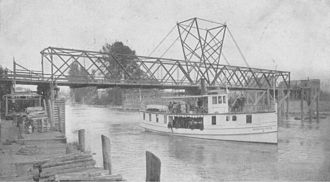
Snohomish River bank, south of the town
The train receded southward in the oncoming darkness- the fading click of wheels over joints an evening rhapsody, with the pant of the engine again audible as it climbed out of the river bottomland toward Woodinville. A whistling for some unknown night crossing inspired a chorus of nearby coyotes to answer in demented yaps and howls. The train now absorbed into the August night, Jimmy fell asleep to the singing of frogs along the slow moving river, happy to be getting by in the worst depression the country had yet experienced; happy he had chosen to cast his lot with men, like himself, who worked rather than schemed for a living. In this generous Puget Sound country, people could get on without cash, at least in summer. And of the people he was meeting, those of the least means, he’d been observing, were always those most willing to share. And he liked being able to choose his own direction. There were advantages in not being tied down to a woman and family, to a place. Perhaps Johnny Driscoll, his former pal, deserved a thank you. Tomorrow he would decide whether to catch an N.P train south back to Seattle, ride east on the G.N. to Spokane or maybe Montana, or walk north across the bridge and inquire as to the whereabouts of the Davis farm.
Jimmy found the farm easily enough, on good flat land between the north bank of the Snohomish River and main east-west road. Finally learning his name, the bull-necked, slow but steady moving Curt Davis soon put Jimmy to work, giving him a decent room in a vacant hired-man’s shack. The work was easy enough for him to catch on to. Curt Davis, as usual not saying much, seemed impressed that a “city boy” from back East needed so little instruction or supervision. But Jimmy’s tasks were not much different from what he’d leaned to do growing up on the little homestead along the South Branch of the Rahway River, not far from the looming dome of the New Jersey State Reformatory- only everything was on a much grander scale. Here they milked not one cow, but 15. The pigs numbered 30 or 40, not three or four. Instead of just a “kitchen garden,” there were nearly ten acres of produce marketed to vendors in Seattle and Everett.
Davis was especially impressed when Jimmy hitched up a two-horse mowing machine, oiled the sickle bar, then following to the inside, the two machines cutting adjacent swaths as they worked to the center of the field, the incisor knives on the bar chattering back and forth, driven by the Pittman arm whirling like a small steam engine. Jimmy drove his team as nearly as straight as Davis did his own, stopping only three times to clear a clog. Otherwise the timothy grass and clumps of red clover fell tumbling before the bar neatly, the grass board at the end floating over the less-than-even ground. Glad for his experience on the one-horse machine they had back home, back when he was 10 or 11, he soon regained his knack, leaving corners less raggedly clipped with each shortened turn around the field.
The dump rake was new to him, but the proper instant to stomp on the pedal was obvious enough, leaving neat windrows striped across the fields.
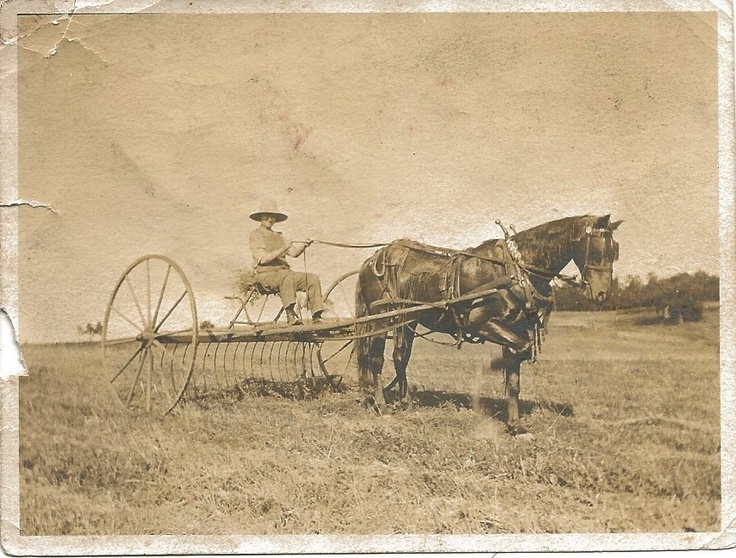
Common dump rake. When the tines are full, a pedal is stomped on to dump the load.
The hay loader was yet more wondrous, being Davis’ most recently purchased implement, still with shiny paint- now hitched to the rear of the hay wagon, towering over it like an open jackknife bridge, ready to straddle the windrows. Curt Davis and Jimmy and the two boys forked the still green-tinted but now dry hay as the conveyer tines swept it from the ground, raising it high overhead, to cascade over onto the moving wagon. Melissa Davis up front drove the team, Curt Davis reminding his three “hands” that the object was to stay on top of the growing pile, to not get buried, to fork it into a stable load. The boys, Ely and Nathan, worked like nimble machines, Jimmy marveling how they never stabbed each other with hayforks. He kept well clear and only once was tempted to yell out in frustration as the ceaselessly tumbling hay threatened to bury him. When Davis called out to his wife to halt the team, giving his newly hired hand time to extricate himself, the farmer showed no sign of lost temper. Sloughing off strands of hay from his hair and clothes with his cap, Jimmy looked over and saw his boss’s mouth curl upward at the corners, in what passed for a grin.
On more than one occasion Davis had stressed that even more important than getting the tasks done in a proper and timely manner was that no one get hurt doing them. At times it seemed to Jimmy the man was a bit obsessed in pointing out all the various hazards around the farm, sometimes graphically describing the gory consequences should one be caught off guard.
To be continued


 J.P. Kenna