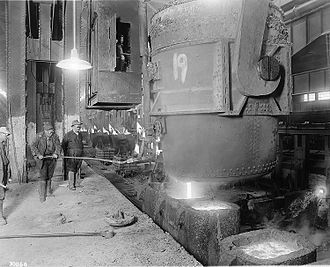
Molten steel from crucible filling molds at Homestead Steel Works
from Wikipedia
July 7th, 1892: From various parts of the country comes the news of festering labor unrest, as workers feel left out of the prosperity issuing from new industrial technologies and rising productivity.
Jimmy Scanlon is holed up in Everett, Washington, waiting for the start of construction on the last link of the Great Northern Railway to Puget Sound.
Excerpted from Chapter 21, Beyond the Divide–Available from Village Books, Fairhaven (Wash., U.S.A.); and from Amazon
In a wooden cell of a room near Nelson’s Saloon, in one of scores of buildings hurriedly constructed between still raw stumps, Jimmy read a letter from home of the birth of his newest brother, John—a large, placid slow-moving baby, quite opposite of Mary, now five, an active headstrong girl who sometimes defied her mother with temper tantrums.
On the last page of his father’s letter, Jimmy read of the darkening clouds over Andrew Carnegie’s sprawling Homestead, Pennsylvania, steel works outside of Pittsburgh. The Amalgamated Association of Iron & Steel Workers, one of America’s strongest trade unions, had been promised wage increases for their hot, dangerous work, much of it highly skilled. Thanks to the McKinley tariff, rendering imported steel and its finished products such as rails prohibitively expensive, profits for American steelmakers were soaring. Desirous of a reputation for being a humanitarian and friend of labor, Carnegie had lobbied for passage of the tariff in Congress, stressing that increased profits to steel companies would allow for the raising of wages.

Andrew Carnegie
from Wikipedia
Carnegie’s plant manager, Henry Clay Frick, proclaimed no such fine sentiments and was virtually in charge of the contract negotiations while Carnegie was vacationing in his native Scotland. For Frick, who saw workers—especially organized workers—as only a drain on company profits, the question was not about increasing wages, or even leaving them as is, but about cutting them. If this led to labor strife, an opportunity would be present to destroy the union. Not surprisingly, negotiations reached a deadlock. Frick then directed to surround the plant with a barbed-wire-topped stockade fence, complete with gun holes and tower-mounted searchlights. To enforce his anticipated “lockout” he was reported to be ordering in an army of Pinkerton guards.
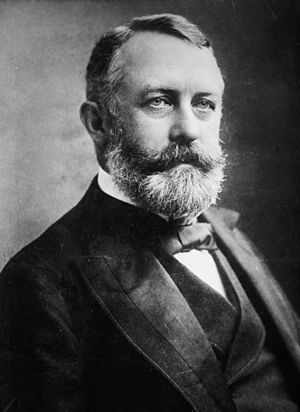
Henry Clay Frick
from Wikipedia
Jimmy’s reading of his father’s letter and description began to rekindle an interest in the outside world. Over the past year he had barely looked at a newspaper.
At one time he’d studied the basics of steelmaking, learning that the industry had a tradition of strong worker organization going back to the days when wrought iron, the predecessor of industrial steel, was made under the watchful eye of “puddlers,” men possessing skill and training rare enough that they could set many of their own demands.
By the 1850’s, with the expanded development of railroads and other industry creating a demand for wrought iron at an accelerating pace, the time was ripe for the replacement of wrought iron by mass-produced steel. The newly developed Bessemer process, where molten iron was poured into egg-shaped vessels, then charged with pressurized air, produced steel in quantity using less-skilled labor. After the Civil War, the new open-hearth process further improved the efficiency of steelmaking, leading to the rise of gargantuan mills adjacent to cities such as Pittsburgh and Bethlehem, Pennsylvania, and Gary, Indiana. While virtual armies of semi-skilled workers, many of them immigrants, replaced the highly skilled iron puddlers, nevertheless a tradition of strong worker organization remained in the industry, at direct odds with the goals of the mill owners and managers who saw their unionized workforce as an impediment to maximized profits.
Burdened with another extended 4th of July holiday, the memory of the year’s previous celebration spent up on Bellingham Bay still festering, Jimmy was grateful for the mental diversion created by following the current developments at Homestead, Pennsylvania. On July 7th, not yet called to work, walking down the dusty swath recently named Hewitt Avenue, he stopped at a well-stocked newsstand and picked up what papers he could that contained wire dispatches from Eastern papers—the New York Herald, the New York Sun and the Pittsburgh Press. Taking them back to his room, he pieced together the happenings of that previous day in Pennsylvania.
____________
Well before dawn the tugboat Little Bill crept up the Monongahela River pushing two barges, the Iron Mountain and the Monongahela, with a combined load of 300 well-armed Pinkerton agents and cases of provisions and ammunition. On shore, the Worker’s Advisory Committee, led by a plate-mill operator named Hugh O’Donnell, was attempting to keep order in the town of Homestead, where 3,800 of the locked-out steel workers were amassing on the riverbank. To O’Donnell’s distress, a barrier reaching into the water had been breached by some of the townsmen.
The rumor ran through the crowd that the Pinkertons were actually sent as scabs, not just to enforce the lockout. As the barges were being beached, hundreds, including women and girls — some carrying both guns and babies — broke through the breach and confronted the first barge, the Iron Mountain. “Let me at them!” shrieked a Mrs. Finch, brandishing a billy club, described as a “white-haired old ‘beldam’ who had seen 40 strikes in her long life.” Shouts of “go back or we’ll not answer for your lives,” or “Don’t come on land or we’ll brain you!” issued from the shore, from men and women alike. Hugh O’Donnell knew many of his fellow workers and townspeople were well-armed, and ordered them not to open fire. Moving to the front, he made a plea to the Pinkertons beginning to file out on deck from inside the barges.
“On behalf of 5,000 men, I beg of you to leave here at once. I don’t know who you are nor from whence you came, but I do know that you have no business here, and if you remain there will be more bloodshed. We, the workers in these mills, are peaceably inclined. We have not damaged any property, and we do not intend to. If you will send a committee with us, we will take them through the works, carefully explain to them the details of the trouble, and promise them a safe return to their boats. But in the name of God and humanity, don’t attempt to land! Don’t attempt to enter these works by force!”
Frederick H. Heinde, captain of the Pinkerton detachment, replied from the barge deck. “We were sent here to take possession of this property and guard it for this company. … We don’t wish to shed blood, but … if you men don’t withdraw we will mow every one of you down and enter in spite of you. You had better disperse, or land we will!”
“I have no more to say,” O’Donnell shouted back. “Before you enter these mills, you will trample over the dead bodies of 3,000 honest workingmen!”
To be continued
Reference–The Labor Movement in American History, by Conrad R. Stein


