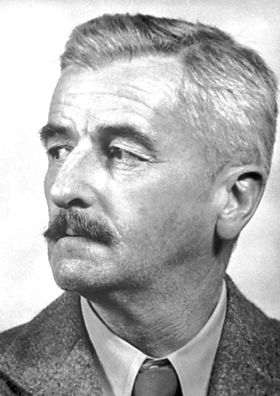
William Faulkner in 1949
In writing, you must kill all your darlings.
Not according to John Crowley, writer of fantasy, science fiction and mainstream fiction. I was happy to read in Crowley’s “Easy Chair” column, in the November 2014 issue of Harper’magazine, that the real credit–or discredit–for this statement goes to one Sir Arthur Quiller-Couch, who did make a similar pronouncement 100 years ago, lecturing in some British university. The “Easy Chair” column quotes the obscure Sir Quiller-Couchin in full: “Whenever you feel an impulse to perpetrate a piece of exceptionally fine writing, obey it–and delete it before sending your manuscript to the press. Murder your darlings.”
Since first hearing of that quote (whichever version), I’ve been disturbed by it. So it was a relief to find that neither Faulkner, nor Mark Twain nor Gustave Flaubert nor Earnest Hemingway (among others given the dubious credit), likely ever said or wrote such a thing. What’s more, on further reading of the Harper’s column I gleaned that John Crowley thinks the advice is rubbish.
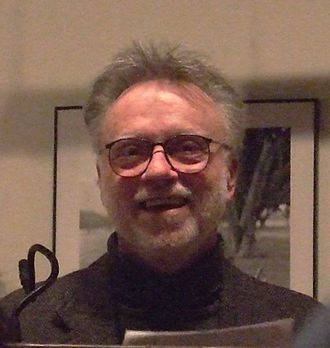
John Crowley
Author and writing instructor
Such advice goes hand-in-hand with the equally trendy notion that one should write in an undisciplined manner, just spew it all out on screen or paper, for then he or she can engage in a feeding frenzy with highlighter and delete button. John Crowley points out that this method has only been practicable since the invention of the word processor–without which it would require laborious multiple hand re-writing or re-typewriting .
Personally, I like to think and write down something I consider close to the end result being sought; and then do minimal editing. It’s gratifying to know I’m in good company with this method, as it had to have been (by necessity, before the word processor became commonplace) the way people wrote, up until the 1990s or so. And hand-in-hand with the new digital-age style of writing is the collaborative method of literary expression, encouraged by “creative writing” courses and groups, exacerbated by the rise of social media. Crowley points out–and for what it’s worth, I would agree–that for untold ages, until the dawn of our new century, writing has been a mostly solitary process.
If this sounds like the ramblings of a curmudgeon, so be it. Whether the flowery “stream of consciousness” of James Joyce, the majestic unadorned prose of Faulkner or Hemingway, the magnificently manic ramblings of Thomas Wolfe, or the evocation of place and time-period by “dean of Western writers” Wallace Stegner, I like pre-digital age fiction. What a tragedy it would have been had any of these writers succumbed to “murdering their darlings,” throwing out their most lyrical prose, and allowing their works to be produced “by committee.”
Not that there isn’t a place for editing. But, in an ideal world (which seems to be slipping further away), editing is done by a person or entity that has a stake in the successful outcome of one’s work. Where would Thomas Wolfe have been without Maxwell Perkins?
Author photos from Wikipedia


 J.P. Kenna
this is Amazing!!!!!!!!!!!!!!!!!!!!!!!!!!