
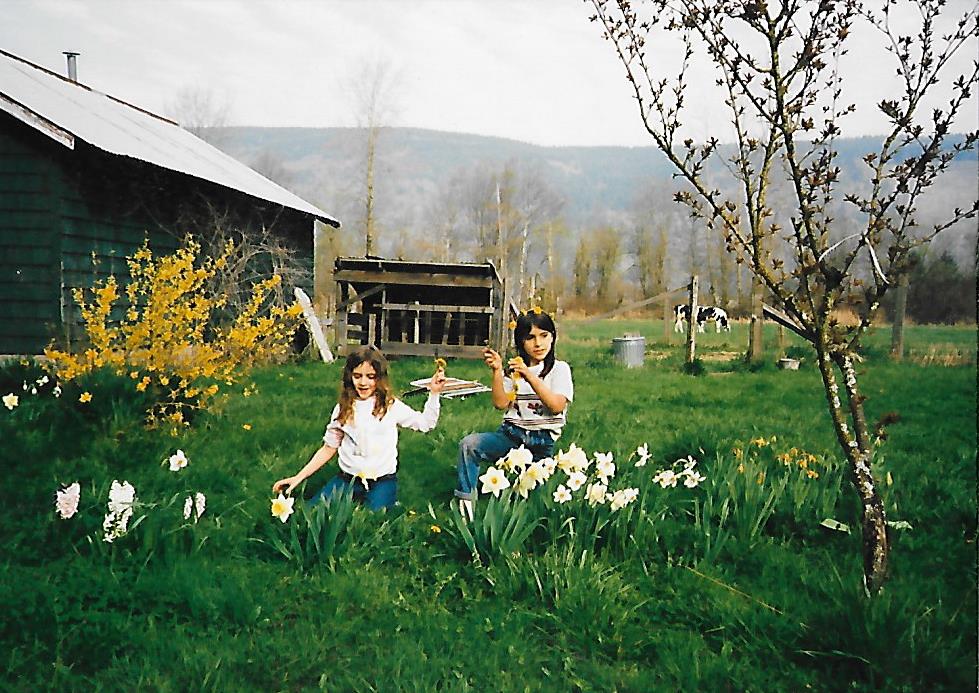
 When my wife and two young daughters and I moved into valley of the South Fork of the Nooksack River in the early 80s, we thought we’d bought into a little slice of heaven. This was rural Western Washington state at its best. Threaded, along with the river, by a two-lane highway and a not-too-busy rail line, the rich bottomland was perfect for dairy pastures and forage crops. The mountain ridges (hills by Western standards) lining each side sprouted enough Douglas fir forests for sustained logging, but mostly remained green, though in fall were speckled with the yellow-gold of bigleaf maple. The snow-covered peaks of the Twin Sisters peered over from the east, while to the north, glimpses of Mount Baker loomed beyond Sumas Mountain, the latter protecting the valley in winter from the chilled winds and snows blowing down from Canada’s Fraser River Valley. Summers were often a week’s long idyll of sun and temperatures lingering in the 70s.
Across the highway from our 18-acre farmstead was a 100-cow dairy, where I found seasonal work bucking hay bales and raking fermented chopped corn or grass in one of the farm’s five silos. Polish and German immigrants began farming the area in the early 20th century, forming a strong Catholic community. Loggers and saw-millers came in the 1890s, following construction of the rail line from Seattle to Canada. The post-1960s era saw an unthreatening influx of diverse types–commercial fisherman wintering in, “back to the land” idealists, along with workers and professionals and university students who commuted to nearby Bellingham. Whether out in the open bottomland or tucked back a ways into the woods, there was room for all without crowding. There were few trailers and no McMansions. Early-to mid-20th century homes predominated. On the highway, between the towns of Deming and Acme, were three general stores, the wood floors pocked by decades of logger boots. Out front stood the obligatory gas pumps. As a neighbor who worked mostly in logging put it, “this place is like Alaska. Filled with people who don’t fit in anywhere else. In our own way, we mostly get along.”
I don’t recall once ever locking the doors on our 1920-built home. We could get fresh milk from the bulk tank of the dairy across the road. One of the boys would, without being asked, run a tractor over following a rare snowfall and plow our driveway. They sold us bull-calves on the cheap for raising beef. When I began putting up my own hay, they would help me bale it. As if, with the two youngest sons and their 70-year-old uncle managing a 100-acre farm, they didn’t already have enough to do. A 90-year-old neighbor, who was born in the area, had a contract with the Burlington Northern Railroad to take down threatening trees along its right-of-way. His equipment consisted of a chainsaw, a choker cable and a 2-cylinder John Deere Model-M tractor. He had a few gruff words to say about some of his “hippie” neighbors, though my family and I could’ve easily passed for such. He would smoke for us some of the sockeye salmon I brought home from my summer fish-tendering. Without taking any kind of payment, he took down a few towering cottonwoods along the stretch of our property that bordered the railroad.
Just recently, this slice of heaven became the subject of two nationally-syndicated crime shows. The TV screen didn’t do the place justice, but the point came across quite clearly–that something changed in this valley on the day following Thanksgiving, 30 years ago.
The Stavik family and the Bass family both lived about a mile away from us, on the Strand Road, at the foot of the mountain that walled the valley on the east. I delivered mail to both, when I had a rural delivery contract. The Staviks had a daughter, Mandy. The Bass’s, a son, Tim. Both attended Mt. Baker Highschool. Mandy’s mother drove the school bus that our daughters rode to Acme Elementary.
In 1989, Mandy was in her freshman year at Central Washington University, home for Thanksgiving. At Mt. Baker High, she was known for her beauty, her friendliness, and athletic and academic prowess. The day after Thanksgiving, she went jogging along the Strand Road with her pet German Sheppard. The dog returned later without Mandy. Frantic searches, including a Whatcom County Sheriff’s posse, went on until the following Sunday, until her body was found submerged in the South Fork of the Nooksack River. We heard references to kidnapping, rape and murder. One neighbor, a commercial fisherman, said he refused to live in fear and suspicion. I tried to do the same. We continued to not lock our doors. But as was pointed out in the TV documentaries , this wasn’t always easy. A pall hung over the woods and fields and sparkling-clean river, that there was “a monster in our midst.” This was before the days of mass shootings, of I-phone sensual bombardment, of internet hysteria. People still believed it possible to live in a safe place of unlocked doors, of trusted, helpful neighbors, who mostly minded their own business. But for those living in this little-known rural refuge nestled between the twin metropolises of Seattle and Vancouver, B.C., 30 years ago such innocence began to unravel.
The cold case hung over the area, including all of Whatcom County and the city of Bellingham, for 29 years. About ten years ago, men who’d lived in the area at the time–myself included–voluntarily submitted DNA samples to sheriff’s department detectives. One former resident refused–Mandy’s close neighbor, Tim Bass. This year, he stood trial in Bellingham and was convicted of murder, and sentenced to 27 years.
Rural Whatcom County has changed. There are fewer well-kept farms, more shabby trailers and pretentious McMansions. Urban and suburban escapees to the “boondocks” don’t interact with the older established residents, the way the “hippies” and the farmers once often did. Remaining farms have gotten bigger and look more like industrial operations. Loggers have gone into other work, or given up. Liberals–now called Progressives–are more tribal than ever. So are the Rednecks. Many farmers used to have Democratic campaign signs in their yards. Now they’re as rare out in “the County” as are pro-Trump signs in Bellingham.
It goes without saying these changes are national in scope, having nothing to do with the murder of a smart, likeable teenage girl 30 years ago. But there was an innocence back then, that one could find a place where undesirable changes weren’t inevitable. And for a time, many of us thought we’d found it.


 J.P. Kenna
After all these years I’m discovering your writings! Nancy, your ( thrilled) Rahway cousin.