Joe Hill–Not Forgotten

jpkenna's avatarJ.P. Kenna

Last Friday, in our local, mainstream daily rag, there appeared in the “Today in History” feature a posting, announcing that on January 10th, 1914, A Salt Lake City grocer (a former policeman) named John G. Morrison and his son were murdered. A Swedish-born itinerant laborer went on trial for the crime, and was convicted and sentenced to death.

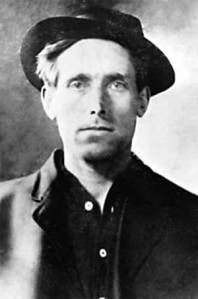
The young laborer was born Joel Emmanuel Hagglund in 1879. After emigrating to the United States he took the name Joseph Hillstrom, then let it be shortened to Joe Hill. Working as a machinist and at various laboring jobs, he drifted his way West, where he joined the Industrial Workers of the World (I.W.W.).

Joe_hill002Though he had already begun making a name for himself as the unofficial songster for the I.W.W., he may not have achieved legendary status had not the State of Utah executed him by firing squad on November 19…

View original post 514 more words

Posted in writing | Leave a comment

Trains (large and small) and Christmas

jpkenna's avatarJ.P. Kenna

Our regional shopping mall here in Bellingham, Washington, dating from the late 1980s, recently had a grand re-opening showing off its multi-hundred thousand dollar face lift.

I didn’t attend. I’ve got nothing against shopping malls. It’s just that I can’t stand them. I’m glad I grew up in a time when the acres of asphalt and lookalike big box buildings–spreading over former farm fields–weren’t the main association with Christmas. That, and all the flimsy junk on sale inside, passing as gifts for kids and necessities of modern life.

Not so long ago, Christmas commercial activity was still more about Main Streets in towns and cities. Like many such places, our own “downtown” in Northeast New Jersey had taken nearly three centuries to evolve. True, by the early 1950s, these districts had absorbed the trappings of a commercialized, electrified post-war modern Christmas season. Housewares and toys featured in the Five and…

View original post 716 more words

Posted in writing | Leave a comment

Blizzard of Books, Queries, Reviews, Blogs

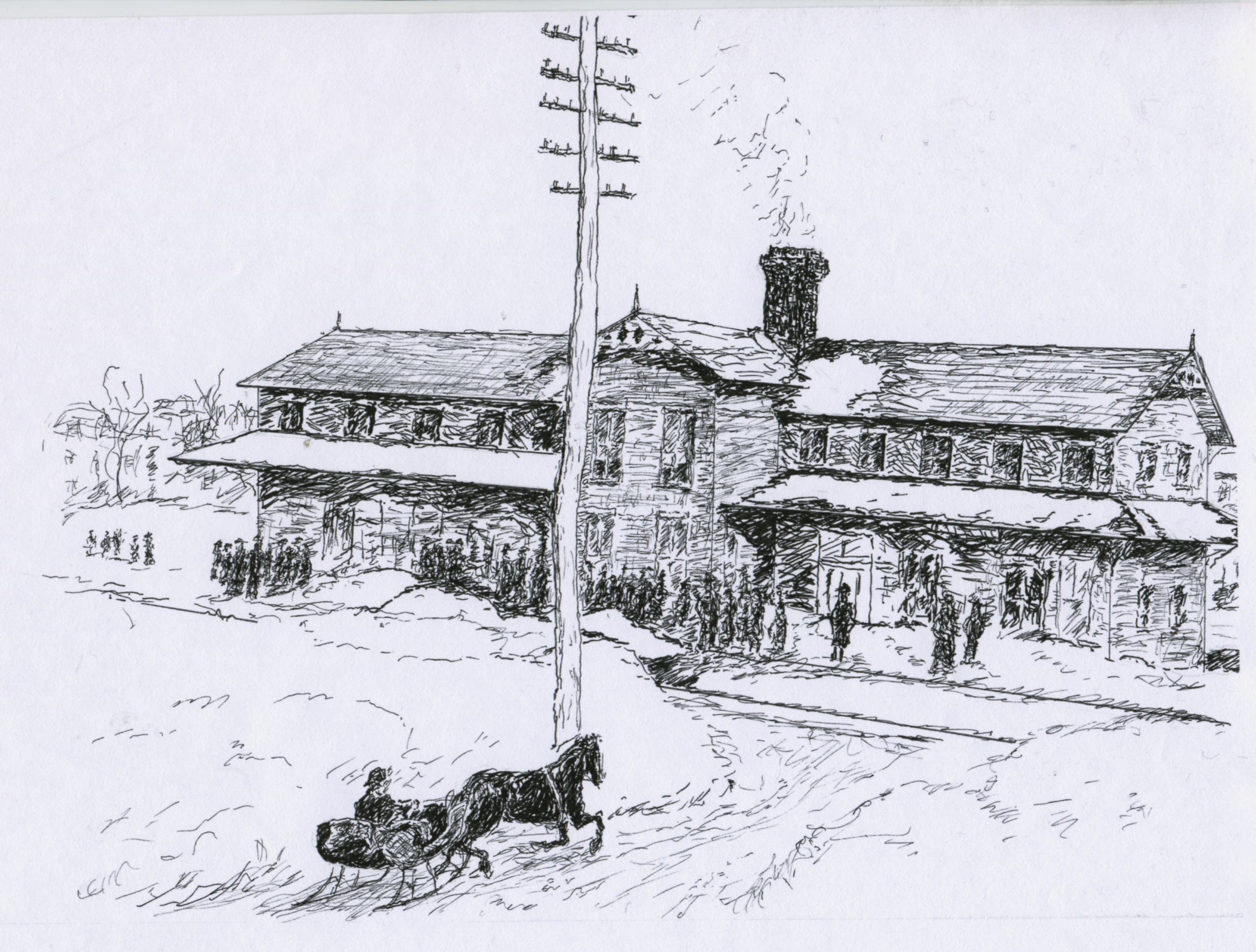
Waiting  for the train from Jersey City. Aftermath of the Blizzard of '88 Sketch by J.P. Kenna

Waiting for the train from Jersey City. Aftermath of the Blizzard of ’88
Sketch by J.P. Kenna

OK, the accompanying sketch–from a photograph of the Pennsylvania Railroad depot in Rahway, New Jersey, following a late-19th Century snow storm (likely the legendary Blizzard of 1888)–might strain the metaphor a bit. Certainly it’s undeniable that in our early 21st Century, the unleashing of digital self-publishing is drowning us in a deluge. But in the sketch, the worst appears to be over and life is getting back to normal. The trains are beginning to run again. While in our present-day onslaught, no shakeout is seen coming down the track. The trains are not going to run again. The times-past abundance of independent publishing houses, willing to take on unproven authors who show promise, is not coming back.

A confession–I sneaked in the sketch to help promote my book. It’s one of three appearing in Beyond The Divide, the second book of an Irish-American epic. And I’ve taken up blogging to help in promotion. And–another confession. I hate self-promotion. Handing out bookmarks with blurbs on them makes me feel like a religious fanatic handing out tracts. And projecting myself out to strangers on Social Media feels–at least to this introvert–a bit creepy. By the way, for more info, please click on the adjacent Facebook link.

Not that it’s all bad news for aspiring authors. If you’re driven to write, you can now see your results in print relatively cheaply. By locating–and paying for–qualified assistance, you can with tolerable effort produce a handsome book, printed on demand. But then, this means that literally millions of writers now have books to give away, to promote through sympathetic book stores, and/or to be placed in inventory in some lonely Amazon warehouse–along with millions upon millions of other lonely volumes.

Most people who go through this not-effortless process think they have a worthwhile product. I know I do. And you start out with this rosy view that browsers (the original, human kind) in your local independent book store–if you’re fortunate enough to still have one–will see your work on the shelf, and that some will be enticed and tell others about it, and a “positive feedback loop” will result.  And a grander–but spookier–version of the process will happen online. You anticipate the day when orders coming from Amazon will begin to overwhelm.

You are encouraged by initial interest shown by friends and acquaintances, but discover a sad truth. Of those who say they are going to run out and buy or order your book, only a small percentage actually get around to doing it. And for those who get around to buying and reading your work who say they’ll write a heartfelt, good review of it, again–the percentage of those who actually do is small.

And you start hearing that for agents and reviewers, your treasured work is just part of a “slush pile,” adding to their onerous task of wading through untold numbers of submissions day-after-day. And you force yourself to get more involved in social media and to set up a blog. As millions of others are doing. And you fear your time becoming squandered, wading through mindless cyber-chatter. Instead of writing, or reading a book, or perusing a favorite magazine (which, even if you’re wasting time, can be enjoyable and relaxing) you slog deeper into the murk of on-line talk and rant, and trip over postings with such inspirational titles as “No One Wants To Read Your Shit.”

This is not to say that on-line experience is always a voyage through the doldrums. The results aren’t always depressing. And though being a Luddite at heart, I don’t see all technological innovation as the work of the devil. Word processors are great. I’m using one now, and have been since 1986. On-demand printing is a concept to be harnessed for the good. Professional quality books can be printed and bound in small neighborhood shops, and on machines that can be fitted into a small room. There are services out there for proofreading and editing, for designing covers. There are book review services, some even free. And there is assistance available in sending out e-queries to agents and publishers.

But here’s the rub. Outside of “subsidy publishing,” normal procedure has been to land a publisher who would take on editing, proofreading, printing; and then marketing and distribution–as a partner, with a vested interest in the outcome of your work. By contrast, the self-publishing writer fully pays for such services, often upfront. The providers of these services of course deserve their fees, and generally speaking strive to establish and keep a professional reputation by doing good work. But it’s still not the same as having  a partner financially committed to the success of your work. This was traditionally the role of the publisher, through in-house editors such as Maxwell  Perkins. 

Might the successors to Max Perkins and his ilk even now be out there, forming or taking part in a new wave of independent publishers, using the best of new technology? We can hope. Though rejection followed by persistence will always be the lot of those who are serious about becoming successful authors, there ought to be a better way than facing sure-rejection by mega-publishers; or the time-consuming effort of self-publishing, which, more often than not, leads to another kind of rejection–that of being spurned by the public. Not because your work is bad. Rather, you just don’t get noticed. You’re just one easily-melted flake in a blizzard

Posted in history, self-publishing, writing | Tagged , , , | 1 Comment

Where Have You Gone, Maxwell Perkins?

Was it easier to get a book published before the recent onset of mass-digital (mostly self) publishing? It may depend on the type of book. Media celebrities, no matter how vacuous, seem to have no trouble getting book deals with mega-publishers. If, like the rest of us, you start out as an unknown, then you have to demonstrate to agents or publishers that you have on your flash-drive the next Harry Potter series, or 50 Shades of Gray. A tall order indeed.

I’m not sure how this situation measures up to the not-too-distant past, when a plethora of publishers and agents, mostly based in New York, might have looked at a manuscript and, with judicious in-house proofreading and editing, decide to take it on, under the premise that–if not the next multi-million-dollar best seller–the process of setting up the plates for a limited run might at least yield a modest profit for the company; and just maybe add a little to humanity’s enrichment. And not to rule out that taking a chance on new authors was how best sellers came about.

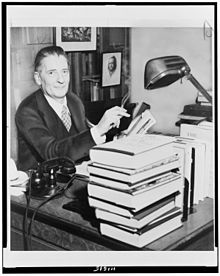
Maxwell Perkins, who grew up in Plainfield, New Jersey, was born in 1884.

220px-Maxwell_Perkins_NYWTS

From Wikipedia:

“After working as a reporter for The New York Times, Perkins joined the venerable publishing house of Charles Scribner’s Sons in 1910. … At the time he joined it, Scribner’s was known for publishing eminently respectable authors such as John GalsworthyHenry James, and Edith Wharton. However, much as he admired these older giants, Perkins wished to publish younger writers. Unlike most editors, he actively sought out promising new artists; he made his first big find in 1919 when he signed F. Scott Fitzgerald. This was no easy task, for no one at Scribner’s except Perkins had liked The Romantic Egotist, the working title of Fitzgerald’s first novel, and it was rejected. Even so, Perkins worked with Fitzgerald to revise the manuscript and then lobbied it through the house until he wore down his colleagues’ resistance.”

Through Fitzgerald, Perkins met beginning writer Ernest Hemingway, leading to publication of The Sun Also Rises and A Farewell To Arms. Soon after began the legendary collaboration with with a lumbering giant of a North Carolinian named Thomas Wolfe. In his New York City flat, the manically writing Wolfe scrawled out hundreds upon hundreds of pages while standing, using the top of his icebox as a desk. The papers were tossed into wooden packing crates. By discarding much from the helter-skelter piles (over Wolfe’s objections), Perkins was able to arrange the remaining sheets into a coherent form, resulting in two ponderous, immortal works–Look Homeward Angel and Of Time And The River.

Thomas Wolfe and his manuscripts

Thomas Wolfe and his manuscripts

Before his death in 1947 at age 63, Perkins went on to make writing celebrities out of Erskine Caldwell (Tobacco Road), Marjorie Kinnon Rawlings (The Yearling), and James Jones (From Here To Eternity).

Jumping ahead a few decades, some questions come to mind. Is the corporatization and digitalization of publishing in recent years leading to a reading world where one must choose between a few mass bestsellers on one hand? And on the other, an ocean of mediocre–mostly self-published–works grossly in need of professional editing? Or totally unsalvageable? Or is there already a rising micro-publishing industry that will democratize and ultimately further enrich the written language? In a digital world, will writers be able to find successors to Maxwell Perkins, and to the publishing houses that would take a chance, if they saw promise?

Optimism is fine, but it can be difficult to maintain in a world of Big Publishing and monopolistic book distribution. Even if a budding author can make a breakthrough and land a publishing contract, will a writer’s compensation–in effect, his or her wages–be squeezed (as already appears to be happening) due to the rise of tablets and e-readers?

And for the vast majority who go the self-publishing route, there is yet another burden in this age of “unbounded publishing.” With agents and publishers awash in “e-queries,” chances are all too likely that there will be no partner with a vested interest in the self-published book’s success. That means going it alone with self-promotion, not something every writer has a knack for. And it means seeking proficiency in the very technology that is so transforming the world of reading and writing and publishing as we know (or knew) it. Such skills can be useful, and often necessary. But navigating and blundering through “social media” can be time consuming and distracting, blunting the creative force that produces great–as opposed to just good–writing. 

Would a Fitzgerald or a Hemingway today have found a publisher? Would they even have produced any great writing if they had to dilute their creative juices, to use their best energies trying to build up a following on Facebook or Google Plus? I sure don’t know, but one thing I can say: Maxwell Perkins, you are sorely missed.

Posted in history, self-publishing, social criticism, writing | Tagged , , , , , , , | 4 Comments

Joe Hill–Not Forgotten

On January 10th, 1914, A Salt Lake City grocer (a former policeman) named John G. Morrison and his son were murdered. A Swedish-born itinerant laborer went on trial for the crime, and was convicted and sentenced to death.

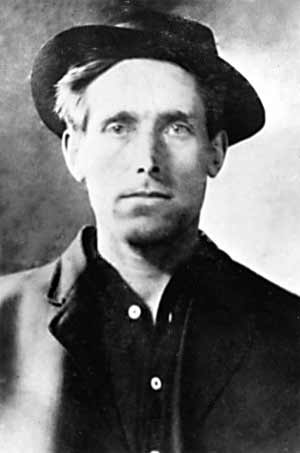
The young laborer was born Joel Emmanuel Hagglund in 1879. After emigrating to the United States he took the name Joseph Hillstrom, then let it be shortened to Joe Hill. Working as a machinist and at various laboring jobs, he drifted his way West, where he joined the Industrial Workers of the World (I.W.W.).

Joe_hill002Though he had already begun making a name for himself as the unofficial songster for the I.W.W., he may not have achieved legendary status had not the State of Utah executed him by firing squad on November 19, 1915. While on trial for murder, unable to afford a capable defense counselor, Hill refused to properly defend himself, though the evidence against him was flimsy. Among those pleading for his life was Helen Keller, the blind-deaf activist. The Swedish embassy in Washington, D.C., intervened to have him spared. President Woodrow Wilson requested the governor of Utah to postpone the execution, pending further examination of evidence. The request was spurned.

While working on the West Coast, Hill had taken popular songs of the day and inserted his own lyrics–satirical, irreverent, often humorous–commenting on the plight of the working class in America. The I.W.W. proved to be a perfect fit for Hill.  A loose organization of young, rowdy itinerant workers in the woods and in the mines and on farms, factories, and wherever else cheap labor was sought, the “Wobblies” used songs and street corner oration to denounce the economic and political system they saw as being skewed against them. In “free speech” demonstrations, in cities such as Spokane and Portland, they let themselves be hauled off to jail in droves, driving their captors to distraction with their songs and antics.

In 1910, Joe Hill wrote “The Preacher and the Slave,” borrowing the melody from the hymn “In the Sweet By and By.” Also called “You Will Eat By and By,” it was sung on the street corners of Portland, Oregon. Copies were sold for 10 cents each.  A verse ended with:

Work all day, live on hay.                                                                                              You’ll get pie in the sky when you die.

Likely Hill didn’t know when he wrote that last line that he was coining a phrase soon to become commonplace in American speech.

The ranks of people whose lifetime overlapped the times when Joe Hill lived, and died, are drastically thinning. The I.W.W. was decimated not long after Hill’s execution, a consequence of President Wilson and his crackdown, through the Espionage Act, on those opposing our entry into World War One. The counterculture of the late 1960s revived, for those who were not too drugged out, an interest in not-to-distant past movements–such as those of the Wobblies, and their spokesmen and heroes such as Joe Hill. At the Woodstock festival of 1969, Joan Baez reverently sang “I Dreamed I Saw Joe Hill Last Night.” The Vietnam War, racial inequality and the nuclear arms race prodded a younger–and arguably more pampered–generation to question the corporate-government establishment; much as economic inequality and the insanity of World War One had energized the young to protest in decades past.

With an emerging revival of class-consciousness–spurred on by the exportation jobs, leading to union busting and stagnant wages, as the corporate sector and its executives and speculators profit mightily–it may be time for a new generation to find inspiration from those who fought similar injustices 100 years ago.

Posted in history, labor, social protest | Tagged , , , , , , | 1 Comment

Trains (large and small) and Christmas

Our regional shopping mall here in Bellingham, Washington, dating from the late 1980s, recently had a grand re-opening showing off its multi-hundred thousand dollar face lift.

I didn’t attend. I’ve got nothing against shopping malls. It’s just that I can’t stand them. I’m glad I grew up in a time when the acres of asphalt and lookalike big box buildings–spreading over former farm fields–weren’t the main association with Christmas. That, and all the flimsy junk on sale inside, passing as gifts for kids and necessities of modern life.

Not so long ago, Christmas commercial activity was still more about Main Streets in towns and cities. Like many such places, our own “downtown” in Northeast New Jersey had taken nearly three centuries to evolve. True, by the early 1950s, these districts had absorbed the trappings of a commercialized, electrified post-war modern Christmas season. Housewares and toys featured in the Five and Ten’s and the hardware stores included items made of plastic. Elaborate “plug-in” games were marketed for the kids. But to kids, and I suspect to many adults, the garlanded light strings stretching crosswise over street and sidewalk in patterns of stars and bells, the decorated stores offering warm refuge from the late-afternoon winter chill, still heralded a magical season. Even the canned carols coming from loudspeakers added to the spell. Back then people weren’t so self conscious about locally-assembled hokeyness.

Pennsylvania Railroad electric trains, used in New Jersey suburban service from 1914 till early 1970s

Pennsylvania Railroad electric trains, used in New Jersey suburban service from 1914 till early 1970s

But we also had the less-homespun grandness of Christmastime New York City. Our yearly family sojourn started out right, with a half-hour train ride in the well-heated, well-worn confines of a Pennsylvania Railroad local. Nose pressed against the pane provided a procession of normally prosaic urban, industrial, and often-shabby residential scenes turned exotic when viewed from a train window. I pitied the deprived souls out there riding in automobiles and buses.
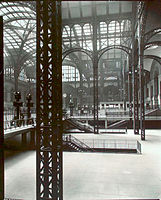
Penn Station Concourse

Penn Station Concourse

Next came the fitting entrance to arguably the world’s greatest city when, after passing under rocky Bergen Hill and the bottom muck of the Hudson, safe in a decades-old tunnel, we de-trained at a high-level platform and ascended the stairs from subterranean track level into the soaring glass-and-steel concourse of Penn Station.

Main Waiting Room, Penn Station

Main Waiting Room, Penn Station

Timelessness hovered over the scurrying crowds. A bank of automatically opening doors led into the mall-like arcade, then into the granite halls of the waiting room, modeled after the Roman Baths of Caracalla. Years of grime–by then the pink granite was washed only up to eight feet above the floor–couldn’t totally diminish the grandeur of  vaulted ceilings and lofty, sunlight-filtering lunette windows . Stepping out through the Corinthian columns onto 7th Avenue was almost a letdown. But the Statler Hotel tree, the parade of animation at Macy’s window, didn’t disappoint. Rockefeller Center and the Radio City Music Hall Christmas girded us with enough seasonal cheer and warmth to face the walk back down Fifth Avenue through the biting chill of New York City’s  windy street-canyons.

Norwegian Pine Christmas Tree, Rockefeller Center

Norwegian Pine Christmas Tree, Rockefeller Center

Darkness had fallen on the New Jersey side of the Hudson, as we headed home, again cozily ensconced in a rattletrap train. Darkness dimmed, but failed to obscure, the landscape of cattail marshes, rail yards and buildings of grimy industrial brick. Man-made light was everywhere. Past Newark, the lofty neon toy soldier–standing guard over America’s foremost zipper manufacturer–and the neighboring Pabst Blue Ribbon icon would have obliterated the Star of Bethlehem. Seasonal lights festooning the Esso refinery at Bayway further chased the gloom of Winter Solstice.

Lionel Trains Catalog, 1954

Lionel Trains Catalog, 1954

In the early part of those magic weeks following Thanksgiving, my father would bring home the latest Lionel Trains catalog. Every boy could dream about owning the ultimate train set, Lionel’s Santa Fe Super Chief streamliner, with its red and yellow “warbonnet” -faced diesels pulling silver cars, including a “vista dome” and a rounded-end observation car. The thought of riding such a train in real life, way out West, was an equally unattainable fantasy. But we did have short hops on our threadbare but lovable locals, that took us to Newark, New York, or the Shore. And I loved my 027-gauge set that enlivened the gloom of our cobwebby cellar, complete with black engine that puffed white smoke. But the dear and familiar didn’t preclude dreaming of the far away; and of grander trains, big and small.

Thankfully at Christmastime we can still indulge in unabashed sentimentality. Christmas cards now show 1950’s downtown street scenes that look as remote and picturesque today as did the snowy scenes of horse-drawn sleighs wending though bucolic landscapes of Christmas cards from childhood years. The “good old days” seem to follow about three generations behind the more jaded present. Will today’s young children someday see scenes of shopping malls as evocative of a golden past? Will they remember navigating freeway exits in SUVs with fondness? Playing with the latest video console under the flickering of a 58-inch wall-mounted flat screen TV?

Maybe so. Personally, I would feel vindicated to live long enough to see our regional shopping mall fall to the wrecker’s ball. It would help make amends for the savage wrecking of my beloved Penn Station in the 1960s. But the analogy doesn’t completely hold up. Penn Station preceded the throwaway society. Built for the ages, it didn’t demolish easily.

To whomever reads this…Merry Christmas!

Posted in history, nostalgia, railroading, social criticism, writing | Tagged , | 4 Comments

A View from the Track Up

A major physical challenge in maintaining railroad track is that just about everything being worked on is less than a foot off the ground. A little like farm labor in that respect. After much of a lifetime of blue-collar jobs, launching into writing historical novels from a working-class point of view is a reversal from that direction. Most blue collar jobs are dirty and/or noisy and/or physically laborious. Add to that–monotonous, and generally looked upon with disdain by those who have titles and don’t soil their hands. So the challenge is to look up from track level, but to remain grounded in what you know and have done. Then mix in human drama and (where appropriate) historical reference. Then upwardly seek a touch of the poetic. Or heroic.

But a trap awaits–that is, to overly romanticize the lives lived and toil performed back in times becoming ever more remote. The writer–safe behind pad and pen or typewriter or laptop–can easily fall into this, portraying the track laborer, the miner, the sailor, the cowboy, (yes, and the prostitute) of decades or a century past in tones of rose-color or sepia.

That said, I believe novelists today have mostly ditched the working class, whether of times past or present. Formulaic fiction must now follow the lead of Hollywood and TV, having us sympathize with characters who are our social and economic betters. Or draw us into a world of the totally fantastical. Or seek to be intellectually avant-garde.

A little of my own background. I graduated from the University of Maine in 1967 with a BA in history. It turns out there were too many of us graduating with similar degrees. Society didn’t need us that badly, except as conscripts to fight in Viet Nam. As an alternative I joined the U.S. Coast Guard. As one of the enlisted ranks, I learned to despise commissioned officers as a class–though not necessarily as individuals. It was a great lesson in social stratification.

On leaving the “Guard” three years later, I gravitated into blue collar jobs (not always by choice) and self-employment. Having since my early 20s wanting to write, inspired by the likes of Wolfe and DosPassos and Steinbeck–and later by Wallace Stegner and Wendell Berry and Ivan Doig–I’m finally finding the time and energy to get around to it, in the onrush of the digital age and amidst the confusion of social media and the profusion brought on by self-publishing. I’m hoping it isn’t too late.

Posted in history, railroading, self-publishing, writing | 5 Comments