Was it easier to get a book published before the recent onset of mass-digital (mostly self) publishing? It may depend on the type of book. Media celebrities, no matter how vacuous, seem to have no trouble getting book deals with mega-publishers. If, like the rest of us, you start out as an unknown, then you have to demonstrate to agents or publishers that you have on your flash-drive the next Harry Potter series, or 50 Shades of Gray. A tall order indeed.
I’m not sure how this situation measures up to the not-too-distant past, when a plethora of publishers and agents, mostly based in New York, might have looked at a manuscript and, with judicious in-house proofreading and editing, decide to take it on, under the premise that–if not the next multi-million-dollar best seller–the process of setting up the plates for a limited run might at least yield a modest profit for the company; and just maybe add a little to humanity’s enrichment. And not to rule out that taking a chance on new authors was how best sellers came about.
Maxwell Perkins, who grew up in Plainfield, New Jersey, was born in 1884.
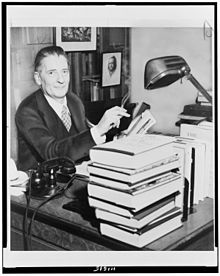
From Wikipedia:
“After working as a reporter for The New York Times, Perkins joined the venerable publishing house of Charles Scribner’s Sons in 1910. … At the time he joined it, Scribner’s was known for publishing eminently respectable authors such as John Galsworthy, Henry James, and Edith Wharton. However, much as he admired these older giants, Perkins wished to publish younger writers. Unlike most editors, he actively sought out promising new artists; he made his first big find in 1919 when he signed F. Scott Fitzgerald. This was no easy task, for no one at Scribner’s except Perkins had liked The Romantic Egotist, the working title of Fitzgerald’s first novel, and it was rejected. Even so, Perkins worked with Fitzgerald to revise the manuscript and then lobbied it through the house until he wore down his colleagues’ resistance.”
Through Fitzgerald, Perkins met beginning writer Ernest Hemingway, leading to publication of The Sun Also Rises and A Farewell To Arms. Soon after began the legendary collaboration with with a lumbering giant of a North Carolinian named Thomas Wolfe. In his New York City flat, the manically writing Wolfe scrawled out hundreds upon hundreds of pages while standing, using the top of his icebox as a desk. The papers were tossed into wooden packing crates. By discarding much from the helter-skelter piles (over Wolfe’s objections), Perkins was able to arrange the remaining sheets into a coherent form, resulting in two ponderous, immortal works–Look Homeward Angel and Of Time And The River.
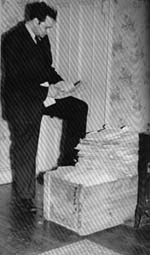
Thomas Wolfe and his manuscripts
Before his death in 1947 at age 63, Perkins went on to make writing celebrities out of Erskine Caldwell (Tobacco Road), Marjorie Kinnon Rawlings (The Yearling), and James Jones (From Here To Eternity).
Jumping ahead a few decades, some questions come to mind. Is the corporatization and digitalization of publishing in recent years leading to a reading world where one must choose between a few mass bestsellers on one hand? And on the other, an ocean of mediocre–mostly self-published–works grossly in need of professional editing? Or totally unsalvageable? Or is there already a rising micro-publishing industry that will democratize and ultimately further enrich the written language? In a digital world, will writers be able to find successors to Maxwell Perkins, and to the publishing houses that would take a chance, if they saw promise?
Optimism is fine, but it can be difficult to maintain in a world of Big Publishing and monopolistic book distribution. Even if a budding author can make a breakthrough and land a publishing contract, will a writer’s compensation–in effect, his or her wages–be squeezed (as already appears to be happening) due to the rise of tablets and e-readers?
And for the vast majority who go the self-publishing route, there is yet another burden in this age of “unbounded publishing.” With agents and publishers awash in “e-queries,” chances are all too likely that there will be no partner with a vested interest in the self-published book’s success. That means going it alone with self-promotion, not something every writer has a knack for. And it means seeking proficiency in the very technology that is so transforming the world of reading and writing and publishing as we know (or knew) it. Such skills can be useful, and often necessary. But navigating and blundering through “social media” can be time consuming and distracting, blunting the creative force that produces great–as opposed to just good–writing.
Would a Fitzgerald or a Hemingway today have found a publisher? Would they even have produced any great writing if they had to dilute their creative juices, to use their best energies trying to build up a following on Facebook or Google Plus? I sure don’t know, but one thing I can say: Maxwell Perkins, you are sorely missed.


 J.P. Kenna
Fantastic write-up. It’s been a dominant question on my mind too: is self-publishing actually sounding the death knell on aspiring writers who have stories that are not yet there but can make it.
Thank you for writing this.
Thank you for your comment.
Self-publishing is looking to me like a do-it-yourself version of the old “subsidy publishers,” the Vanity Presses. Is there anything out there to replace the traditional publishers that have been lost in this age of corporate take-overs and Wall Street domination? Unless you’re as interested in launching and promoting a business as you are in writing, self-publishing looks like a dead-end street.
A ‘dead-end street’ pretty much sums it up. Unfortunately, the hucksters of self-publishing have painted such a rosy picture that authors are flocking to these services in the hopes of 70% royalty and retention of rights. Authors would sooner self-publish than hear an editor’s inputs on improving the text.
Such are the times we live in.
Looking forward to your next post.
Reblogged this on Blue Collar Author.